
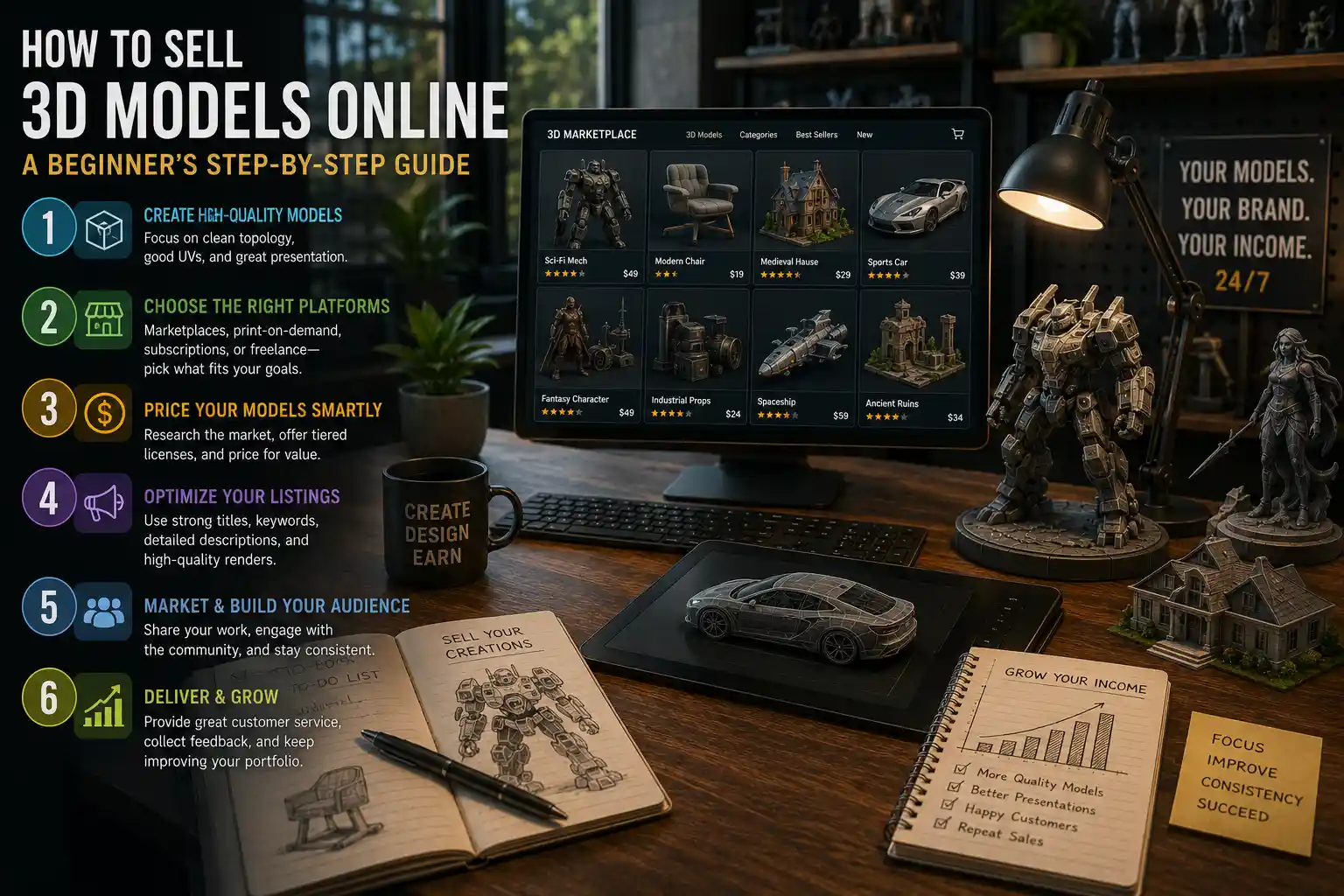
The global market for 3D models is booming, driven by the rise of immersive video games, virtual production for film, 3D printing, architectural visualization, and even metaverse real estate development. In 2023 alone, the 3D modeling industry was valued at over $1.8 billion, and analysts project consistent 15% annual growth through the end of the decade. If you’re a 3D artist, hobbyist, or designer looking to turn your skills into a steady stream of passive income, selling 3D models online is one of the most accessible and rewarding ways to do it. You don’t need a fancy studio or a massive marketing budget to get started—all you need is skill, attention to industry standards, and a clear strategy to reach the right buyers.
Preparing Your 3D Models for Market
Before you list a single model for sale, you need to make sure it meets the expectations of professional buyers. Unlike digital art sold for display, 3D models are functional assets used in production workflows, so technical quality and usability matter more than almost anything else. A beautiful model that won’t import correctly or is too high-poly for game engines will get bad reviews and rarely generate repeat sales.
Understand What Sells
Not all 3D models are in equal demand. While you can certainly sell creative, abstract models, focusing on categories with consistent buyer demand will help you generate sales faster. The most popular niches right now include:
- Game assets: low-poly environment props, character models, and modular assets for indie game developers
- Architectural visualization: furniture, landscaping assets, and pre-built building components for architects and interior designers
- 3D printing: pre-supported miniature models, cosplay props, and functional household items
- Product design: CAD models for manufacturing and custom product development
- Virtual production: photorealistic set assets for VFX and virtual filming
Before creating a batch of models, spend 30 minutes browsing major marketplaces to see what buyers are actually purchasing. Look for models with hundreds of sales and note common gaps—for example, you might find a lot of generic kitchen furniture, but few high-quality models of mid-century modern lighting fixtures. That gap is your opportunity.
Follow Technical Best Practices
Every category of 3D model has different technical requirements, but there are universal rules that apply to every asset you sell. For polygon-based models, always clean up your mesh to remove non-manifold geometry, overlapping faces, and unused vertices. These common issues cause import errors in game engines and 3D editing software, and buyers will leave negative reviews if your model doesn’t work out of the box.
If you’re selling models for game development or real-time applications, prioritize polygon count efficiency. A 100,000-polygon decorative rock might look great, but it will be useless for an indie developer trying to keep their game’s frame rate high on mobile devices. For most real-time assets, aim for polygon counts between 100 and 10,000 triangles depending on the asset size and purpose.
Texturing is another make-or-break factor. Always include properly UV-unwrapped maps, including base color, normal, roughness, metallic, and ambient occlusion maps where relevant. Use 4K resolution for large assets like furniture, 2K for medium props, and 1K for small assets to balance quality and file size. For 3D print models, ensure your model is watertight, has consistent wall thickness, and include pre-supported files if possible—printable models with pre-made supports sell 30% faster on average than unsupported models, according to data from leading 3D print marketplace CGTrader.
Create Professional Previews
Buyers can’t touch or test your model before purchasing, so your preview renders are your only chance to make a good first impression. Render your model from multiple angles, including close-ups of key details and wireframe previews that show your clean mesh topology. For game assets, include a screenshot of the model imported into a common engine like Unity or Unreal Engine to prove it works in that environment. For 3D print models, add a photo of the physical printed model if you have one—this builds far more trust than a digital render alone.
Choosing the Right Online Marketplace
Once your models are ready, the next step is choosing where to sell them. There are two main approaches: selling through established third-party marketplaces, or selling directly from your own website. Each has pros and cons, and many successful sellers use a mix of both to maximize their income.
Third-Party Marketplaces: Pros and Cons
Third-party marketplaces handle all the payment processing, hosting, and traffic generation for you. That means you can upload your models and start getting sales in days, without building a website or running marketing campaigns. They’re the best option for new sellers who want to test the waters without investing a lot of time or money upfront.
The most popular marketplaces for selling 3D models are:
- TurboSquid: The largest general 3D model marketplace, with a huge audience of professional buyers from architecture, game development, and VFX. Commission rates range from 40% to 60%, with lower commissions for sellers who exclusive content.
- CGTrader: A popular alternative to TurboSquid, with lower starting commission rates (around 30% for new sellers) and a strong focus on 3D printable models. It also offers custom 3D model job boards that let you take on client work alongside selling pre-made assets.
- Sketchfab: Best known for its 3D embedding and AR preview tools, Sketchfab has a large marketplace for both downloadable and streaming 3D models. It also has a strong community of game developers and metaverse creators, with commission rates starting at 30%.
- MyMiniFactory: The leading marketplace exclusively for 3D printable models. It allows you to sell STL files and offers a print-on-demand service that lets you earn royalties when customers print your model through one of their partners, with zero extra work from you.
- Etsy: A surprising but effective option for 3D printable models and small creative assets. Etsy has a huge audience of hobbyists and makers looking for custom print files, and fees are much lower than many specialized 3D marketplaces, starting at just 6.5% per transaction.
The main downside of third-party marketplaces is that you don’t own the customer relationship, and you have to pay commissions that can eat into your profits. Most marketplaces also have strict rules about what you can sell, and they can change their fee structure or suspend your account at any time. For that reason, many sellers start on marketplaces and then move a portion of their sales to their own site as they build an audience.
Selling Directly From Your Own Website
Selling directly from your own website means you keep 100% of the profits (minus payment processing fees, which are usually around 3%) and you own full control over your business and your customer list. You can set your own prices, create bundles and discount codes, and market your models however you want.
Building a website to sell 3D models is easier than it used to be, thanks to platforms like WordPress with WooCommerce, Shopify, or Squarespace. You can host your files on services like Dropbox, Google Drive, or dedicated digital asset hosting like SendOwl, which handles automatic delivery after purchase without you having to do anything.
The biggest downside of selling direct is that you have to generate all your own traffic. Unlike marketplaces, which have millions of monthly visitors searching for assets, you have to bring buyers to your site yourself through marketing, social media, and SEO. That’s why most sellers recommend starting with marketplaces to validate your work and build an audience, then gradually moving toward direct sales once you have a following.
“The biggest mistake new 3D sellers make is putting all their eggs in one basket. If you only sell on one marketplace, and that marketplace changes its algorithm or increases its fees, your entire income can disappear overnight. Diversify where you sell, and start building your own email list from day one, even if you only sell on marketplaces at first.”
Pricing Your 3D Models Correctly
Pricing is one of the biggest challenges for new 3D sellers. Price too high, and you’ll struggle to get sales. Price too low, and you’ll end up working for pennies and undervaluing your time and skill. The right price depends on three main factors: the type of model, its quality, the niche it serves, and where you’re selling it.
Factor in Your Time and Costs
Before you set a price, calculate how much time it took you to create the model, including modeling, texturing, rendering, and uploading. If you spent 10 hours creating a high-quality character model, selling it for $5 means you’re making $0.50 an hour, which is not sustainable even for hobbyists. Instead, think of pricing in terms of long-term passive income: a $20 model that sells one copy a month will earn you $240 a year, which is a great return on your original 10 hours of work.
Standard Pricing Tiers by Niche
While every model is different, most sellers follow these general pricing guidelines based on asset type:
- Small, low-poly assets (props, textures, small decorative items): $5–$20. These are often sold in bundles of 10–20 assets for $20–$50 to encourage larger purchases.
- Medium assets (furniture, small characters, environment sets): $20–$50. This is the sweet spot for most general-purpose models, and balances affordability for buyers with fair compensation for sellers.
- High-quality, large assets (full characters, vehicles, architectural building models): $50–$200. Professional buyers will pay a premium for production-ready assets that they don’t have to modify, so don’t be afraid to charge more for complex, high-quality work.
- 3D printable miniature models: $5–$15 for individual miniatures, $20–$50 for full character sets. Many 3D print sellers offer monthly subscription boxes of new models for $10–$30 a month, which creates consistent recurring income.
If you’re selling exclusively on your own website, you can usually charge 10–20% more than you would on a third-party marketplace, because buyers expect direct-from-creator pricing and you don’t have to pay marketplace commissions. For exclusive content that can’t be found anywhere else, you can charge even more.
Pricing Strategies to Boost Sales
There are a few simple pricing strategies that can help you increase your overall revenue without putting in extra work. Bundling is one of the most effective: group related models together (like a full set of kitchen furniture or a pack of 10 medieval game props) and sell the bundle for 20–30% less than the total price of buying each model individually. Bundles increase your average order value and encourage buyers to purchase more from you in a single transaction.
Offering a free model is another great strategy, especially for new sellers. Give away one high-quality small asset for free to let buyers test the quality of your work, and then upsell them on your paid models. Free models help you get exposure on marketplaces (many platforms prioritize free assets in search results) and build trust with potential buyers.
Subscriptions are a growing trend for 3D sellers, especially for creators who make 3D printable models or game assets. For a monthly fee, subscribers get access to all your existing models and one or more new models every month. Recurring subscription income is much more stable than one-off sales, and it can grow exponentially as you add more subscribers. Platforms like Patreon, Gumroad, and Substack make it easy to set up a subscription for your 3D models.
Marketing Your 3D Models to Increase Sales
Even if you have the highest-quality models on the market, you won’t make sales if no one can find them. Marketing doesn’t have to be complicated or expensive, but it’s a critical part of building a sustainable business selling 3D models. The best marketing strategies for 3D sellers focus on building an audience of potential buyers by showcasing your work and sharing your expertise.
Optimize for Marketplace and Search Engine Traffic
Most of your early sales will come from search, whether that’s internal search on a third-party marketplace or Google search for your website. To rank well, you need to use clear, descriptive keywords in your model title and description. Think about what a buyer would actually search for when looking for your model: instead of “Wooden Chair,” use “Mid-Century Modern Wooden Dining Chair” for a specific, searchable title.
In your description, include relevant details about the model: polygon count, file formats included, texture resolution, what software it’s compatible with, and what it can be used for. This helps both search algorithms and buyers find exactly what they’re looking for. Many marketplaces also let you add tags to your models—use all the available tag slots with relevant keywords to maximize your visibility.
Use Social Media to Showcase Your Work
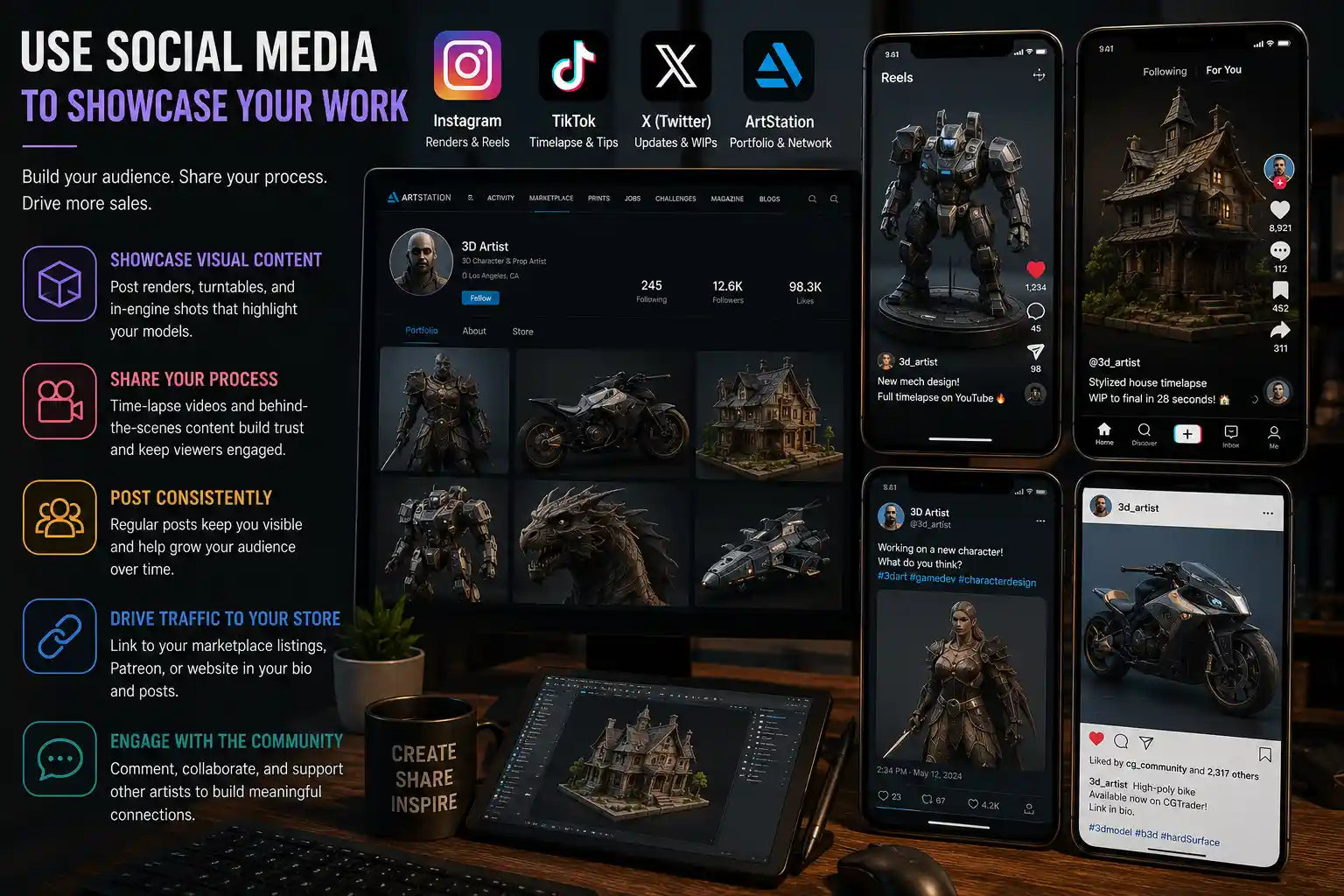
Social media is one of the most powerful tools for 3D artists to build an audience. Visual platforms like Instagram, TikTok, Twitter/X, and ArtStation are perfect for showcasing your 3D work. Post short clips of your model spinning in 3D space, time-lapse videos of your modeling process, or previews of new models you’re working on.
ArtStation is particularly important for 3D artists, because it’s a community of professional artists, game developers, and buyers. Post your work there regularly, link back to your marketplace listings or your website, and engage with other artists to build your following. TikTok and Instagram Reels are also great for reaching new audiences—short, 15–30 second clips of your 3D model in action can go viral and drive hundreds of new sales to your listings.
Build an Email List for Long-Term Growth
One of the most underutilized marketing strategies for 3D sellers is building an email list. When a buyer purchases a model from you, whether on a marketplace or your own website, you can add them to your email list to notify them of new models, discounts, and updates. Email marketing has a much higher conversion rate than social media, because the people on your list already know your work and trust your quality.
Even if you only sell on third-party marketplaces, you can encourage buyers to join your email list by adding a small readme file to your model download with a link to join your list for free assets or updates. Over time, your email list becomes one of your most valuable business assets—when you launch a new model, you can send an email to your list and get dozens of sales in the first 24 hours, no extra marketing required.
Engage With Your Target Community
Find where your target buyers hang out online and engage with them there. If you sell game assets, join Reddit communities like r/indiegames or r/Unity3D, participate in discussions, and share your work when it’s relevant. If you sell 3D printable models, join Facebook groups for 3D printing enthusiasts or tabletop gaming miniature collectors. Don’t just spam your links—contribute to the community, answer questions, and share useful content, and people will naturally check out your work.
Optimizing for Long-Term Passive Income
The biggest benefit of selling 3D models online is that it can generate passive income for years after you create the model. A single high-quality model can sell consistently for 5+ years with no extra work from you. But there are a few steps you can take to maximize your long-term income and reduce the amount of work you have to put in over time.
Create a Consistent Portfolio of Related Assets
Instead of creating random models in different niches, focus on building a cohesive portfolio of related assets. For example, if you make medieval game props, keep adding more medieval props to your catalog. This helps you build a reputation as an expert in that niche, and buyers who purchase one of your models are more likely to come back and purchase more. Having a large portfolio of related assets also improves your visibility in marketplace search—more listings mean more opportunities for buyers to find you.
Aim to add at least one new model to your portfolio every month, even if it’s a small one. Over the course of a year, that’s 12 new models added to your catalog, and over five years, that’s 60+ models all generating passive income for you. Even if each model only makes $50 a month, that’s $3,000 a month in passive income from your portfolio.
Update Your Old Models
3D software and industry standards change over time. A model you created five years ago might not meet current expectations for polygon count, texture resolution, or compatibility with new software. Every year, set aside some time to update your older models to meet current standards. Add new file formats if needed, upgrade texture resolution, and re-upload the updated file. This keeps your old models relevant and helps you avoid negative reviews from buyers who get an outdated asset.
Diversify Your Income Streams
As we mentioned earlier, putting all your eggs in one basket is a big risk. Diversify where you sell your models and how you earn income from your skills. For example, you can sell pre-made models on marketplaces, sell subscriptions on Patreon, sell directly from your website, and take on occasional custom 3D work for clients. This way, if one income stream dries up, you still have others to fall back on.
You can also repurpose your 3D models for other uses to earn extra income. A 3D model you created for game development can also be sold as a 3D printable miniature, or turned into a NFT, or licensed for use in a virtual production set. Repurposing existing models takes very little extra time but can double or triple the income you earn from a single asset.
Conclusion
Selling 3D models online is a flexible, rewarding way to turn your 3D modeling skills into steady income, whether you’re a hobbyist looking for extra pocket money or a professional artist wanting to build a full-time business. The keys to success are simple: start with high-quality, technically sound models that meet the needs of buyers, choose the right sales channels for your goals, price your work fairly, and market consistently to build your audience.
You don’t need to have a huge portfolio or thousands of followers to start making sales. Even new sellers can make their first sale within a month of uploading their first models if they follow the steps we’ve outlined here. Over time, your portfolio will grow, your audience will build, and you’ll have a passive income stream that works for you 24/7, long after you’ve finished creating the model. The 3D asset market is growing faster than ever, and there’s never been a better time to start selling your work online.