
It’s 2 a.m. You just finished refining the 3D model of a vintage coffee mug you designed for a personal project, and as you hit save, a thought crosses your mind: can I actually sell this? If you’ve spent hours creating 3D assets for 3D printing, game development, product visualization, or even digital art, you’ve probably asked yourself the same question. The good news is that selling 3D models has never been more accessible, with a growing global market hungry for everything from simple household printable designs to high-poly assets for AAA video games. But turning your 3D design hobby into a viable income stream isn’t as simple as uploading a file and waiting for sales. Success depends on understanding the market, choosing the right platforms, protecting your work legally, and creating assets people actually want to buy. This guide breaks down everything you need to know to start selling your 3D models confidently.
The Current Market for 3D Models: Is There Demand?
Before you dive into listing your first model, it’s worth understanding how big the 3D asset market actually is, and where demand is growing. Global market research projects the 3D modeling industry will hit $4.5 billion by 2027, driven by the explosion of 3D printing, video game development, virtual reality, augmented reality, and e-commerce product visualization. No longer are 3D models solely the domain of professional studios; small businesses, independent creators, and hobbyists are the fastest growing group of buyers, looking for affordable, high-quality assets they can use immediately.
Key demand categories for 3D models
Demand isn’t evenly spread across all types of 3D models. Certain categories consistently outperform others, depending on whether you’re targeting consumer 3D printing or commercial creative industries:
- 3D printable models: This is one of the fastest growing segments, with demand for everything from functional household items (phone stands, drawer organizers) to cosplay props, figurines, and custom jewelry. Hobbyist 3D printer owners often buy pre-made models instead of designing their own, saving hours of work and troubleshooting.
- Game assets: Independent game developers make up a huge segment of 3D model buyers. They need low-poly environment assets, character models, props, and animations that they can drop directly into their projects without building from scratch. Even small indie studios will pay a premium for well-optimized, properly textured assets that fit popular engines like Unity or Unreal.
- Product visualization assets: E-commerce brands increasingly use 3D models to display products online instead of static photos. Furniture, clothing, electronics, and home goods brands buy 3D models that customers can rotate and zoom on product pages, or even preview in their own home via AR. Architectural visualization is another huge commercial market, with firms buying pre-made 3D furniture, landscaping, and building assets to speed up client renderings.
- Digital art and collectibles: While the NFT boom has cooled, demand for 3D digital art for virtual worlds, social media avatars, and digital collectibles remains steady. Creators sell custom 3D avatars for platforms like VRChat, Roblox, and Meta Horizon, as well as limited edition digital sculptures for collectors.
The barrier to entry is lower than it used to be, but that also means competition is growing. That doesn’t mean new creators can’t succeed; it just means you need to niche down to stand out. For example, instead of selling generic “anime figurines,” niche down to 3D printable chibi figurines of 1990s cartoon characters, or custom wedding cake topper models. A clear niche helps you target specific buyers who are willing to pay for exactly what you offer, instead of competing with hundreds of generic creators.
- Personal use only: Buyers can use the model for their own non-commercial projects (like printing it for their home) but can’t sell prints of the model or use it in commercial work. This is the most common license for hobbyist 3D printable models, and lets you charge lower prices while still protecting your commercial rights.
- Commercial use for small businesses: This license allows buyers to use the model in commercial projects, like printing and selling 100 physical copies, or using the asset in an indie game. Many creators charge more for commercial licenses, which can boost your average order value.
- Extended commercial use: For larger businesses that want to use your model in high-volume projects (like printing 10,000 physical products or using an asset in a AAA game), an extended license with a higher price point gives them the rights they need.
“The biggest mistake new 3D sellers make is assuming that because something is popular and no one is enforcing it right now, it’s safe to sell. I’ve seen creators build a 6-figure business selling fan art models, only to lose everything when a rights holder issues a mass takedown. Building your brand around original work is always the safer long-term play.”
If you’re ever unsure about the legal status of a model, err on the side of caution. It’s better to take the time to create an original design than risk losing your entire seller account and all the income you’ve built up.
How to Price Your 3D Models Correctly
Pricing is one of the hardest parts of starting out as a 3D model seller. Price too high, and you’ll scare off new buyers; price too low, and you’ll end up working for pennies and undervaluing your time. The right price depends on what type of model you’re selling, who your target buyer is, and how much time and effort you put into creating it.
Pricing for different 3D model categories
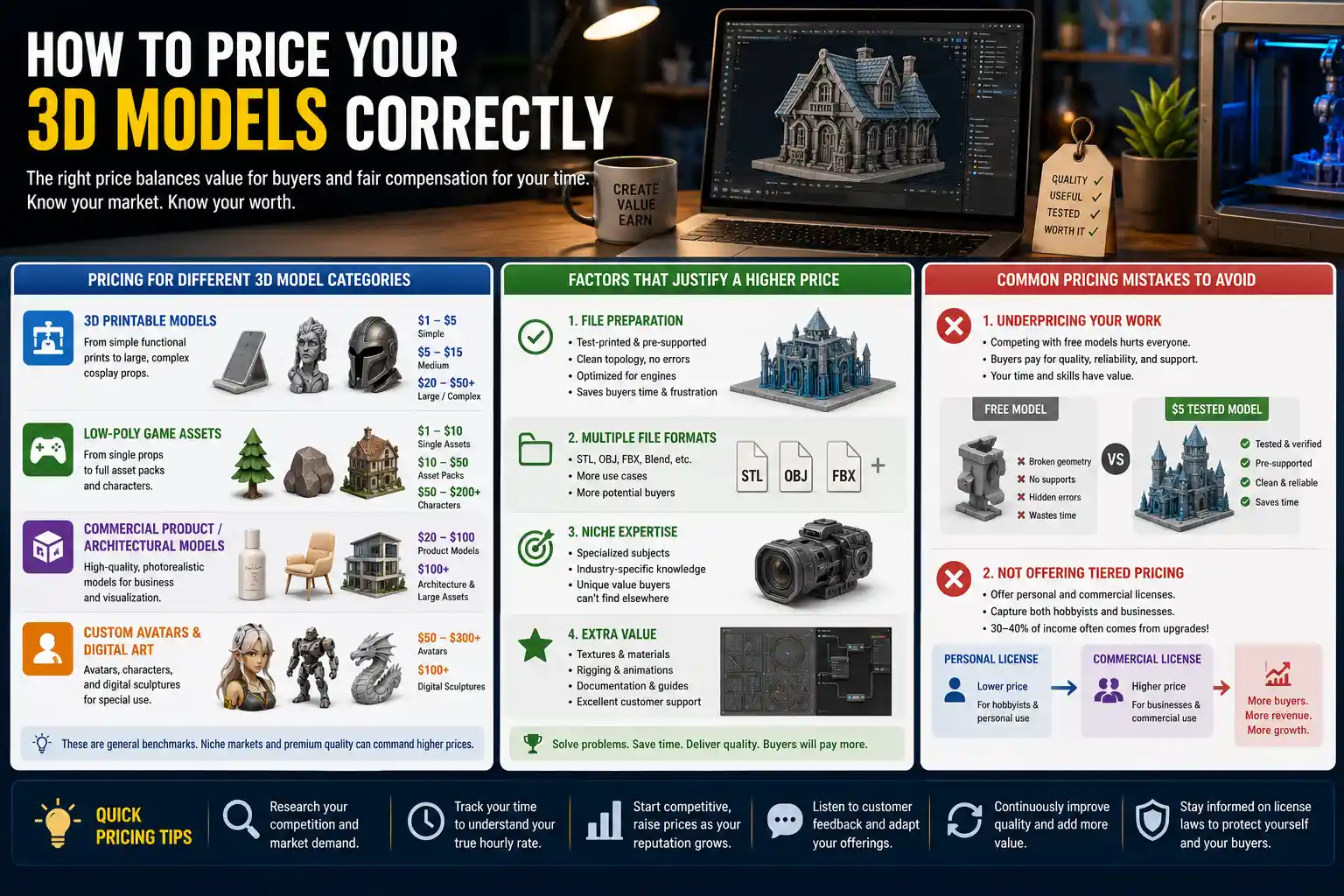
There’s no one-size-fits-all price, but these industry benchmarks give you a starting point:
- Small 3D printable models: Simple functional models (like a phone stand or keychain) typically sell for $1 – $5. Medium-sized models like cosplay props or small figurines sell for $5 – $15, while large, complex models like full-size armor sets can sell for $20 – $50 or more.
- Low-poly game assets: Individual small assets like a single tree or rock sell for $1 – $10, while bundled asset packs (like a full set of medieval village props) can sell for $10 – $50. Higher-poly character models with rigging and animations can sell for $50 – $200+.
- Commercial product/architectural models: High-quality, photorealistic product models for e-commerce typically sell for $20 – $100 for individual models, with extended commercial licenses doubling or tripling that price. Large architectural assets can sell for $100+.
- Custom avatars and digital art: Custom VRChat or Roblox avatars usually start at $50 for a basic model and can go up to $300+ for high-poly, fully rigged avatars with custom textures. Limited edition digital sculptures often sell for $100+ to collectors.
Factors that justify a higher price
Don’t just price based on size or complexity. Buyers will pay more for models that solve specific problems and require extra work on your part. Always highlight these value-adds to justify your price:
First, file preparation is a huge selling point. For 3D printable models, buyers pay more for models that are test-printed, pre-supported, and have no geometry errors that will ruin a print. If you’ve already spent hours troubleshooting the model, that saves buyers hours of frustration, and they’ll pay for that convenience. For game assets, properly optimized models that fit engine polycount limits, with correctly packed textures and working rigs, are worth far more than untested files.
Second, multiple file formats increase the value of your model. Including STL, OBJ, and FBX files lets buyers use the model for 3D printing, game development, or renderings, which expands the number of potential buyers and justifies a higher price.
Third, niche expertise commands premium pricing. If you specialize in 3D models of vintage camera parts for collectors, or 3D printable orthodontic models for dental students, your specialized knowledge means buyers can’t find that exact model anywhere else, so you can charge more than you would for a generic model.
Common pricing mistakes to avoid
The most common mistake new sellers make is underpricing their work to compete with free models. Remember: buyers who pay for models are paying for quality, reliability, and support that free models don’t offer. A free model downloaded from a forum might have broken geometry, no supports, or hidden errors that waste hours of a buyer’s time. A $5 tested, supported model is a far better deal for most buyers, so don’t undercut yourself.
Another mistake is not offering tiered pricing. Offering a personal use license at a lower price point and a commercial license at a higher price point lets you capture both hobbyist buyers and business buyers, increasing your overall revenue. Many sellers make 30-40% of their income from commercial license upgrades, so it’s a simple way to boost your bottom line.
Best Platforms to Sell Your 3D Models
Once your models are ready and you’ve sorted out legal and pricing, it’s time to choose where to sell. There are two main options: sell on established third-party marketplaces, or sell directly from your own website. Each has pros and cons, and many successful sellers use both to maximize their income.
Top third-party marketplaces for 3D models
Third-party marketplaces handle payment processing, hosting, and bring their own existing audience of buyers, so you can start making sales faster without building your own audience from scratch. Some of the most popular options include:
- CGTrader: One of the largest general 3D model marketplaces, with categories for 3D printing, game assets, and commercial visualization. CGTrader charges a 15% commission on sales, which is lower than many other platforms, and gives you control over your license terms. They also have a job board where you can bid on custom 3D modeling work for clients.
- TurboSquid: The go-to marketplace for professional commercial 3D models, with a large audience of architectural and product visualization buyers. TurboSquid charges a 20-40% commission, depending on whether you sell exclusively on their platform, but they offer high visibility to professional buyers who are willing to pay more for quality.
- Cults3D: Popular for 3D printable models, based in Europe but with a global audience. Cults3D charges a 20% commission, and has a strong community of 3D printing enthusiasts who regularly buy new models. They also let you offer free models to grow your audience, which can drive more sales of your premium designs.
- MyMiniFactory: Another marketplace focused exclusively on 3D printable models. MyMiniFactory has a “guaranteed printable” quality badge that helps your models stand out, and offers both commission-based sales and the option to run a Patreon-style subscription for your fans. Commission rates are 15% for non-exclusive sales.
- Etsy: Many sellers don’t think of Etsy as a 3D model marketplace, but it’s actually a great place to sell 3D printable models, especially niche designs like custom wedding cake toppers, jewelry patterns, or home decor models. Etsy charges low listing fees and a 6.5% transaction fee, which is lower than many specialized 3D marketplaces, and you can reach buyers who aren’t actively browsing 3D-specific sites. The key to success on Etsy is optimizing your listings for search terms your buyers actually use, like “custom 3D printable cake topper” instead of “3D model STL.”
The biggest downside of third-party marketplaces is that they take a cut of every sale, and you don’t own the relationship with your buyers. You also have to follow their rules, which can change at any time, and your account can be suspended if you violate a terms of service update.
Selling directly from your own website
Once you start growing an audience, selling directly from your own website lets you keep 100% of the revenue and own your customer relationships. You don’t have to worry about platform rule changes or account suspensions, and you have full control over your branding, pricing, and license terms.
Popular tools for selling 3D models directly include Shopify for a full online store, WooCommerce if you want to build a site on WordPress, and Payhip or Gumroad, which let you upload your digital files and start selling in minutes with no technical experience. Gumroad and Payhip charge a small commission per sale (5% for Gumroad, 5% + 30 cents per transaction for Payhip) and handle payment processing and file hosting, so you don’t have to worry about technical setup.
The biggest downside of selling direct is that you have to drive your own traffic. You won’t get organic traffic from the marketplace’s audience, so you need to invest time in marketing your work on social media, building an email list, and growing your brand. Many successful sellers start on third-party marketplaces to build an initial audience and validate their designs, then move a portion of their sales to their own website over time to increase profits.
Subscription models for recurring income
One of the most popular ways to grow a stable income selling 3D models is to offer a subscription, where fans pay a monthly fee to access all your new models exclusively. Patreon is the most popular platform for this, and you can offer different tiers: for example, a $5/month tier gets access to all monthly models for personal use, a $10/month tier gets commercial use, and a $20/month tier gets custom request voting. Many full-time 3D sellers make the majority of their monthly income from subscriptions, because it gives you predictable recurring revenue instead of relying on one-off sales.
Tips to Boost Sales and Build a Sustainable Business
Uploading your models is just the first step. To build a sustainable income selling 3D models, you need to actively market your work and keep your customers happy. These simple tips can help you stand out from the competition and grow your sales over time.
First, invest in high-quality previews and marketing assets. Your listing is only as good as your photos or renderings. Buyers can’t touch or see your model in person before buying, so clear, well-lit renderings or photos of the printed model are non-negotiable. Show multiple angles of the model, close-ups of details, and if it’s 3D printable, include a photo of the finished print to prove it works well. A $10 model with great previews will outsell a $5 model with bad previews every time.
Second, optimize your listings for search. Whether you’re selling on a marketplace or your own website, buyers find your models by searching for keywords. For example, if you’re selling a 3D printable D&D dice box, use keywords like “3D printable D&D dice box,” “STL for Dungeons and Dragons dice storage,” and “dice tray with lid” in your title and description. Think about what your target buyer would actually search for, and include those terms naturally. This helps your listing show up higher in search results, both on marketplaces and Google.
Third, build an audience on social media. Social media is the best free way to drive traffic to your listings and grow a loyal following. TikTok, Instagram, and YouTube Shorts are particularly effective for 3D creators, because 3D design and 3D printing is inherently visual. Post time-lapses of your design process, clips of your 3D printer printing the model, and examples of finished products. Even short 15-second clips can go viral and drive hundreds of new buyers to your listings. Many new creators have grown a full-time business in a year just by consistently posting short-form content of their work.
Fourth, listen to your customers and create what they want. The best way to know what to design next is to ask your existing audience. If you have a mailing list or a social media following, run polls asking what type of model they want to buy next. Respond to questions and support requests quickly: if a buyer has an issue with a file, fixing it quickly builds trust and leads to repeat purchases. Many of your repeat customers will become subscribers if you keep delivering models they want.
Finally, update and improve older listings. If you have an older model that isn’t selling well, update the previews, add more file formats, or add pre-support for 3D printing. Small updates can boost the model’s ranking in search and make it more attractive to buyers. Over time, your library of models becomes passive income: every model you add is a new listing that can generate sales for years with no extra work from you.
Conclusion
So, can you sell your 3D models? The answer is a resounding yes – if you go into it with the right preparation and expectations. The global market for 3D models is growing faster than ever, and there is demand for everything from small functional 3D printable designs to high-end commercial assets for games and product visualization. Success doesn’t happen overnight: you’ll need to start by creating original, high-quality models that solve a specific need for buyers, sort out your legal licenses to avoid costly mistakes, price your work fairly, and choose the right platform for your goals. Whether you’re looking to make a little extra side income from your 3D design hobby, or build a full-time creative business, there’s never been a better time to start selling your 3D models. By focusing on creating value for your buyers, building your brand gradually, and learning as you go, you can turn your 3D design skills into a sustainable source of income.