
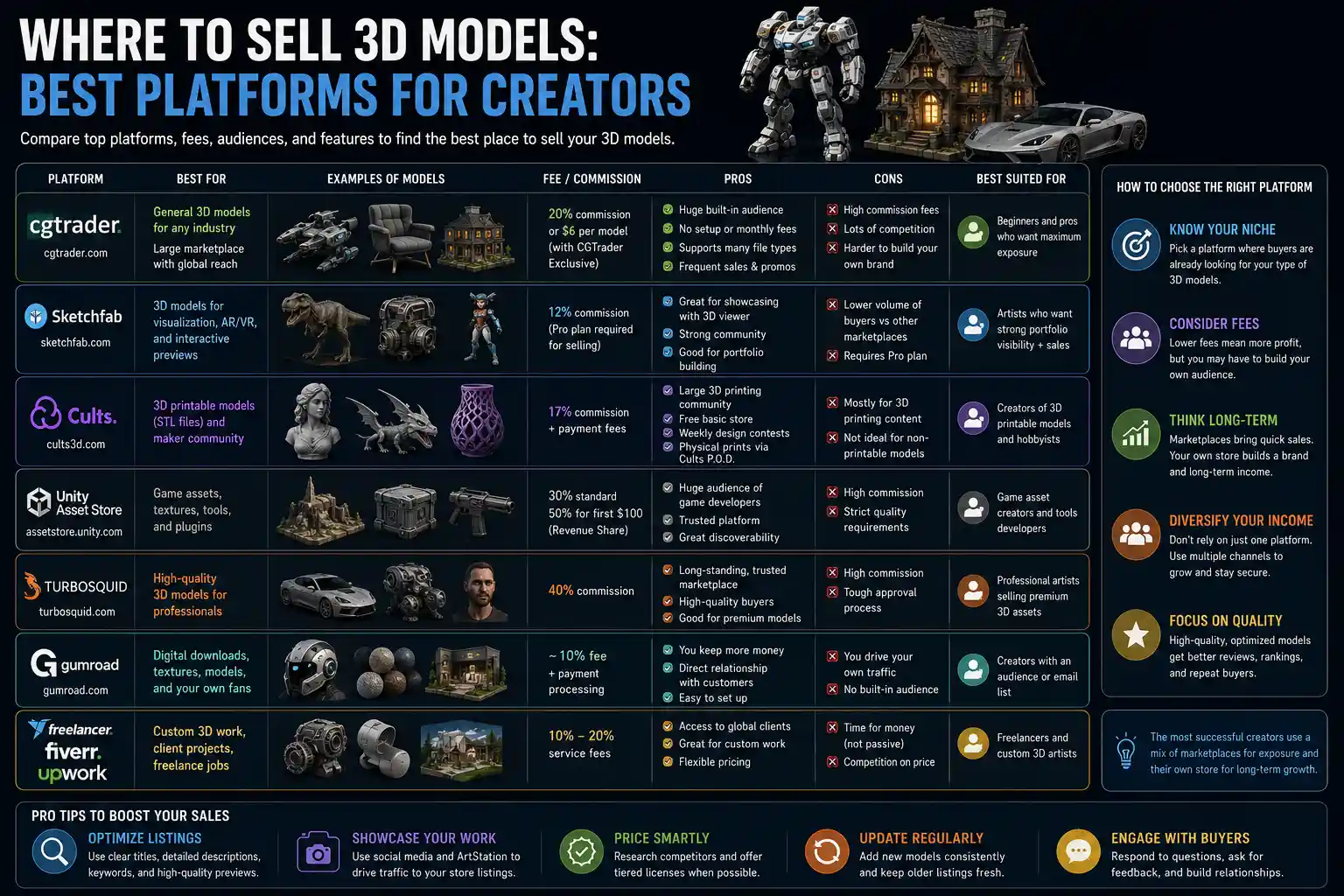
Whether you’re a freelance 3D artist building a side income stream, a game studio with leftover high-quality assets, or a hobbyist who’s created useful models others might want, one question keeps popping up: where do you actually sell your work? The 3D model market has exploded in the last decade, driven by demand from game developers, product designers, architects, content creators, and even 3D printing enthusiasts. But with dozens of platforms to choose from, picking the right ones can make the difference between making consistent sales and letting your hard work collect dust. This guide breaks down the best places to sell 3D models, organized by niche and business model, to help you choose the right fit for your work.
General-Purpose 3D Model Marketplaces
General marketplaces are the most popular starting point for new 3D sellers. These platforms host a wide range of 3D assets, from low-poly game assets to high-poly product models, and already have built-in audiences of millions of buyers. They handle payment processing, marketing, and customer support, so you can focus on creating models instead of running a website.
TurboSquid
TurboSquid is one of the oldest and most recognizable 3D model marketplaces, owned by Shutterstock. It caters to a professional audience, including architects, product designers, and VFX artists, and typically favors high-quality, photorealistic models. TurboSquid offers two seller tiers: an exclusive plan that gives you 80% of each sale, and a non-exclusive plan that gives you 60%. The platform has strict quality guidelines, which means less competition from low-effort models, but also means you’ll need to put more work into cleaning up your models before uploading. One big benefit is that TurboSquid often promotes models through Shutterstock’s larger network, giving you extra exposure to buyers who might not find your work otherwise.
CGTrader
CGTrader is a direct competitor to TurboSquid, with a broader community that includes both professional and hobbyist creators. Unlike TurboSquid, CGTrader doesn’t require exclusive rights, and royalty rates range from 70% to 80% depending on your seller level. It also offers a custom 3D model commission service, where buyers can request custom work directly through the platform. This is a great feature for sellers who want to take on custom projects in addition to selling pre-made models. CGTrader is also more flexible with what types of models you can upload, which makes it a good fit for newer sellers who are still building their portfolios.
Sketchfab
Sketchfab has grown from a 3D model hosting site to a full-fledged marketplace with millions of active users. What sets Sketchfab apart is its native in-browser 3D viewer, which lets buyers preview your model before purchasing, and its integration with game engines like Unity and Unreal Engine. Royalty rates for sellers are 70% for non-exclusive sales, and 80% if you agree to sell exclusively on Sketchfab. It’s also a great platform for building a following: many designers use Sketchfab to share free work alongside paid models to attract new buyers. The audience on Sketchfab leans heavily toward game developers and VR/AR creators, so if you make low-poly or game-ready assets, this is a great place to focus your efforts.
Niche Platforms for Specific 3D Model Types
General marketplaces give you broad exposure, but niche platforms cater to specific audiences that are actively looking for the type of models you create. If your work fits into one of these categories, you’ll often face less competition and see higher conversion rates than on general platforms.
3D Printing Marketplaces
The rise of consumer and industrial 3D printing has created a huge demand for 3D printable models. Unlike models designed for rendering or games, 3D printable models need specific design features (like watertight geometry and correct wall thickness) that most general-marketplace buyers don’t need. The top platforms for 3D printable models are:
- Cults 3D: Based in Europe, Cults 3D is one of the most popular 3D printing marketplaces, with more than 3 million registered users. Sellers keep 80% of each sale, and there’s no exclusivity requirement. It also has a strong community of creators, with trending categories like home decor, cosplay props, and functional tools.
- MyMiniFactory: MyMiniFactory focuses exclusively on 3D printable models, and guarantees that every model on the platform prints correctly, which builds trust with buyers. Sellers earn 80% royalty on sales, and the platform offers a subscription model that lets creators earn recurring income from subscribers who get access to all their models.
- Thangs: Thangs is a newer entrant to the 3D printing space, with a powerful search engine that helps buyers find exactly what they’re looking for. It offers sellers 80% royalty, and allows free downloads with optional tips, or paid sales.
Most 3D printing sellers also use a “subscription model” where fans pay a monthly fee to access exclusive models. Platforms like Patreon integrate seamlessly with 3D printing marketplaces: you can post free previews on Cults or Thangs, and direct customers to your Patreon for exclusive content. This model can generate much more consistent monthly income than one-off sales.
Game Development Asset Stores
Game developers are one of the largest groups of 3D model buyers. They need game-ready assets – low-poly models with clean topology and optimized texture maps – to speed up development. If you specialize in game-ready assets, asset stores tied to popular game engines are the best place to sell:
- Unity Asset Store: As the official asset store for the Unity game engine, which powers more than half of all mobile games, the Unity Asset Store has a huge built-in audience of active buyers. Royalty rates start at 70% for new sellers, and can go up to 80% for top sellers. The approval process is strict, but once your model is approved, it can generate passive income for years.
- Unreal Engine Marketplace: Epic Games’ Unreal Engine Marketplace is the go-to for Unreal Engine creators, and also offers a 70% royalty rate for sellers. Epic often promotes high-quality assets to its large audience of game developers, which can lead to big sales spikes for popular models. It’s particularly good for sellers who make environment assets, character models, and VFX packs.
- Itch.io: Itch.io is a popular indie game marketplace that also lets you sell 3D assets. It’s much more flexible than the official engine asset stores: you set your own price, keep 100% of revenue if you opt out of their optional revenue share, and can sell any type of game asset with no approval process. It’s a great place to sell indie-friendly assets like pixel art 3D models or retro game assets.
Architectural and Product Visualization Marketplaces
Architects, interior designers, and product designers regularly buy pre-made 3D models to speed up visualization projects. If you specialize in high-quality furniture, fixtures, architectural elements, or consumer products, niche platforms for this niche can be very profitable. TurbSquid has a large section for architectural models, but dedicated platforms like 3D Export and Archmodels cater specifically to this audience. These platforms prioritize models that are ready to drop straight into architectural renderings, so if you can deliver clean, correctly scaled models, you can command higher prices than on general marketplaces.
Selling 3D Models on Your Own Website
All third-party platforms take a cut of your sales, ranging from 20% to 30% in most cases. If you already have an audience or want to build your own brand, selling directly from your own website lets you keep 100% of the revenue and have full control over your business.
Why Sell on Your Own Site?
There are several key benefits to selling 3D models on your own website. First, you don’t have to pay platform royalties, which means you make more money on every sale. Second, you own the relationship with your customers, so you can build an email list, sell additional products or services, and market directly to people who already bought from you. Third, you don’t have to follow platform rules: you can price your models however you want, sell any type of content, and change your business model whenever you want.
The biggest downside is that you have to handle all your own marketing and payment processing. Unlike a marketplace, you don’t get built-in traffic, so you have to drive buyers to your site yourself. That said, for sellers who have already built a following on social media or YouTube, this is often the most profitable option.
Tools to Sell 3D Models on Your Own Site
You don’t need to be a web developer to set up a shop for your 3D models. There are several easy-to-use tools that handle everything from payment processing to file delivery:
- Gumroad: Gumroad is one of the most popular options for digital creators. You can upload your 3D model files, set your price, and embed the checkout directly on your website, or just share your Gumroad link directly with your audience. Gumroad charges a small fee of 10% plus 30 cents per transaction, which is much lower than most third-party marketplaces. It also handles file delivery automatically, so you don’t have to worry about sending files to customers manually.
- Payhip: Payhip is similar to Gumroad, with lower fees (just 5% per transaction, no fixed fee) and built-in affiliate marketing tools, which let other people promote your models for a cut of the sale. It’s a great option if you want to build an affiliate program for your 3D models.
- Shopify: If you want a full custom store, Shopify lets you build your own website with a full shopping cart, custom branding, and all the features you need to sell digital products. You pay a monthly subscription fee starting at $39, plus payment processing fees, so it’s best for sellers who are already making consistent sales and want to scale their business.
Building Traffic to Your Own Store
To make sales on your own site, you need to drive traffic. The most effective strategies for 3D creators include sharing free models on Sketchfab or Pinterest to attract new followers, posting tutorials or behind-the-scenes content on YouTube or TikTok to build an audience, and optimizing your website for search engines so that people searching for specific types of 3D models find your work.
“The biggest mistake new 3D sellers make is putting all their eggs in one marketplace basket. If that platform changes its algorithm or its royalty structure, your income can disappear overnight. Building your own audience and a portion of sales through your own site gives you security and control over your career.”
Print-on-Demand and Physical Products
Selling digital 3D models is great for passive income, but you can also turn your 3D designs into physical products and sell them without owning a 3D printer yourself. Print-on-demand services let customers order physical versions of your designs, and the service handles printing, shipping, and customer support. You just earn a commission on each sale.
How It Works
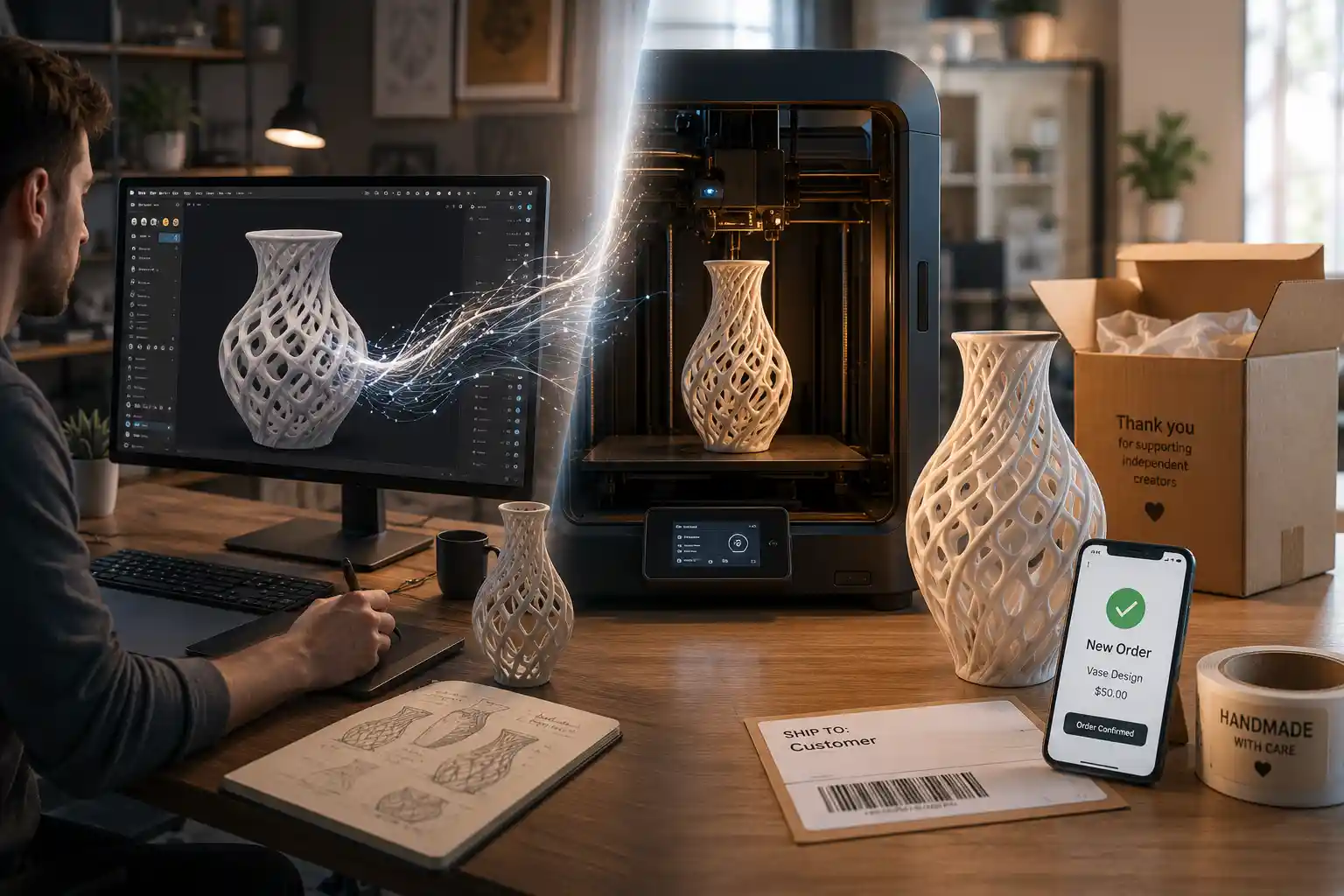
Most print-on-demand services for 3D designs work like this: you upload your 3D model to the platform, set your price, and the platform lists it for sale. When a customer places an order, the platform 3D prints the model, finishes it, packages it, and ships it directly to the customer. You don’t have to handle any inventory or shipping, and you don’t pay anything upfront.
The top print-on-demand platforms for 3D designs include Shapeways, Sculpteo, and JLC3DP. Each of these platforms offers different materials, from plastic to metal to resin, and different price points. You can set your own markup on top of the base printing price, so you decide how much profit you make per sale.
Who Is This Good For?
Print-on-demand is a great option for designers who create art, jewelry, home decor, or consumer products. If you have a design that people might want to buy as a physical object instead of just a digital file, print-on-demand lets you reach that audience without any upfront cost. For example, if you design a 3D model of a decorative vase, you can sell the digital file on Cults 3D for $10, and sell the physical print-on-demand version on Shapeways for $50, earning $20 profit on each sale without doing any extra work.
Tips to Maximize Your 3D Model Sales
No matter which platform you choose, there are a few best practices that will help you sell more 3D models consistently. These tips are based on feedback from hundreds of successful 3D sellers, and they apply to every niche and platform.
Focus on Quality and Usability
The biggest difference between sellers who make consistent sales and sellers who don’t is the quality and usability of their models. Buyers don’t just want a 3D file that looks good in a preview – they want a model that is clean, properly scaled, has correctly unwrapped UVs, and is ready to use right out of the box. For 3D printable models, that means checking for errors like non-manifold geometry and testing the model before uploading. For game assets, that means optimizing polygon counts and making sure textures are correctly assigned. Taking an extra 30 minutes to clean up your model will lead to better reviews and more repeat buyers.
Write Clear Descriptions and Take Great Previews
Your preview images and description are the only thing buyers have to judge your work before they buy. Invest time in creating high-quality, well-lit preview renders from multiple angles, and include wireframe previews so buyers can see the topology of your model. Your description should include all the technical details buyers need: polygon count, file type, texture resolution, and what software the model is compatible with. Include keywords that buyers would actually search for – for example, “modern minimalist coffee table 3d model” instead of just “coffee table” – to help buyers find your model in platform search results.
Diversify Your Listings Across Multiple Platforms
Don’t just upload your models to one platform and call it a day. Unless you’re required to sell exclusively (which most platforms don’t require), you can upload the same non-exclusive model to multiple platforms to reach more buyers. For example, you can upload a 3D printable model to Cults, Thangs, and MyMiniFactory at the same time, and link to your Patreon from all of them. This gives you more exposure and reduces your risk if one platform changes its policies or sees a drop in traffic.
Publish New Models Consistently
Most platforms prioritize new content in their search algorithms, so publishing new models on a regular schedule will help you keep your existing models visible and attract new buyers. You don’t have to publish a new complex model every week – even adding one new model per month is enough to keep your profile active and growing. Over time, your portfolio will grow, and each new model becomes a new asset that generates passive income for you.
Conclusion
There’s no one “best” place to sell 3D models – the right choice depends on your niche, your experience level, and your business goals. If you’re just getting started, general marketplaces like CGTrader or Sketchfab are a great place to start, because they give you built-in traffic and don’t require any upfront investment. If you create 3D printable models or game assets, niche platforms like Cults 3D or the Unity Asset Store will connect you directly to an audience actively looking for your work. Once you build an audience, selling through your own website using tools like Gumroad lets you keep more of your revenue and build a sustainable long-term business. No matter which path you choose, focusing on creating high-quality, usable models and publishing consistently will help you build a successful income stream from your 3D work.