
If you’ve ever spent hours browsing 3D model marketplaces like Sketchfab, TurboSquid, or CGTrader for a car model to use in a video game, 3D print, or commercial project, you’ve probably noticed a familiar disclaimer: “this model is for personal use only” or “not for commercial distribution.” Many 3D artists and designers assume that car designs enter the public domain after a set number of years, just like books or old movies. But the reality of copyright for car 3D models is far more complicated, mixing trademark law, design patent rules, and intellectual property norms that vary wildly between countries. Whether you’re a hobbyist 3D printing a scale model of a 1967 Ford Mustang or a game studio licensing hundreds of vehicles for a new open-world racing game, understanding how long car designs are protected—and how that protection applies to 3D models—can save you from expensive legal disputes down the line.
Understanding the Basics: Copyright vs. Other Intellectual Property for Cars
To answer how long car 3D models are copyrighted, you first need to untangle the different types of intellectual property (IP) that apply to automobile designs. Many people confuse copyright, design patents, and trademark law, but each protects a different part of a car’s design and lasts for a completely different period of time.
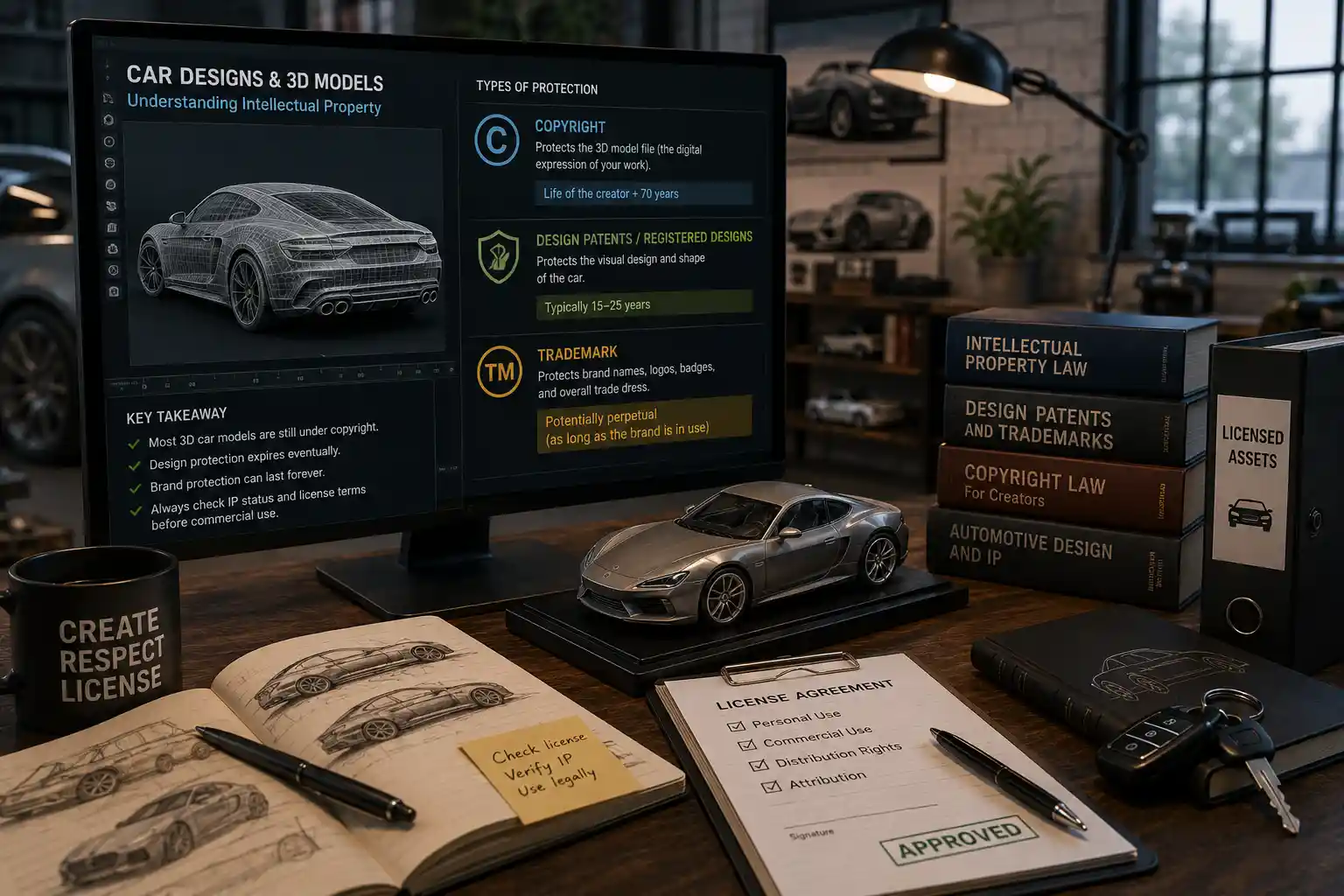
Copyright protection for original creative work
Copyright automatically protects original creative works fixed in a tangible medium of expression, including 3D models themselves. When a 3D artist creates an original model of a car from scratch, that artist gets automatic copyright to their 3D model file the moment it’s saved. That said, copyright does not protect the underlying design of the real car the model is based on—at least not in most cases. In the United States, for example, useful articles (objects that have a practical function beyond their aesthetic appearance) like cars are only eligible for copyright protection for their separable artistic features. That means a custom paint job or a unique hood ornament might be copyrighted, but the overall shape and dimensions of the car are considered a functional feature, not a separable artistic work.
In the European Union, the rules are slightly more creator-friendly. The EU Copyright Directive allows for limited copyright protection of industrial designs, but this protection still overlaps heavily with registered design rights, which are a separate form of IP. For 3D modelers, this distinction is critical: the 3D file you create is copyrighted by you, but the car design you copied is still likely protected by other forms of IP held by the original car manufacturer.
Design patents and registered design rights
For car manufacturers, the primary way to protect the overall shape and design of a new vehicle is through design patents (in the US) or registered community designs (in the EU). Unlike copyright, these IP forms specifically protect the visual, ornamental design of a functional product like a car. This is where the question of “how long” starts to get clearer, because these protections have explicit expiration dates:
- In the United States, design patents last for 15 years from the date the patent is granted. Before 2015, the term was 14 years, so any design patent filed before that date expires one year earlier.
- In the European Union, a registered community design lasts for up to 25 years total, renewed in 5-year increments from the date of registration.
- In most other countries, including Australia and Canada, registered design protection for cars lasts between 10 and 25 years, depending on the region.
Once a design patent or registered design right expires, anyone can reproduce the car’s design without permission from the original manufacturer—right? Not so fast. There’s a third form of IP that never expires, and it’s the one that trips up most 3D modelers: trademark law.
Trademark protection for brand identity
Trademarks protect brands, logos, and trade dress that consumers associate with a specific manufacturer. That means the Toyota emblem, the Ford blue oval, and even the distinctive shape of a Jeep Wrangler or a Tesla Cybertruck can be protected as trademark, so long as the manufacturer continues to use the brand and the shape is still recognizable to consumers. Unlike copyright and design patents, trademark protection never expires as long as the brand is active and the manufacturer defends its trademark. Even if a car model went out of production in 1970, if the brand that made it still exists and still uses that name, the trademark is still in force. This is why even 50-year old car designs can still be subject to legal claims if you use their 3D model commercially.
How Long Does Copyright Protection Last for Car 3D Models?
Now that we’ve sorted out the different types of IP, let’s break down the specific copyright terms that apply to car 3D models themselves, depending on who created the model and where you live.
Copyright term for the 3D model file
As we noted earlier, the 3D model file itself is an original creative work, so it gets the same copyright term as any other creative work. The length of copyright varies by country, but the standard terms are consistent across most developed nations:
- For models created by individual independent artists: In the US, UK, Canada, and Australia, copyright lasts for the life of the artist plus 70 years. If the artist created the model in 1990 and died in 2020, the copyright will not expire until 2090.
- For models created by a company or as work for hire: In the United States, copyright lasts for 95 years from the date of publication, or 120 years from creation, whichever comes first. In the EU and UK, it lasts for 70 years from the date of publication.
- For anonymous or uncredited models: Most countries calculate copyright from the date of publication, so an anonymous car 3D model posted online in 2000 will enter the public domain between 2070 (EU/UK) and 2095 (US).
This means that most car 3D models available online today are still under copyright, held either by the original artist or the marketplace that commissioned the work. Only very old models created by artists who died more than 70 years ago are in the public domain—and since 3D modeling has only been widely accessible since the 1980s, that’s almost no existing car models.
Copyright term for the underlying car design
The thornier question is whether the underlying design of the real car is copyrighted, and how long that protection lasts. As we noted earlier, most countries do not grant broad copyright to the overall design of a functional car. In the US, the 1976 Copyright Act explicitly limits copyright protection for useful articles, and the US Copyright Office has repeatedly rejected registration for overall car shapes as non-separable from the car’s function. That means that once a car’s design patent expires, there is no remaining copyright protection on the underlying design in most cases.
There are a few exceptions. For example, unique artistic features that are separable from the car’s function—like a custom hand-sculpted body for a limited-edition hypercar, or a distinctive interior mural—can be protected by copyright for the standard life-plus-70 term. But for mass-produced consumer cars, the underlying design is only protected by design patent and trademark, not copyright.
"The biggest mistake independent 3D artists make is assuming that because a car is 70 years old, its design is free to use. Trademark lasts forever, and car manufacturers actively police the use of their brand and designs on popular 3D platforms. You can get a takedown notice for a model of a 1950s Chevrolet just as easily as you can for a 2024 Corvette."
— Sarah Weber, intellectual property attorney specializing in 3D design and digital media
Key Factors That Change Copyright Terms for Car 3D Models
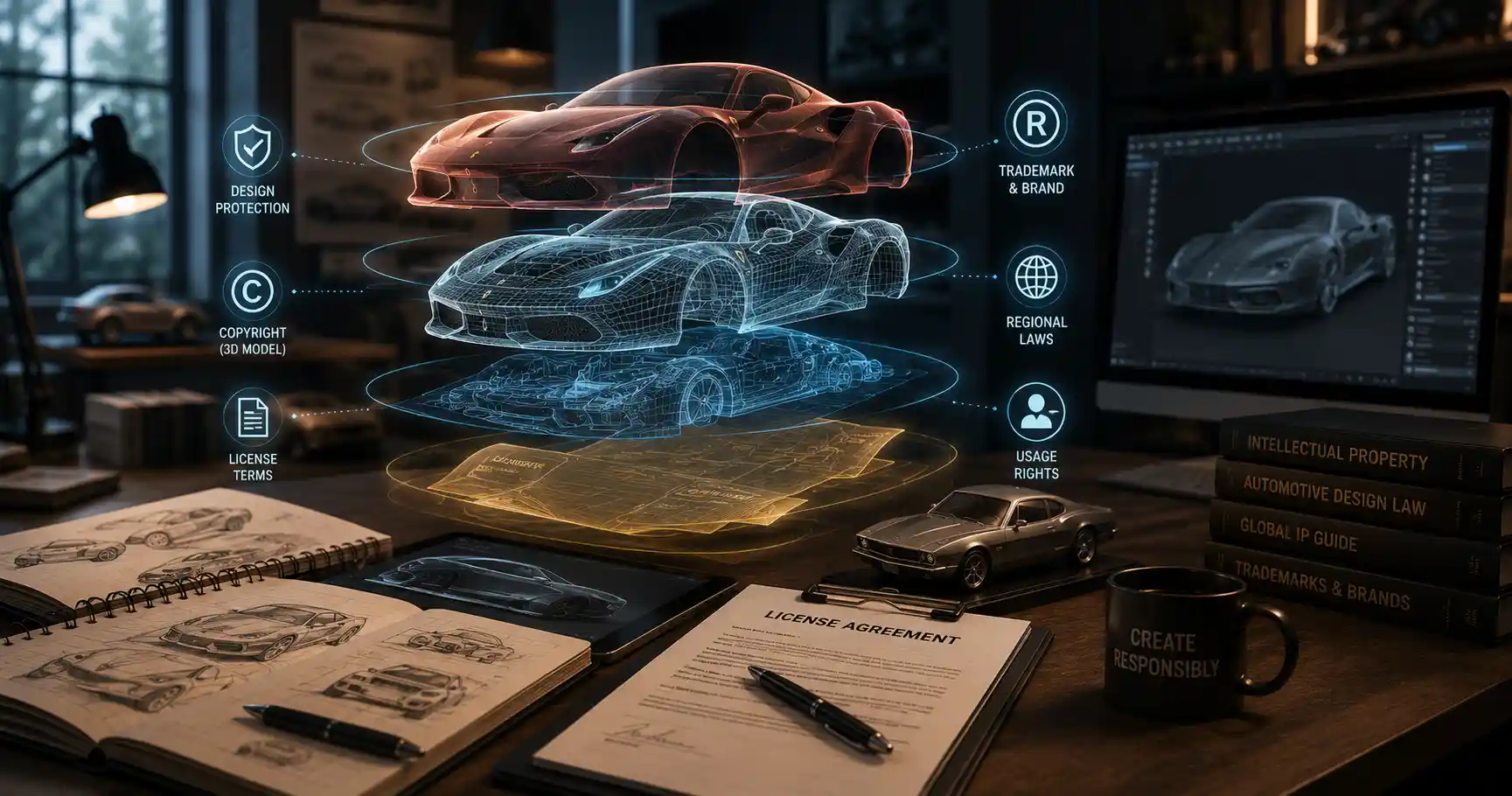
There is no one-size-fits-all answer to how long a car 3D model is copyrighted, because several factors can extend or change protection depending on your use case and the car in question. Here are the most important factors to consider before using a car 3D model in any project:
Age of the car vs. age of the 3D model
One of the most common points of confusion is the difference between the age of the real car and the age of the 3D model. A 1963 Volkswagen Beetle, for example, has an original design that is now more than 60 years old. Its original design patent expired decades ago, so the functional design is no longer protected by that right. But any 3D model of that 1963 Beetle created in 2020 is a brand new original creative work, so the 3D file itself is under copyright until the 2090s. Even if the underlying car design is free to use, the specific 3D model file you downloaded from a marketplace is still owned by the artist who made it, unless they explicitly released it into the public domain.
Fair use exceptions for non-commercial and transformative use
Even if a car 3D model is still under copyright, that doesn’t mean all unlicensed use is illegal. Most countries have fair use (or fair dealing) exceptions that allow limited use of copyrighted material without permission for purposes like criticism, comment, news reporting, education, or transformative work. For example:
- A hobbyist 3D printing a single scale model of a 2024 Ferrari for their personal display is almost always considered fair use, and very unlikely to face any legal action.
- A video game modder creating a custom car model for a fan-made mod of a popular racing game is generally protected by fair use, though some studios still issue takedowns for unlicensed branded content.
- A commercial project that uses a modified car design to parody a specific brand might qualify as fair use, but this is a much riskier area.
It’s important to note that fair use is an affirmative defense, meaning you have to go to court to claim it. It doesn’t prevent a manufacturer from filing a takedown notice or suing you for infringement—it just gives you a defense if the case goes to court. For most small creators and hobbyists, even a successful defense is too expensive to be practical, so it’s always better to err on the side of caution.
Country-specific variations in copyright and design terms
IP terms vary significantly between countries, so if you’re distributing your 3D model or project internationally, you have to comply with the strictest terms in any country where your work is available. For example:
- In Canada, copyright for individual works is life plus 50 years, compared to 70 in the US, UK, and EU. That means works enter the public domain 20 years earlier in Canada than in the US for individual creators.
- In Australia, unregistered design protection lasts for 12 years after the design is first made public, so any unregistered car design older than that is free to use there, even if it would still be protected in the EU.
- China offers 10 years of design protection from registration, far shorter than the EU’s 25 years, so many older car designs have entered the public domain there that are still protected in Europe.
That said, most major car manufacturers are based in the US, EU, Japan, or South Korea, so they will generally enforce their IP rights under their home country’s rules regardless of where you live, especially if you’re selling your work commercially online.
Open-source and public domain car 3D models
Not all car 3D models are under exclusive copyright. Some artists release their models under open-source licenses like Creative Commons CC0, which explicitly puts the work into the public domain and allows anyone to use it for any purpose, commercial or non-commercial. Other models are released under permissive licenses like CC BY, which allow commercial use as long as you credit the original artist. Always check the license of any 3D model you download: the license terms set out exactly what you can and can’t do, and if the model is explicitly public domain, you don’t have to worry about expiration terms.
When Do Car Designs Enter the Public Domain for 3D Modeling?
If you want to create a 3D model of an older car and use it commercially without paying licensing fees, when is that legally safe to do? Let’s break down the conditions that have to be met for a car design to be fully free and clear for 3D modeling:
- All design and registered design rights have expired: First, you need to confirm that any design patents or registered designs for the car have expired. For US cars, that means the design patent was granted at least 15 years ago (14 years if granted before 2015). For EU cars, that means 25 years have passed since the design was registered. For most cars that went out of production before 2000, this condition is already met.
- All trademark rights have been abandoned: This is the hardest condition to meet. Trademark only expires if the manufacturer has stopped using the brand name, logo, and trade dress entirely. If the manufacturer still exists and still produces cars under the same brand, the trademark is still active, even for old discontinued models. For example, Ford still owns the trademark to the “Mustang” name, even for the original 1960s models, because Ford still produces Mustangs today. The only time trademark expires is when the entire brand is discontinued and abandoned—for example, brands like Oldsmobile, Plymouth, or DeLorean are no longer in production, but even these brands’ trademarks are still owned by the parent company that bought the rights. General Motors still owns the Oldsmobile trademark, decades after it discontinued the brand, so you can’t use the name commercially without permission.
- There is no separable copyright protection for artistic features: As we noted earlier, unique artistic features of a car can still be under copyright even after the design patent expires. For most mass-produced cars, this isn’t an issue, but for custom or one-off cars with unique hand-built features, it’s something to check.
- The 3D model itself is public domain or properly licensed: Even if the underlying car design is fully in the public domain, any existing 3D model of that car created recently is still under copyright by the artist. You either need to create the model yourself from scratch (and release it yourself, or use it freely) or find an existing model that is already licensed for free commercial use.
What does this mean in practice? It means that very few car designs are fully in the public domain for commercial use, even very old ones. The only exceptions are rare cases where the manufacturer went out of business more than 70 years ago and no one has claimed the trademark. For example, many independent 3D modelers consider pre-WWII car brands like Packard or Studebaker to be de facto public domain, because the brands have been defunct for decades and no active manufacturer is defending the trademark. But that doesn’t mean there is zero legal risk—if a successor company still owns the trademark, you could still face a claim.
Practical Advice for 3D Artists and Designers
Whether you’re a hobbyist creating 3D printed models for fun or a professional studio working on a commercial project, there are a few simple rules you can follow to avoid copyright and trademark disputes when working with car 3D models:
For non-commercial hobbyist use
If you’re only creating models for your own personal use, or sharing non-commercial fan work online, your legal risk is extremely low. Most car manufacturers don’t go after individual hobbyists creating non-commercial 3D models, because it’s bad for public relations and not worth the legal cost. That said, you should still avoid selling models or making money from them if you don’t have a license. Even small-scale commercial sales can attract legal attention.
For commercial use of car 3D models
If you plan to use a car 3D model in a commercial project (like a video game, advertising campaign, or mass-produced 3D printed product), you have three safe options:
- Purchase an officially licensed model from a reputable marketplace. Many 3D model marketplaces offer commercially licensed car models that have been cleared for commercial use, and some even work directly with manufacturers to offer official licensing.
- Create a generic or heavily modified design that doesn’t infringe on trademark. If you create a car that doesn’t look exactly like any existing branded model, and don’t use any branded logos or names, you can use it freely without risk.
- Use explicitly public domain or permissively licensed models from artists who have released their work for free commercial use. Always double-check the license terms and confirm that the underlying design is not protected by active trademark.
What to do if you get a takedown notice
If you get a DMCA takedown notice (or equivalent) for a car 3D model you posted online, the best course of action for most independent creators is to remove the model. If you believe you have a valid fair use defense or the model is actually in the public domain, you can file a counter-notice, but this should only be done if you’re prepared to potentially defend your position in court. For most small creators, removing the model is the most practical choice to avoid legal costs.
Conclusion
To sum up, the question of how long cars are copyrighted for 3D models doesn’t have a single simple answer. The 3D model file itself is copyrighted for the life of the creator plus 70 years in most countries, meaning almost all existing 3D models are still under copyright today. The underlying design of the car is protected by design patents or registered designs that last between 15 and 25 years, so those expire eventually—but trademark protection for the brand, name, and trade dress can last forever, as long as the manufacturer continues to defend its brand. Only in rare cases where a car brand has been completely abandoned for decades does a car design become fully free for commercial 3D modeling.
For hobbyists, the risk of using unlicensed car 3D models for personal use is very low, but commercial users should always prioritize officially licensed or properly cleared models to avoid expensive legal disputes. As 3D printing and digital content creation become more accessible, car manufacturers are becoming more active in policing unlicensed use of their designs online, so understanding the rules of IP for car 3D models is more important than ever. By taking the time to check license terms, confirm expiration of IP rights, and understand the difference between copyright, design patents, and trademark, you can create and use car 3D models safely and avoid unnecessary legal risk.