
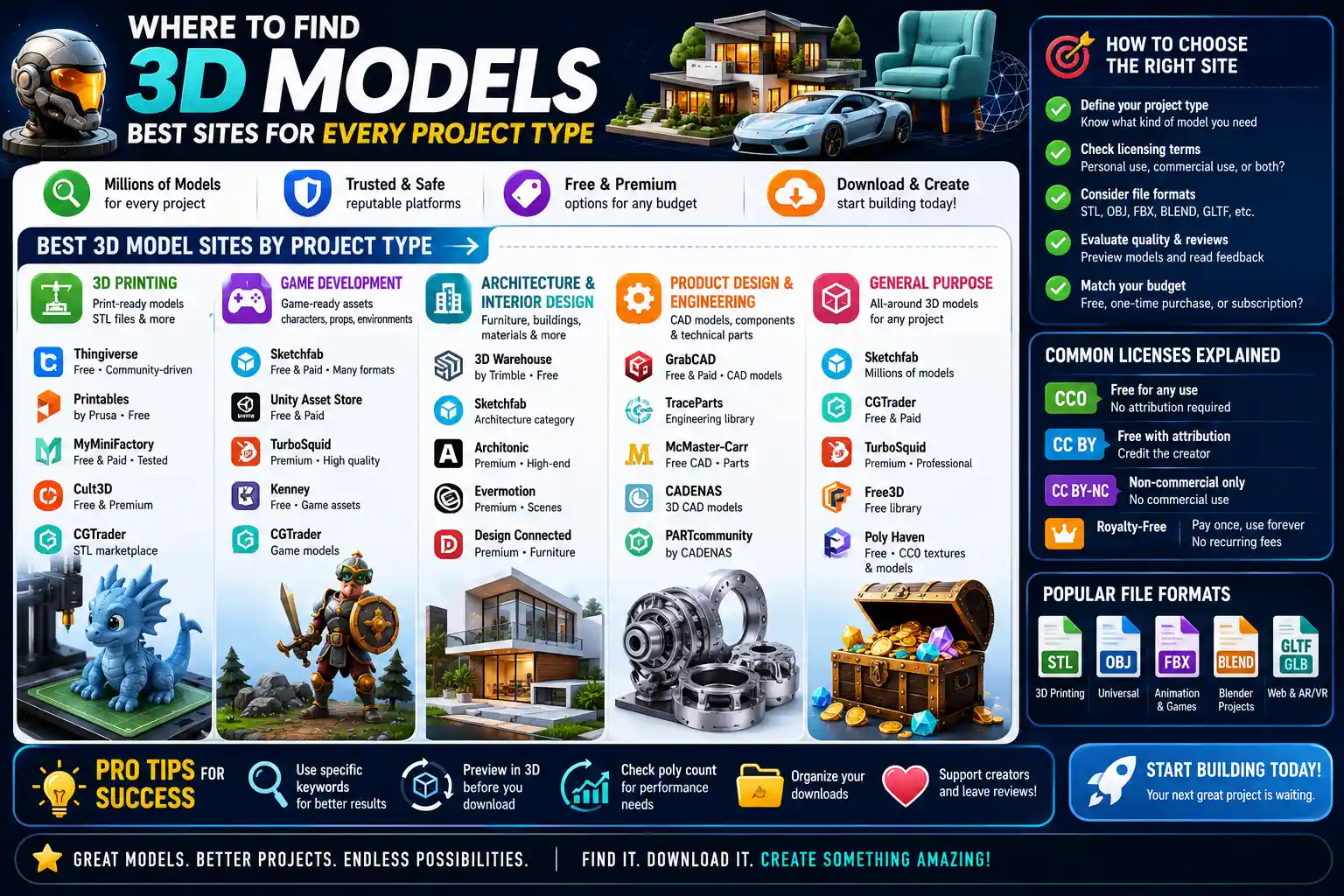
Whether you’re a game developer prototyping a new indie title, a product designer showcasing a prototype, a 3D printing enthusiast working on a weekend project, or an architect visualizing a new building, high-quality 3D models are the foundation of any successful project. Hunting down the right model can feel overwhelming: free options might lack the detail or commercial licensing you need, while premium marketplaces can drain your budget before you even get started. Knowing where to look, and what to expect from each source, saves you hours of frustration and ensures your project stays on track and legally compliant. This guide breaks down the best places to find 3D models for every use case and budget.
Free 3D Model Repositories for Hobbyists and Beginners
For new creators, hobbyists working on personal projects, or anyone testing an idea on a tight budget, free 3D model repositories are an excellent starting point. These platforms host thousands of user-uploaded models, covering everything from common household objects to complex character designs, and many offer permissive licensing for non-commercial use. The key advantage of free repositories is accessibility: you can download and start working with models in minutes without spending a dime.
Google Poly
Google Poly launched as a free, curated library of 3D models optimized for real-time use in AR, VR, and game development. While Google retired active development of the platform in 2021, the existing library of over a million models remains accessible to the public. Most models on Poly are licensed under Creative Commons, meaning they’re free to use for personal projects, and many allow commercial modification with attribution. The platform’s strong search filters let you sort by poly count, license type, and format, making it easy to find low-poly models perfect for mobile games or AR filters. The main downside is that no new models are being added, so you won’t find many niche or trending assets here.
Sketchfab
Sketchfab is one of the largest 3D model communities online, with millions of user-uploaded models available for free download. What sets Sketchfab apart is its built-in 3D viewer, which lets you inspect a model’s geometry, textures, and topology directly in your browser before you download it. That feature alone saves hours of wasted time downloading models that don’t match your needs. Free users can download thousands of models marked for free use, with filters that let you sort by license type (including commercial use). Many creators on Sketchfab release their work for free in exchange for attribution, which is a small price to pay for high-quality assets. Keep in mind that quality varies wildly on user-uploaded platforms: a free 3D chair model might be perfectly usable for a quick visualization, but it could also have non-manifold geometry or missing textures that require extra work to fix.
Other Notable Free Repositories
Several smaller, niche free platforms cater to specific use cases that larger repositories often overlook. For 3D printing enthusiasts, Thingiverse is the go-to source, with hundreds of thousands of pre-tested models designed specifically for FDM and resin printing. All models on Thingiverse are free to download and modify, with most created by the community for personal use. If you need architectural assets, ArchDaily and CADblocks offer free CAD-compatible 3D models of building components, furniture, and landscape elements. For open-source and low-poly game assets, Kenney Assets releases entire packs of 3D models for free, with permissive licensing that allows commercial use without attribution. That makes it a favorite among indie game developers just starting out.
- Always check the license before using a free 3D model for commercial projects: many free licenses restrict use to non-commercial work only.
- Inspect models for errors: common issues include flipped normals, non-manifold geometry, and missing texture files that can break 3D prints or game engines.
- Save time by using search filters to narrow results by file format (OBJ, FBX, STL are the most common) and poly count before you start browsing.
Premium 3D Model Marketplaces for Professional Projects
When you’re working on a commercial project or need a high-quality, game-ready model that doesn’t require hours of rework, premium marketplaces are worth the investment. These platforms curate their asset libraries, require creators to meet specific quality standards, and offer clear commercial licensing that protects you from copyright claims. Prices vary widely, from $5 for a single small object to $50 or more for a fully rigged character model, and many platforms offer monthly subscriptions for creators who need regular access to new assets.
TurboSquid
TurboSquid is the largest and most well-known premium 3D model marketplace, with a library of over a million models covering every category imaginable: product models, architectural assets, characters, vehicles, and more. What makes TurboSquid stand out is its quality control: all premium models are checked by moderators to ensure they match the creator’s description and meet basic geometry standards. Many models come with multiple LODs (level of detail) for game development, and high-resolution textures for architectural visualization. TurboSquid also offers a royalty-free commercial license with most purchases, allowing you to use the model in end products without additional fees. For enterprise clients, they offer custom 3D model creation services if you can’t find exactly what you need. The only downside is that lower-priced models can still have quality issues, so it’s worth reading user reviews before purchasing.
CGTrader
CGTrader is another major premium marketplace that combines a curated library of pre-made 3D models with a custom creation service. If you need a unique model that doesn’t exist anywhere else, you can post a project on CGTrader and receive bids from 3D artists around the world, with prices starting as low as $50 for simple models. The marketplace itself has a strong focus on game-ready and AR/VR assets, with many creators offering fully rigged, animated characters that work directly in Unity or Unreal Engine. CGTrader also offers a royalty-free license for most purchases, and their buyer protection policy means you can get a refund if the model doesn’t match the description. Compared to TurboSquid, CGTrader tends to have more competitive pricing from independent creators, making it a good option for small studios and independent creators on a budget.
Unity Asset Store and Unreal Engine Marketplace
If you’re a game developer working with Unity or Unreal Engine, the native asset stores for each engine are incredibly convenient sources for 3D models. Both marketplaces sort assets by compatibility with your engine version, so you never have to worry about importing a model that won’t work with your project. 3D models sold here are often already optimized for real-time rendering, with correct import settings, rigs, and animations ready to go. You can find everything from 10-dollar environment packs to fully developed character bundles for triple-A projects. Both engines also have a large selection of free 3D assets for beginners, so you can test the platform before investing in premium assets. The main limitation is that most assets are licensed specifically for use in the native engine, so they’re less useful if you’re working on a 3D printing or architectural visualization project outside of game development.
“The cheapest 3D model isn’t the one that costs nothing. It’s the one that doesn’t require 10 hours of fixing geometry or reworking textures before you can use it in your project.”
This saying among professional 3D creators highlights a key truth about purchasing 3D models: the time you spend fixing a bad free model is almost always more valuable than the money you save. For commercial projects, investing in a quality premium model from a reputable marketplace pays off in avoided delays and legal headaches.
Niche Platforms for Specific Use Cases
General repositories and marketplaces work well for common needs, but if you’re working in a specialized field like 3D printing, architecture, or scientific visualization, niche platforms offer models tailored exactly to your requirements. These platforms cut through the noise of generalist marketplaces and provide assets that are pre-tested for your specific use case.
3D Printing
While Thingiverse is the biggest name in free 3D printable models, there are several other platforms that cater to 3D printing creators. MyMiniFactory is a popular alternative that offers both free and premium 3D printable models, with a guarantee that all models on the platform are test-printed and confirmed to work. That eliminates the common frustration of downloading a model only to find it has errors that ruin your print. For creators who want to sell their own 3D printable designs, MyMiniFactory also handles payment processing and licensing, making it easy to monetize your work. If you’re looking for premium, high-quality 3D printable models, sites like CGTrader also have dedicated 3D printing categories, and many designers offer custom file modifications for a small fee.
Architectural Visualization
Architects and interior designers need accurate, scaleable 3D models of furniture, building materials, and landscape elements to create realistic visualizations for clients. Platform like 3D Warehouse (owned by Trimble, the creators of SketchUp) is the go-to free source for architectural models, with millions of user-uploaded models of actual building products from real manufacturers. Many major furniture and fixture brands upload official 3D models of their products to 3D Warehouse, so you can add an exact replica of a sofa or kitchen cabinet to your visualization instead of using a generic placeholder. For premium assets, sites like ArchDaily’s 3D library and Modelur offer high-quality, V-Ray-ready models optimized for architectural rendering, with accurate materials and textures that match real-world products.
Scientific and Medical Visualization
Creating educational content, medical animations, or scientific research visualizations requires accurate, anatomically correct 3D models that general marketplaces rarely offer. For medical models, the Visible Human Project provides free, open-source 3D models of human anatomy based on real cadaver scans, making them the gold standard for educational and research use. For commercial medical projects, marketplaces like Medartec and 3D4Medical offer premium, high-resolution anatomically correct models that are perfect for patient education, surgical training, and pharmaceutical marketing. These models are created with input from medical professionals, so you can trust their accuracy for professional use.
Game Development
Beyond the Unity and Unreal marketplaces, there are niche platforms specifically for indie game developers looking for affordable, high-quality 3D assets. itch.io is a platform for independent game creators that hosts thousands of free and low-cost 3D model packs, often released by other indie developers looking to support the community. Many of these packs are royalty-free for commercial use, with prices as low as $10 for an entire environment pack. For low-poly retro-styled games, sites like Low Poly Heaven specialize in optimized, stylized 3D models that are perfect for indie titles. If you need animated characters, Reallusion’s Character Creator marketplace offers fully rigged, ready-to-animate character models that work with most major game engines and animation software.
- For 3D printing: Always choose models marked as “tested” to avoid failed prints and wasted filament.
- For architecture: Prioritize models from official brand pages to ensure scale and accuracy match the real product.
- For medical/scientific work: Verify that models were created with input from qualified professionals to ensure accuracy.
- For game development: Look for models that include multiple LODs to ensure smooth performance on all devices.
Custom 3D Model Creation: When to Commission a Unique Model
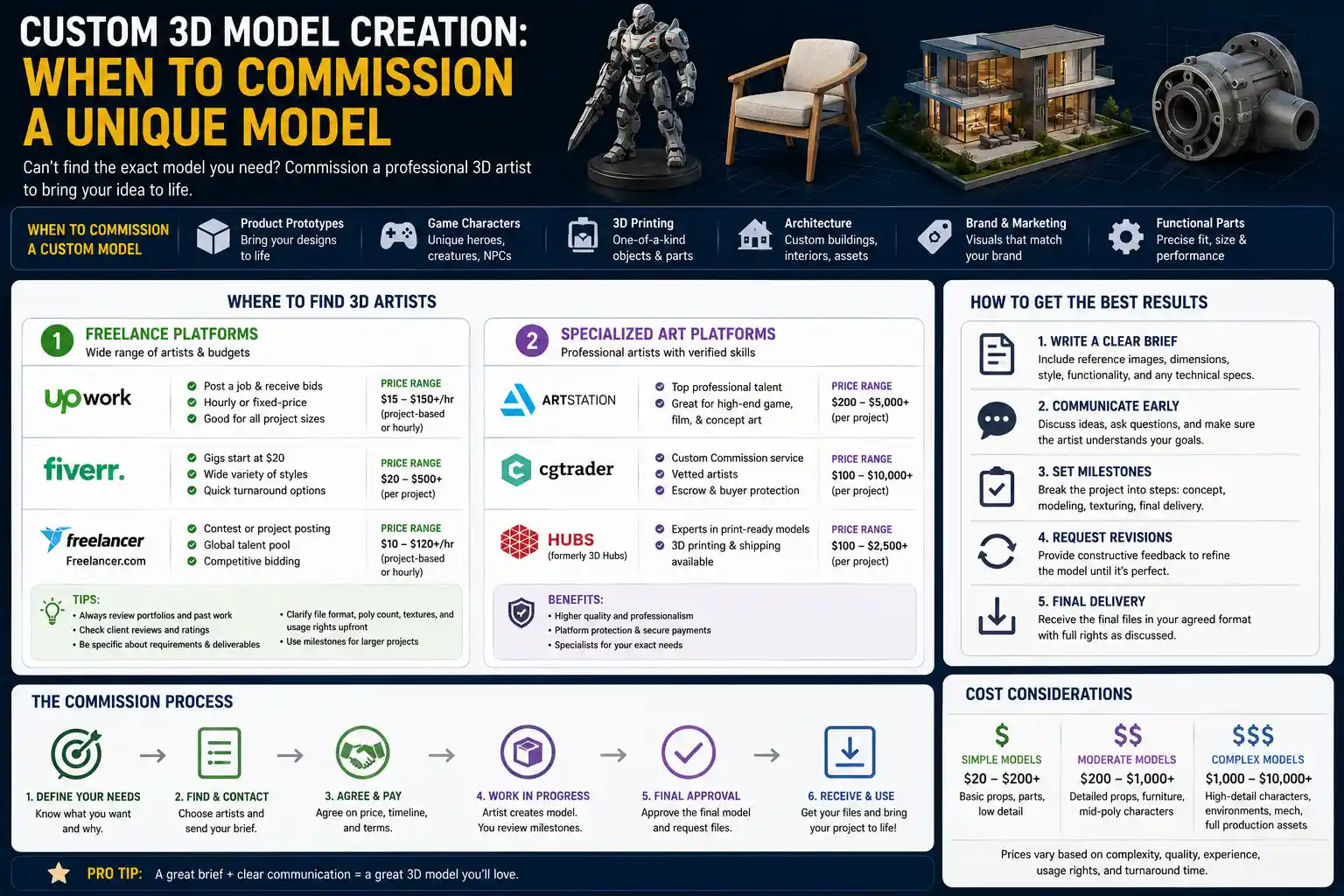
Sometimes, you can’t find the exact model you need anywhere. Whether you’re creating a product prototype of a custom design, need a unique character for your game, or want to 3D print a one-of-a-kind sculpture, commissioning a custom 3D model from a freelance artist is the best solution. There are more places to find skilled 3D artists than ever before, and prices are competitive for all types of projects.
Freelance Platforms
General freelance platforms like Upwork, Fiverr, and Freelancer let you post your 3D modeling project and receive bids from artists around the world. This is a good option if you’re working on a budget, as you can find skilled artists in many price ranges. On Fiverr, for example, you can find simple product models starting at $20, while complex fully rigged characters can cost several hundred dollars. When hiring from a general freelance platform, always ask to see a portfolio of previous 3D modeling work, and check reviews from past clients to avoid scams or low-quality work. It’s also important to be as specific as possible about your requirements: file format, poly count, texture resolution, and usage rights before you agree on a price.
Specialized Art Platforms
For higher-quality custom work, specialized art platforms connect you with professional 3D artists who specialize in specific types of work. ArtStation is the largest platform for professional digital artists, with a huge community of 3D modelers who take custom commissions. Most artists on ArtStation specialize in game art, character design, or architectural visualization, so you can easily find someone with experience in your specific use case. CGTrader, which we mentioned earlier for pre-made models, also offers a custom commission service that vets artists and offers buyer protection, so you don’t pay until you approve the final model. For product design and 3D printing prototypes, platforms like 3D Hubs (now Hubs) connect you with 3D modelers who specialize in creating print-ready models, and can even handle the printing and shipping for you.
Commissioning a custom model is almost always more expensive than buying a pre-made model, but it gives you complete control over the final result. If you need a model that matches a specific design, brand guidelines, or functional requirements (like being strong enough for 3D printing), the extra cost is worth it to get exactly what you need. Many 3D modelers also offer revision rounds, so you can adjust the design until it matches your vision.
Key Tips for Licensing and Copyright Compliance
One of the most overlooked aspects of sourcing 3D models is understanding licensing and copyright. Using a model without the right license can lead to copyright strikes, legal claims, and having to pull your finished product from market, which can be devastating for a small business or independent creator. Different sources have different licensing terms, so it’s critical to understand what you’re allowed to do before you use a model in a commercial project.
Most free 3D models are released under some form of Creative Commons license. Creative Commons licenses vary: some allow commercial use with attribution, some allow modification, and some restrict commercial use entirely. For example, a CC BY-NC license means you can’t use the model for any commercial purpose, only personal or non-profit work. Always read the full license terms before using a free model in a commercial product.
Premium models from most reputable marketplaces come with a royalty-free commercial license, which typically allows you to use the model in end products (like a game, 3D print, or visualization) without paying additional royalties. However, most royalty-free licenses do not allow you to re-sell or redistribute the model itself as a stock asset. For example, you can use a 3D tree model in your game that you sell to customers, but you can’t put that tree model in a stock asset pack and sell it yourself. If you want to use a model in a product that will be distributed to thousands or millions of users, some marketplaces require an extended license, which costs a little extra but gives you broader usage rights.
If you commission a custom 3D model, always get the usage rights in writing before you start work. Some artists retain the copyright to the model and only license you to use it for specific purposes, while others will transfer full copyright ownership to you for an extra fee. Clarifying this upfront avoids disputes later on.
Conclusion
Finding the right 3D model doesn’t have to be a frustrating process, no matter your budget or use case. For hobbyists and personal projects, free repositories like Sketchfab and Thingiverse offer thousands of quality assets that let you get started without spending any money. For professional commercial projects, premium marketplaces like TurboSquid and CGTrader offer high-quality, legally compliant models that save you hours of work. Niche platforms cater to specialized needs like 3D printing, architectural visualization, and medical work, giving you access to models tailored to your specific requirements. And when you can’t find what you need, freelance platforms make it easy to commission a custom model that matches your exact vision. The most important rules to remember are always check the license terms, inspect the model for errors before committing to a project, and weigh the cost of a premium model against the time you’d spend fixing a free one. By choosing the right source for your needs, you can spend less time hunting for assets and more time creating your finished project.