
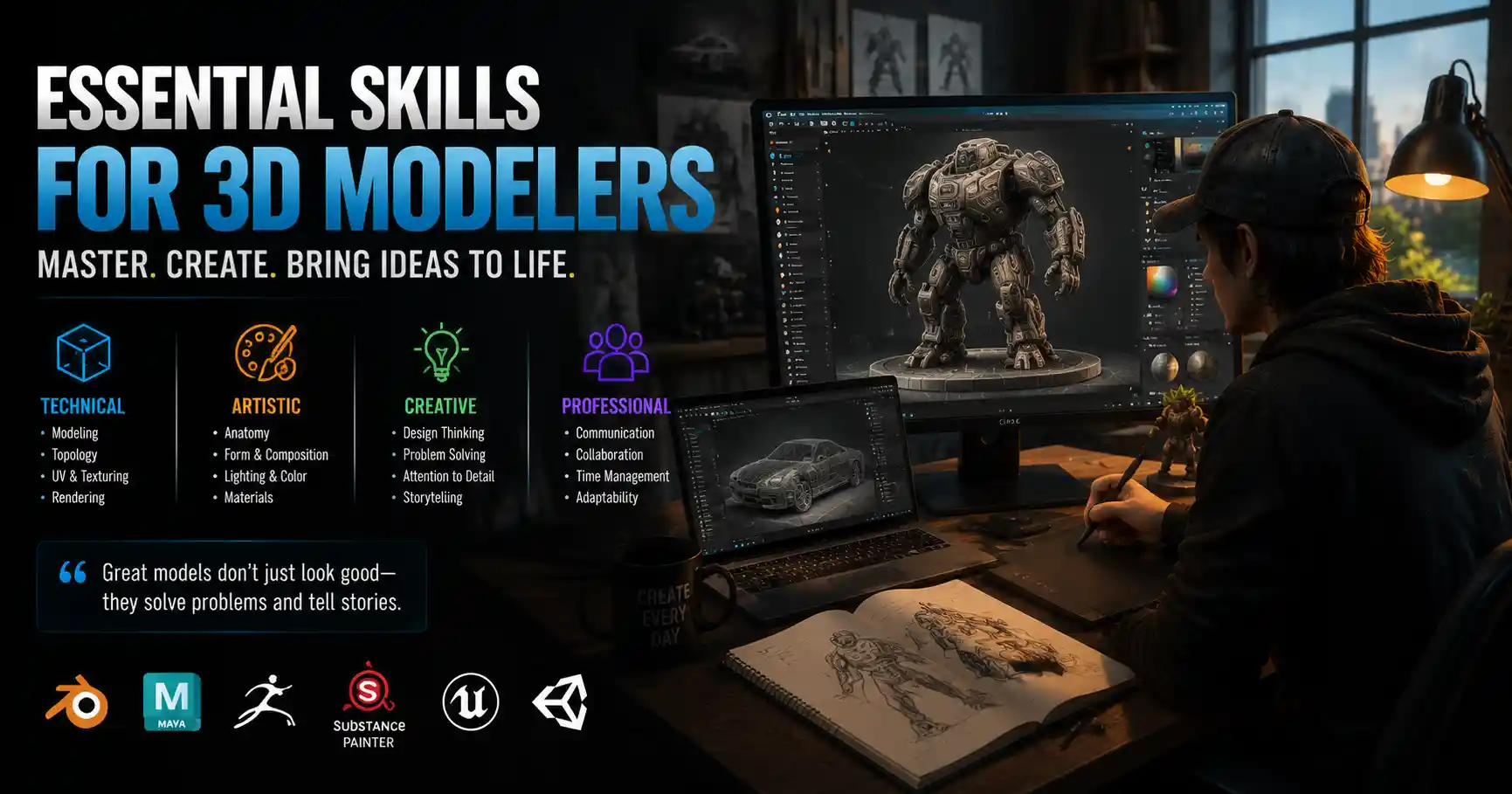
3D modeling has transformed from a niche technical skill into a foundational craft powering industries from video games and film to architecture, medical device design, and sustainable product development. As immersive technologies like virtual reality (VR), augmented reality (AR), and 3D printing become mainstream, the demand for skilled 3D modelers continues to grow at a rate of 16% annually through 2030, according to the U.S. Bureau of Labor Statistics. But what separates a hobbyist who can build a basic shape from a professional 3D modeler that top companies compete to hire? Success in this field relies on a mix of technical mastery, creative problem-solving, and soft skills that many new creators overlook. In this guide, we break down the most important skills for 3D modelers at every career stage, with practical tips to build and refine them.
Core Technical 3D Modeling Skills
At its core, 3D modeling is a technical craft, and mastery of fundamental tools and techniques is non-negotiable for professional work. Unlike creative fields that rely purely on inspiration, 3D modeling requires consistent precision to produce assets that work for their intended use case, whether that’s a 3D printable prototype or a character for a AAA video game.
Proficiency with Industry-Standard Software
The first technical skill any aspiring 3D modeler needs to build is fluency with the software tools used in their target industry. No single program works for every use case, so understanding the strengths of each platform and being able to adapt is key.
- Polygon modeling software: Autodesk Maya, Blender, and 3ds Max are industry standards for character modeling, environment art, and animation. Blender, in particular, has become a popular starting point for new modelers thanks to its free, open-source license and massive global community of creators.
- Subdivision and sculpting tools: ZBrush is the go-to for high-detail organic sculpting, from character faces to intricate product designs, while Blender’s built-in sculpt mode offers a capable free alternative.
- CAD (Computer-Aided Design) software: For industrial design, architecture, and 3D printing, SolidWorks, AutoCAD, Fusion 360, and Rhino are the standard. These tools prioritize precision and parametric modeling, which allows designers to adjust dimensions easily without rebuilding the entire model from scratch.
- Texture and rendering tools: Substance Painter and Designer are widely used for creating PBR (physically based rendering) textures that look realistic in game engines or final renders. Keyshot and V-Ray dominate the rendering space for product visualization and architectural marketing.
While mastering every tool is impossible, being fluent in at least two to three core tools for your niche makes you far more employable than a modeler who only knows one platform. Many employers also prioritize familiarity with game engines like Unity or Unreal Engine, especially for modelers working in interactive media.
Understanding of Modeling Fundamentals: Topology, Geometry, and Scale
Software proficiency means nothing without a deep understanding of the core principles that make a 3D model functional. Topology—the arrangement of vertices, edges, and faces that make up a 3D mesh—is one of the most critical skills that separate amateur work from professional. A model with clean topology deforms correctly for animation, is easier to texture, and renders faster than a messy mesh. For example, a character model for a game needs edge loops placed around the mouth and eyes to ensure the face moves naturally when the character speaks or smiles; bad topology will create weird creases or distortion that ruin the final shot.
Understanding scale and proportion is equally important, especially for 3D printing, architecture, and product design. A 3D model of a chair that’s 10 times the correct size won’t work for a manufacturer, and a character that’s out of proportion will look uncanny to viewers even if the texturing and shading are perfect. For parametric CAD work, understanding geometric constraints and how different parts fit together in an assembly is essential to avoiding costly manufacturing errors.
UV Unwrapping and Texturing
Many new modelers think their job is done once the 3D mesh is complete, but UV unwrapping and texturing are what bring a model to life. UV unwrapping is the process of flattening a 3D mesh into a 2D map so that textures can be applied correctly. A clean UV unwrap avoids stretching and distortion, ensuring that textures look consistent across the entire surface of the model. For PBR workflows, modelers also need to understand how different material properties—albedo, roughness, metalness, normal mapping—work together to create realistic surfaces that react correctly to light in any environment.
Creative and Artistic Skills for 3D Modelers
Even the most technically precise 3D model fails if it doesn’t meet the creative requirements of a project. 3D modeling is a blend of technical skill and art, and strong artistic fundamentals help modelers create assets that are both functional and visually compelling. This is true regardless of niche: a 3D model of a new office building needs to look inviting to stakeholders, just as a character model for a horror game needs to evoke fear in players.
Traditional Art Fundamentals
Many successful 3D modelers start with a background in 2D art, and for good reason. Core art principles translate directly to 3D work and help modelers make intuitive, visually appealing decisions without relying on constant feedback.
- Anatomy and form: For organic modelers (those who create characters, plants, animals, or living things), a deep understanding of anatomy is non-negotiable. Even stylized characters need to follow basic anatomical rules to feel believable. For example, knowing how muscles attach to bone and how the body moves helps a modeler create a character that looks natural even in a static pose.
- Perspective and composition: Understanding how objects appear in different perspectives helps modelers build assets that look correct from any camera angle, which is critical for interactive media where viewers can move the camera freely. Composition skills also help when creating full environments or rendering final shots for client approval.
- Color theory and lighting: Texturing and shading rely on a solid understanding of how color works and how light interacts with different surfaces. A modeler who understands warm and cool tones, contrast, and how light bounces off objects can create a realistic render that doesn’t require heavy post-production edits.
Design Thinking and Problem-Solving
3D modeling is rarely just about creating something that looks good—it’s about creating something that solves a specific problem. A product modeler designing a new water bottle needs to consider ergonomics (how it fits in a user’s hand), manufacturing constraints, and branding guidelines alongside aesthetics. An architectural modeler needs to balance a client’s vision for a beautiful home with structural requirements and accessibility standards.
Design thinking—the process of understanding the end user, defining problems, and iterating on solutions—helps modelers create work that meets all of these requirements. For example, if a game studio needs a 3D environment that runs smoothly on a mobile phone, a skilled modeler will use problem-solving skills to reduce polygon count without sacrificing the visual style of the environment, rather than delivering a high-poly model that forces developers to optimize it themselves.
Adaptability to Different Creative Styles
Professional 3D modelers rarely get to work exclusively in their favorite style. A modeler working in the game industry might be asked to create a stylized cartoon character one month and a hyper-realistic weapon the next. A product visualization modeler might work on a minimalist skincare line one quarter and a rugged outdoor equipment brand the next. Being able to adapt your creative approach to match the project’s requirements is a hugely valuable skill that many new modelers don’t prioritize.
“The best 3D modelers aren’t just technical wizards—they’re chameleons. They can match the style of a project, adapt to new tools, and solve problems that don’t have a step-by-step answer. That flexibility is what makes someone hireable long-term, not just for one job.”
Industry-Specific Specialized Skills
3D modeling is used in dozens of industries, and each has its own unique set of requirements that go beyond core technical and creative skills. Building niche-specific skills helps you stand out to employers and command higher rates as a freelancer.
Games and Interactive Media
For 3D modelers working in video games, AR, or VR, the most important specialized skill is optimization. Every polygon in a game model uses processing power, so modelers need to know how to create detailed-looking assets with as few polygons as possible. This often involves baking high-poly details into a low-poly mesh using normal maps, a technique that creates the illusion of high detail without the performance cost.
Modelers in this space also need to understand how models integrate with game engine pipelines, including rigging (the process of adding a skeleton to a character so it can be animated) and collision detection for interactive objects. Knowledge of procedural modeling techniques—using algorithms to generate assets like trees, rocks, or buildings automatically—can also be a huge advantage for creating large open worlds efficiently.
Film, Animation, and Visual Effects
In film and VFX, the priority is hyper-realism and high detail, since assets will be rendered in 4K or even 8K resolution for the big screen. Modelers in this industry need to be comfortable creating extremely high-poly models with intricate details, from the pores on an actor’s face to the individual threads on a costume. Understanding camera tracking and how 3D assets match the lighting of a live-action shot is also critical for seamless integration of CGI into live-action footage.
Architecture, Product Design, and Manufacturing
For modelers working in fields that produce physical objects, precision and knowledge of manufacturing constraints are non-negotiable. 3D models for 3D printing or injection molding need to have correct wall thickness, avoid overhangs that can’t be printed without support, and account for shrinkage or expansion of materials during manufacturing. Architectural modelers need to understand building codes, structural requirements, and how to create models that work with architectural rendering software to create realistic marketing materials for clients. Many roles in this space also require knowledge of Building Information Modeling (BIM) standards, which integrate 3D models with data about materials, cost, and construction scheduling.
Medical and Scientific Modeling
This fast-growing niche requires an extra layer of accuracy: 3D modelers creating models of human organs for surgical planning or medical device design need to work from clinical data like CT or MRI scans, so skills in segmenting (extracting 3D data from 2D scan images) and understanding basic human anatomy are critical. Models need to be anatomically accurate to within millimeters to be useful for clinical use, so attention to detail is more important here than in almost any other niche.
Soft Skills That Drive Long-Term Career Success
It’s common for new 3D modelers to focus entirely on technical and creative skills, but soft skills are often what determine long-term career growth. Even the most skilled modeler will struggle to hold down a job or build a freelance business if they can’t communicate effectively or meet deadlines.
Communication and Collaboration
Virtually all professional 3D modeling work is done in teams. A game character modeler works with concept artists, animators, game designers, and art directors to bring a character to life. A product modeler works with engineers, marketing teams, and clients to finalize a design before manufacturing. Being able to understand client requirements, ask clarifying questions, accept feedback gracefully, and explain your design decisions is critical to a smooth workflow.
For example, if an art director asks you to change the proportions of a character, being able to adjust your work and explain why you made the original choices (instead of getting defensive) leads to a better final product and a better working relationship. For freelancers, communication skills are even more important: keeping clients updated on progress, managing expectations, and clarifying project scope upfront avoids miscommunications that lead to unpaid work or lost clients.
Time Management and Meeting Deadlines
3D modeling projects almost always have tight deadlines, especially in fast-paced industries like game development or commercial advertising. A model that’s delivered a week late can delay an entire product launch or film release, costing companies thousands of dollars. Being able to break down a large project into manageable chunks, estimate how long each task will take, and prioritize work to meet deadlines is a skill that employers value more than raw talent.
One common challenge new modelers face is over-polishing: spending hours adding tiny details that no one will ever notice, instead of meeting the project requirements and moving on. Skilled modelers understand how to balance quality and efficiency, focusing their time on the details that matter for the final product.
Attention to Detail and Quality Control
Small errors in a 3D model can lead to big problems down the line. A flipped normal (a common geometry error that makes a surface invisible or render black) can break an entire scene in a game or render. A 3D printable model with a 1mm gap between parts can render the entire object useless. Building the habit of checking your work for errors at each stage of the modeling process saves time for everyone on the team and builds your reputation as a reliable professional.
Continuous Learning and Adaptability
The 3D modeling industry changes faster than almost any other creative field. New tools, new workflows, and new technologies emerge every year that change how modelers work. Ten years ago, PBR texturing was a new innovation; today it’s the industry standard. Five years ago, AI-assisted 3D modeling was a niche experiment; today tools like Blender’s geometry nodes and generative AI platforms like Luma AI are changing how modelers create assets.
Modelers who are comfortable learning new skills and adapting to new workflows will always be in demand. This doesn’t mean you have to drop everything and learn every new tool that comes out, but it does mean staying curious, following industry trends, and being open to updating your workflow when a new tool makes you more efficient.
Actionable Tips to Build Your 3D Modeling Skills
Whether you’re just starting out or you’re a professional looking to level up, building skills takes intentional practice. Here are practical, proven tips to improve your skills over time:
- Start small, focus on fundamentals first: It’s tempting to jump straight into building a complex character or a huge environment when you’re new, but mastering basic shapes, topology, and scale on simple projects (like a mug, a chair, or a stylized head) builds a foundation that will make complex projects much easier.
- Study real-world reference images: Even if you’re creating stylized fantasy characters, referencing real objects and anatomy helps you build believable models. Sites like Unsplash, Pinterest, and Sketchfab have millions of free reference images and existing models to study.
- Do weekly speed sculpts or modeling challenges: Consistent short practice is more effective than occasional long sessions. One-hour speed modeling challenges help you learn to work efficiently and make quick creative decisions. Platforms like ArtStation host weekly challenges that also give you a chance to get feedback from the community.
- Share your work and ask for feedback: It’s hard to see your own mistakes. Sharing your work in communities like Reddit’s r/3Dmodeling, Blender Artists, or ArtStation gives you access to feedback from more experienced modelers that can help you fix bad habits you don’t even know you have.
- Reverse-engineer professional work: Pick a professional model you admire, try to recreate it yourself, and then compare your work to the original. This helps you see where your topology, proportions, or texturing can be improved, and teaches you how experienced modelers approach projects.
- Learn from industry tutorials, but build your own projects: Tutorials are great for learning new tools and techniques, but following a step-by-step tutorial doesn’t teach you how to solve problems on your own. After you complete a tutorial, try building a similar project from scratch on your own to cement what you’ve learned.
For modelers looking to enter a specific niche, one of the best things you can do is do pro bono or personal projects that match the work you want to do. For example, if you want to work in game development, build a full set of optimized game assets for your portfolio; if you want to do product visualization, pick a product you love and create a high-quality render of it. This gives potential employers proof that you already have the niche skills they need, even if you haven’t done paid work in that space yet.
Conclusion
Becoming a skilled, in-demand 3D modeler isn’t just about mastering a piece of software or being born with artistic talent. It’s about building a balanced mix of core technical skills, creative intuition, industry-specific knowledge, and soft skills that help you collaborate and deliver high-quality work on time. The good news is that none of these skills are innate—they can all be learned with intentional practice, consistent feedback, and a willingness to adapt as the industry evolves.
Whether you’re just starting your 3D modeling journey or you’re a professional looking to advance your career, focusing on these skills will help you stand out in a competitive market and build a long, successful career. As the demand for 3D content continues to grow across every industry, skilled modelers who can bring both technical precision and creative vision to their work will continue to be some of the most sought-after creators in the global economy.