
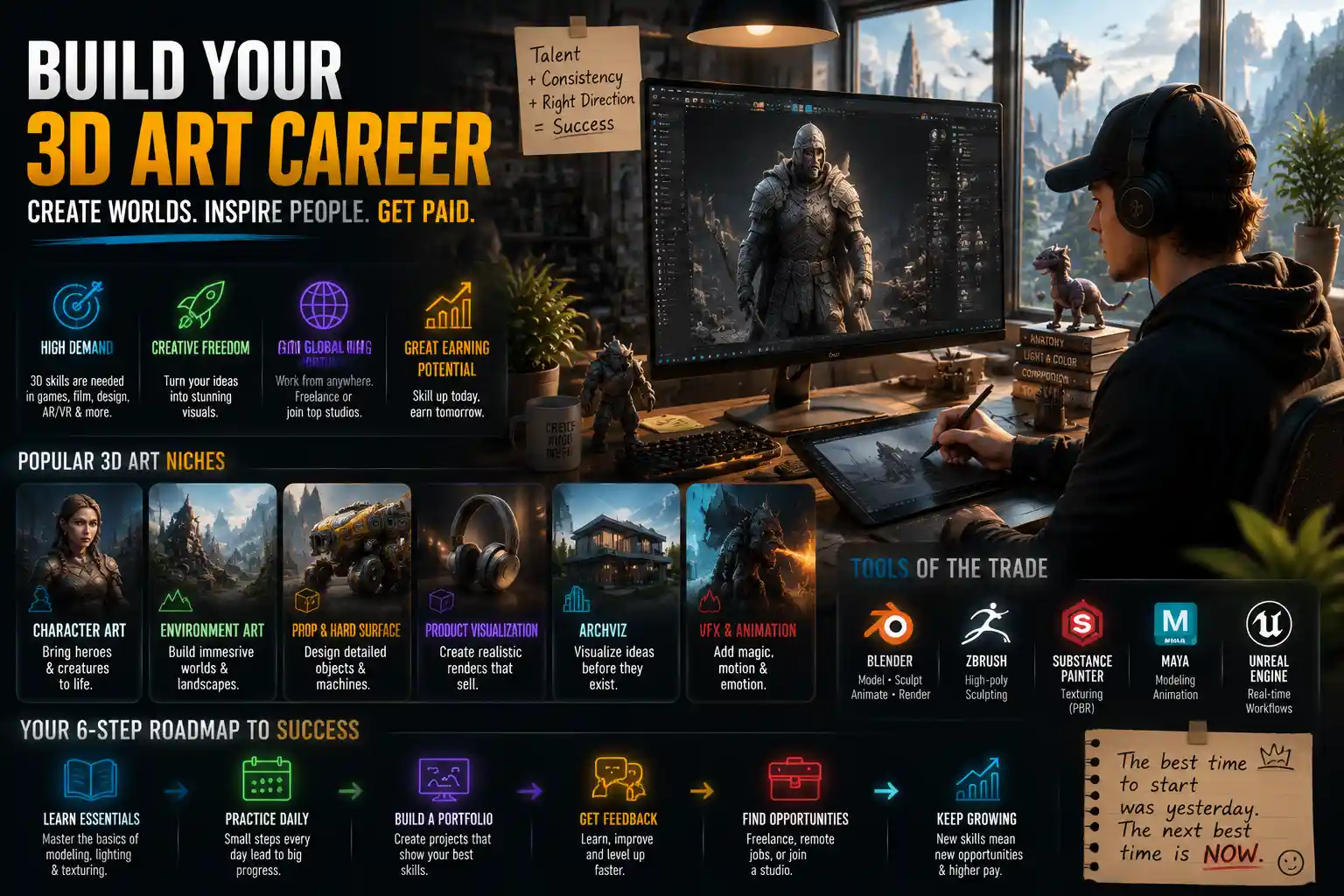
It’s 2024, and 3D art is everywhere: from the blockbuster VFX that bring alien worlds to life, to the hyper-realistic product designs that populate e-commerce stores, to the immersive environments players explore in open-world video games. What was once a niche craft limited to big-budget studios is now accessible to anyone with a decent computer and the drive to learn. But turning a casual hobby into a sustainable, full-time career as a professional 3D artist requires more than just mastering software. It demands intentional skill building, smart workflow habits, a standout portfolio, and a strategic approach to finding work. This guide breaks down everything you need to know to build a successful long-term career in 3D art.
Building a Foundational Skill Set
Many new 3D artists jump straight into learning the latest software, skipping over the core creative fundamentals that separate amateur work from professional output. Software changes all the time – tools that are industry standard today may be obsolete in a decade – but foundational artistic skills are forever. Whether you want to specialize in character modeling, environment design, or motion capture, these core skills will serve you in every niche of the industry.
Core Art Fundamentals
You don’t need a four-year fine arts degree to be a professional 3D artist, but you do need to master the basics that apply to all visual creative work. Traditional drawing and painting experience translates directly to 3D, helping you understand composition, value, and form before you ever touch a 3D mesh. If you can’t draw a convincing cylinder from multiple angles, you’ll struggle to model a realistic bottle or character limb in 3D space.
Anatomy is non-negotiable for character artists, and even environment artists benefit from understanding how natural forms like rocks, trees, and mountains are structured. Perspective, light theory, and color theory help you create believable, immersive scenes that read correctly to the human eye. A common mistake new 3D artists make is relying on software’s auto-render settings to “fix” poor composition or bad lighting, but professionals know that a great render starts with intentional creative choices before any lighting is added.
Software Proficiency: What Do You Actually Need to Learn?
The 3D software landscape can feel overwhelming for new artists, with dozens of paid and free tools competing for attention. The good news is that you don’t need to learn every tool to get a job. Most professional 3D artists specialize in a specific niche, which means you only need to master the tools relevant to that work.
For generalist work and most industry roles, the industry standard tools remain consistent across regions:
- Modeling: Autodesk Maya, Blender, ZBrush, Autodesk 3ds Max
- Texturing: Substance Painter, Substance Designer, Mari
- Rendering: Arnold, V-Ray, Keyshot, Cycles
- Sculpting: ZBrush, Blender
Blender’s explosive growth over the last five years has made it a viable free alternative to paid tools, and many independent studios and even some large companies now hire artists who only know Blender. For new artists on a budget, starting with Blender is a smart choice that doesn’t limit your career options later on. What matters more than which tool you use is how deeply you understand it. Professional employers care more about the quality of your work than your software of choice.
Specialization vs. Generalism
One of the first big decisions you’ll make as a professional 3D artist is whether to specialize in a specific skill or work as a generalist. Generalists can do a little bit of everything: model, texture, rig, animate, and render a full project from start to finish. This is incredibly valuable for small studios, freelance clients, and indie game developers who don’t have the budget to hire a team of specialized artists.
Specialists, on the other hand, focus on one specific area of 3D art, like character modeling, VFX simulation, or architectural visualization. Large studios like Pixar, Ubisoft, or Industrial Light & Magic hire dozens of specialists to work on different parts of a single big-budget project. Specialists often command higher rates for their expertise, but they have fewer options outside of large studio work. For most new artists, starting as a generalist to build a broad skill set, then specializing in an area you enjoy, is the most flexible career path.
Creating a Standout Professional Portfolio
No other factor influences your ability to get hired as a 3D artist more than your portfolio. Employers don’t care about your resume or your degrees nearly as much as they care about what you can create. A great portfolio doesn’t just show off your best work – it’s tailored to the specific roles you want to get, and it demonstrates that you understand the needs of professional clients and studios.
Curate Your Work, Don’t Clutter It
One of the most common mistakes new 3D artists make is adding every piece of work they’ve ever created to their portfolio. A potential hiring manager or client only has a few minutes to look at your work, so including 20 mediocre pieces will distract from your 5 great pieces. As a rule of thumb, your portfolio should only include your best 10-15 pieces of work. If a piece isn’t the type of work you want to get paid to do, cut it.
For example, if you want to work as an architectural visualization artist, your portfolio should be almost entirely made up of finished ArchViz projects. Including your fan art of a video game character isn’t helping you, even if it’s good. Tailoring your portfolio to your target niche shows employers that you already have experience doing the exact work they need.
Show Your Process, Not Just the Final Result
Professional studios don’t just hire artists for their final renders – they hire artists who can solve problems and work efficiently within a production pipeline. Showing your process in your portfolio demonstrates that you understand how 3D art is made in a professional setting, not just as a personal project. For each piece, include wireframes, break down your topology, show early concept sketches, and explain what your role was if you worked on a team project.
A great wireframe shot tells me more about an artist’s skill than any 8K beauty render. I can see immediately if they understand clean topology, efficient UVs, and how to build assets that work in a game or VFX pipeline. That’s the stuff that actually matters for getting the job done.
Showing process is especially important for game artists, where asset efficiency is critical. A 3D character for a real-time game can’t have 10 million polygons – it needs to be optimized to run on consoles or mobile devices. Showing your optimized wireframe and poly count in your portfolio proves that you know how to create assets that fit production requirements.
Where to Host Your Portfolio
For professional 3D artists, your online portfolio is your business card. There are several popular platforms that make it easy to host your work without needing to code your own website:
- ArtStation: The industry standard for 3D artists, especially in games and VFX. It’s built specifically for visual artists, has a built-in job board, and makes it easy for recruiters to find your work.
- Behance: Popular with freelance artists and those working in advertising, product design, and architectural visualization. It’s owned by Adobe and integrates well with other Adobe tools.
- Personal Website: If you want full control over your portfolio, building your own site with tools like Squarespace or Webflow gives you complete customization. This is a great option for freelance artists who want to build their own personal brand.
No matter where you host your portfolio, make sure it’s easy to navigate, loads quickly, and looks good on mobile. Recruiters often browse portfolios on their phones, so a mobile-unfriendly site can cost you a job before anyone even looks at your work.
Mastering Professional Workflows and Collaboration
Once you have the skills and a portfolio that gets you hired, the next step is thriving in a professional production environment. Amateur 3D artists often work on personal projects with no deadlines, no feedback, and no need to fit their work into a larger team pipeline. Professional work is very different: you’ll need to meet tight deadlines, revise your work based on feedback, and collaborate with dozens of other artists and stakeholders. Mastering these soft skills and workflow habits is what turns a good artist into a consistently employed professional.
Version Control and Organization
Nothing kills a professional reputation faster than losing work or turning in messy, unorganized files. Professional 3D pipelines rely on consistent file naming, organized folder structures, and version control to keep large projects on track. If you’re working on a team, everyone needs to be able to find your files, understand what version is the latest, and make changes without overwriting your work.
Even for freelance solo work, good organization saves you hours of time hunting down a lost file or digging through 10 different versions of a model. Start adopting these habits early:
- Use clear, consistent file naming conventions, like projectname_assetname_version01 instead of model_final_final_v2
- Keep all project assets (textures, references, source files) organized in a logical folder structure
- Use version control software like Git or Perforce to track changes and roll back if you make a mistake
- Clean up your meshes, delete unused nodes, and pack textures before sharing files with a client or team
These habits take a little extra time up front, but they prevent catastrophic mistakes that can cost you clients or your job.
Giving and Receiving Feedback
3D art is a collaborative process, and almost all professional work requires multiple rounds of revisions based on feedback from art directors, clients, or other team members. Many new artists take feedback personally, seeing critiques of their work as critiques of them as a person. The best artists learn to separate their ego from their work, and see feedback as a tool to make the project better, not as an attack on their skill.
When receiving feedback, ask clarifying questions to make sure you understand what the other person is actually asking for. A client saying they “don’t like the color” might mean they want it brighter, or they want it to match the company brand guidelines, or they just think it doesn’t fit the mood of the project. Asking follow-up questions saves you from wasting hours revising the wrong thing.
When you’re the one giving feedback (common if you move into a lead or senior artist role), focus on the work, not the artist, and be specific. Saying “this character’s head feels too small for the body, let’s adjust the proportions” is much more helpful than saying “it doesn’t feel right.”
Meeting Deadlines Without Sacrificing Quality
Tight deadlines are a fact of life for almost every professional D artist. Games get pushed back to meet release dates, clients change their scope last minute, and VFX studios have to turn around revisions in days to meet a film’s release schedule. The ability to deliver high-quality work on time, even when the deadline is tight, is one of the most valuable skills you can have as a professional.
The key to managing deadlines is planning your work before you start. Break the project down into small, measurable milestones: block out base mesh, add high-resolution details, texture, light, render. Estimate how long each step will take, and add 20% extra time for unexpected problems – something always goes wrong, whether it’s a computer crash, a last-minute feedback change, or a render that takes twice as long as you expected. Prioritize the most important parts of the project first, so if you do run out of time, you’ve already finished the core work that matters most.
Finding and Growing Your Career
Once you’re ready to start working professionally, there are more career paths open to 3D artists than ever before. You don’t have to move to Los Angeles or Vancouver to work in the film or game industry anymore – many studios are fully remote, and freelance work is available for artists all over the world. Understanding your options and building a professional network will help you find consistent work that fits your lifestyle.
Different Career Paths for 3D Artists
3D art is used in almost every industry today, so you can choose a niche that aligns with your interests. The most common professional career paths include:
- Video Games: Create characters, environments, weapons, and props for AAA or indie game studios. This is one of the largest employers of 3D artists, with roles available for almost every specialization.
- Film and VFX: Build assets, create environments, or simulate effects like water, smoke, or explosions for feature films, TV shows, and commercials. This industry often requires very high-detail output and tight collaboration with large teams.
- Architectural Visualization (ArchViz): Create realistic renderings of buildings and interiors for architects, real estate developers, and construction companies. This is a steady niche with lots of freelance and full-time opportunities.
- Product Design and Manufacturing: Create 3D models of consumer products, from furniture to cars to electronics, for prototyping, marketing, and manufacturing. This often requires a focus on accuracy and technical precision.
- Freelance Independent Work: Work with multiple clients on a project basis, from small businesses needing product renderings to content creators needing 3D assets. Freelancing gives you flexibility, but it requires you to manage your own business and find your own clients.
Building Your Professional Network
Most 3D art jobs aren’t advertised publicly – they’re filled through referrals from people in your network. That means building relationships with other artists and industry professionals is one of the most effective ways to find new opportunities. Even if you’re an introvert, networking doesn’t have to mean going to big industry events and handing out business cards. It can be as simple as sharing your work on ArtStation, joining online communities for 3D artists, giving constructive feedback on other artists’ work, and connecting with people who work in roles you want.
Attending industry events like GDC (Game Developers Conference), Siggraph, or local meetups is a great way to meet people in person, but even online communities like Discord, Reddit’s r/3Dmodeling, or ArtStation forums can help you build relationships. Remember that networking is a two-way street: don’t just ask people for jobs, offer to help other artists when you can, share their work, and contribute to the community. People are much more likely to refer you for a job if they know you and respect your work.
Negotiating Rates and Salaries
One of the most confusing parts of starting a professional career is understanding how much you should be paid. Salaries vary a lot by niche, location, and experience, but there are some general guidelines: full-time entry-level 3D artists in the US earn between $50,000 and $75,000 per year, while mid-level artists earn $75,000 to $100,000, and senior artists or leads can earn $100,000 to $150,000 or more at large studios. Freelance artists typically charge between $50 and $150 per hour, depending on their experience and niche, with product and ArchViz freelancers often commanding higher rates than generalists.
Don’t undersell yourself when you’re starting out. Many new artists take low-paying or unpaid work just to get experience, and while that can be okay for your first couple of projects, don’t make a habit of it. Unpaid work devalues the entire industry, and clients who don’t want to pay you for your time are rarely good to work with. Do your research on industry rates for your location and niche, and don’t be afraid to negotiate – most employers expect a little bit of negotiation, and asking for fair pay shows that you value your work.
Continuing Education and Career Growth
The 3D industry changes faster than almost any other creative field. New software, new tools, and new techniques are released every year, and artists who stop learning quickly fall behind. Even once you have a full-time job, you need to dedicate time to learning new skills and staying up to date with industry trends. That doesn’t mean you have to learn every new piece of software that comes out, but it does mean dedicating a few hours a week to personal projects, learning new techniques, and experimenting with new tools.
Many professional artists do a “personal project month” every year, where they work on a piece outside of their day job to experiment with a new style or tool. This not only keeps your skills sharp, it also gives you new work to add to your portfolio, which can lead to better opportunities down the line. As you gain experience, you can move into senior artist, lead, or art director roles, which come with higher pay and more creative responsibility, or you can strike out on your own as a full-time freelance artist if that’s what you prefer.
Conclusion
Becoming a professional 3D artist is a journey that takes time, practice, and intentional effort. It’s not something you can achieve in a few months, but it’s an incredibly rewarding career for people who love creating, problem-solving, and bringing new ideas to life. Start by building your foundational skills, create a portfolio that shows off your best work tailored to your niche, master the workflow and collaboration skills that make you reliable to work with, and build the network that will help you find consistent opportunities.
The 3D industry is growing faster than ever, with more demand for skilled artists than there were 10 or even 5 years ago. Whether you want to work on the next blockbuster video game, create realistic architectural renderings, or build your own freelance business working with clients you love, there’s never been a better time to build a career as a professional 3D artist. With patience, persistence, and the right approach, you can turn your passion for 3D art into a sustainable, fulfilling career.