
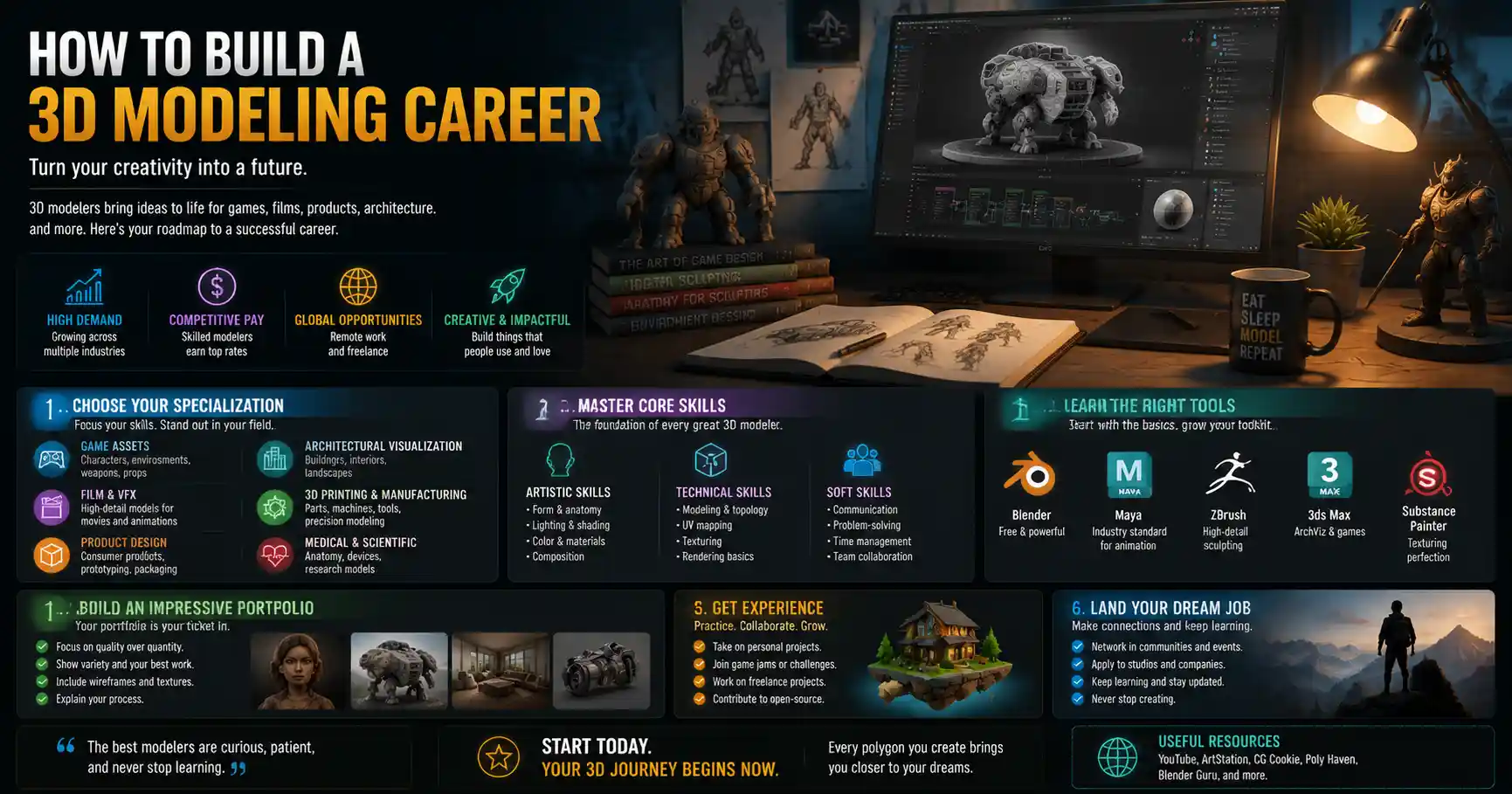
Imagine turning a creative idea that only existed in your head into a detailed, tangible digital object that can be 3D printed, animated in a Hollywood film, sold as a virtual asset in a video game, or used to build a prototype of a life-saving medical device. That’s the daily reality for 3D modelers, professionals who combine artistic creativity with technical precision to shape the digital world around us. Over the past decade, demand for skilled 3D modelers has exploded across nearly every industry, from entertainment and gaming to manufacturing, architecture, and healthcare. If you’ve ever wondered how to turn a love of art and technology into a stable, high-paying creative career, this guide will walk you through every step of building a successful 3D modeling career.
What Does a 3D Modeler Do?
At its core, 3D modeling is the process of creating a mathematical representation of a three-dimensional object or surface using specialized software. 3D modelers build digital frameworks for objects, characters, environments, and products, which are then used for everything from visual effects to 3D printing. Unlike 2D art, which exists on a flat plane, 3D models can be rotated, scaled, modified, and viewed from any angle, making them incredibly versatile across industries.
While the general public often associates 3D modeling only with video games and movies, the reality is that 3D modelers work in nearly every sector of the global economy. A 3D modeler’s day-to-day work depends heavily on their industry specialization, but common tasks include creating asset models from reference sketches or photos, refining geometry to reduce polygon count for real-time applications, adding textures and materials to achieve a desired look, collaborating with animators, engineers, or designers, and iterating on designs based on client feedback.
Common Specializations for 3D Modelers
Most 3D modelers choose a specialization early in their career to build deep expertise and command higher rates. Some of the most in-demand specializations today include:
- Game Asset Modeling: Creates characters, environments, weapons, and props for video games. Modelers in this space need to optimize assets for real-time performance, keeping polygon counts low without sacrificing visual quality.
- Film and VFX Modeling: Builds detailed models for feature films, television shows, and commercials. This often involves ultra-high-resolution models that can be slowed down and rendered for final shots, so detail is prioritized over performance.
- Product Modeling for Manufacturing: Creates precise, dimensionally accurate models of consumer products, industrial parts, and machinery for prototyping and production. These models are often used directly for 3D printing or CNC machining, so accuracy is non-negotiable.
- Architectural Visualization (ArchViz): Builds 3D models of buildings, interiors, and landscapes to create realistic renderings for real estate developers, architects, and construction companies. Modelers in this space need to understand building codes, materials, and scale to create accurate representations of unbuilt structures.
- Medical and Scientific Modeling: Creates models of organs, biological systems, or scientific equipment for medical training, pharmaceutical research, and patient education. This often requires working with scan data from MRI or CT machines to create accurate anatomical models.
Other growing specializations include 3D modeling for virtual reality (VR) and augmented reality (AR), jewelry design, and even creating digital assets for the metaverse and NFT collections.
Core Skills You Need to Succeed
Becoming a successful 3D modeler requires a mix of artistic, technical, and soft skills. Unlike many traditional creative careers, you don’t need a formal degree to land a job, but you do need to master a core set of competencies to stand out to employers.
Artistic Fundamentals
Even if you’re modeling industrial parts rather than cartoon characters, a strong foundation in artistic principles will set you apart from amateur modelers. Key artistic skills include:
- Understanding of form, anatomy, and perspective to create objects that look natural and proportional
- Knowledge of light, shadow, and texture to make models look realistic or stylized, depending on the project requirements
- Color theory to match reference materials and achieve the desired mood or aesthetic
- Composition skills to arrange assets within a scene for visual impact, especially for ArchViz or marketing renderings
For example, a character modeler who understands human anatomy will be able to create a realistic walking character that deforms correctly when animated, while a modeler without anatomical training will end up with stiff, unnatural proportions that break immersion for the audience.
Technical Software Skills
3D modelers rely on a range of software tools to create their work, and the specific tools you need to learn depend on your chosen specialization. Some of the most widely used industry tools include:
- Autodesk Maya: The industry standard for character modeling and animation in film and games
- Blender: A free, open-source tool that has become incredibly popular for indie developers and hobbyists, and is increasingly used in professional studios
- ZBrush: The go-to tool for high-resolution sculpting of characters and detailed organic models
- Autodesk 3ds Max: Commonly used for ArchViz and hard-surface modeling for games
- SolidWorks: The standard for product and industrial modeling for manufacturing
- Substance Painter/Designer: Used for creating and applying textures to 3D models
You don’t need to master every tool on this list to get started. Most employers care more about the quality of your work than which specific software you used to create it, but learning the tools common in your target industry will make it easier to land your first job. It’s also worth noting that Blender’s growing popularity has lowered the barrier to entry for new modelers, since you can learn and practice professionally without paying hundreds of dollars in software subscription fees.
Soft Skills for Career Growth
Beyond artistic and technical skills, soft skills are critical for building a long-term successful 3D modeling career. Most 3D modeling work is done in cross-functional teams, so communication skills are non-negotiable. You’ll need to be able to understand client feedback, explain technical constraints to non-technical stakeholders, and collaborate effectively with animators, designers, and project managers. Time management and the ability to meet tight deadlines are also essential, especially in industries like games and film where production schedules are rigid. Finally, problem-solving skills are key: you’ll often be asked to create a model within specific technical constraints (like a maximum polygon count for a game asset) and will need to find creative ways to deliver high-quality work within those limits.
“The best 3D modelers aren’t just people who can push polygons around – they’re problem solvers who understand how their work fits into the bigger picture. A model that looks amazing in a viewport but breaks when an animator tries to move it is useless. The people who succeed are the ones who think beyond their own task.”
How to Get Started: Education and Building Your Portfolio
One of the biggest advantages of a 3D modeling career is that there’s no single “right” path to get started. Unlike careers like law or medicine that require a specific degree, you can break into 3D modeling with self-study, a vocational certification, a traditional art degree, or a combination of all three. The most important thing you’ll need to land a job is a strong portfolio that demonstrates your skills – far more than any diploma on your wall.
Education Pathways
There are four main education pathways for aspiring 3D modelers, each with its own advantages and drawbacks:
- Self-Study: With thousands of high-quality free or low-cost tutorials available on platforms like YouTube, Udemy, and Skillshare, many successful 3D modelers have taught themselves the skills they need. This pathway is the most affordable and flexible, but it requires a lot of self-discipline to stay on track and build a consistent body of work.
- Vocational/Trade Programs: Community colleges and private vocational schools offer 1-2 year programs focused specifically on 3D modeling and digital art. These programs are often more affordable than four-year degrees and are focused on teaching practical, job-ready skills, rather than general education requirements.
- Bachelor’s Degree in Fine Arts or Digital Media: Many 3D modelers earn a four-year degree in digital art, animation, or fine arts from a college or university. This pathway gives you access to mentorship from industry professionals, networking opportunities, and a structured learning environment. It’s also often preferred by large studios that require a degree for entry-level roles, though that requirement is becoming less common as more companies prioritize portfolio work over credentials.
- Bootcamps: Intensive 3-6 month bootcamps focused on 3D modeling and game art have become popular in recent years. These programs are designed to take you from beginner to job-ready in a short period of time, and many offer career placement support after graduation. They are more expensive than self-study but cheaper and faster than a four-year degree.
No matter which pathway you choose, the goal should be to build a consistent body of work that you can show to potential employers. Even if you’re in a degree program, you should be working on personal projects outside of class to fill out your portfolio.
Building a Standout Portfolio
Your portfolio is the most important asset you have as a 3D modeler. Employers don’t care where you learned to model – they just want to see that you can do the work they need. Here are practical tips for building a portfolio that gets noticed:
- Tailor your portfolio to your target specialization: If you want to work in ArchViz, don’t fill your portfolio with cartoon character models. Focus on showing the type of work you want to be hired to do.
- Include only your best work: It’s better to have 5 high-quality, finished projects than 20 half-finished or amateur pieces. Remove any work that doesn’t represent the level you want to work at.
- Show your process: Employers love to see how you work. Include wireframes, reference images, and work-in-progress shots alongside your final renders to show that you understand modeling fundamentals and can iterate on your work.
- Host your portfolio online: Use a platform like ArtStation, Behance, or your own personal website to host your work. Make it easy for potential employers to download your work and contact you – avoid requiring visitors to create an account to see your portfolio.
- Do personal projects that demonstrate your skills: If you don’t have any professional client work, create original personal projects that show off what you can do. For example, a game modeler might create a full set of fantasy weapons optimized for real-time use, while an ArchViz modeler might recreate a famous building to show off their attention to detail.
Many new modelers also participate in 3D modeling challenges like the weekly Blender Guru challenges or monthly Sculpt January events to build their skills and add new work to their portfolio. These challenges also help you connect with other modelers and get feedback on your work.
Job Outlook, Salary, and Work Environments
3D modeling is a growing field with strong demand across multiple industries, making it a stable choice for creative professionals. According to the U.S. Bureau of Labor Statistics, employment for special effects artists and animators (which includes most 3D modelers in entertainment) is projected to grow 16% through 2032, much faster than the average for all occupations. Demand is even faster in manufacturing and healthcare, where 3D modeling is increasingly used for product development and medical research.
Salary Ranges by Experience and Specialization
Salaries for 3D modelers vary widely based on experience, location, industry, and whether you work full-time for a company or as a freelance modeler. According to data from Glassdoor, Payscale, and industry surveys from 2024, here’s what you can expect to earn:
- Entry-level (0-2 years experience): $40,000 – $65,000 per year for full-time roles in North America and Western Europe. Freelance entry-level modelers typically earn $20 – $50 per hour, depending on their client base.
- Mid-level (3-8 years experience): $65,000 – $95,000 per year for full-time roles. Experienced freelancers can earn $50 – $150 per hour, depending on their specialization and client list.
- Senior/lead modeler (8+ years experience): $90,000 – $150,000+ per year for full-time roles at major studios or manufacturing companies. Top freelance modelers working with luxury brands or major game studios can earn well over $200,000 per year.
Certain specializations command higher salaries than others. For example, 3D modelers working in automotive manufacturing or medical device development typically earn more than those working in freelance content creation, while senior modelers at AAA game studios or major VFX houses can earn six-figure salaries early in their careers.
Common Work Environments
3D modelers have a lot of flexibility when it comes to where they work. The most common work environments include:
In-house full-time roles: Many 3D modelers work full-time for a single company, like a game studio, architectural firm, manufacturing company, or VFX studio. Full-time roles typically come with a steady salary, benefits, health insurance, and opportunities for advancement. Large studios are often based in major entertainment hubs like Los Angeles, Vancouver, London, or Montreal, but remote full-time roles have become much more common after the pandemic, so you don’t have to relocate to a major city to work for a big company.
Freelance self-employment: A large number of 3D modelers choose to work freelance, taking on projects from multiple clients instead of working for one employer. Freelancing gives you more flexibility to choose your projects and set your own schedule, but it also requires you to handle client acquisition, invoicing, taxes, and benefits on your own. Many freelance modelers build a stable income by working with repeat clients, selling pre-made 3D assets on marketplaces like TurboSquid or CGTrader, or taking on long-term contract work with studios.
Independent content creation: A growing number of 3D modelers build their own brand by creating tutorials, selling assets, or offering online courses to other aspiring 3D modelers. Some modelers also create 3D printable models and sell them on platforms like Etsy or MyMiniFactory, earning passive income from their work. This pathway requires a lot of marketing and business skills, but it can give you full control over your career and income.
How to Advance Your 3D Modeling Career
Once you land your first job or start getting consistent freelance work, there are several strategies you can use to advance your career, increase your income, and open up new opportunities.
First, specialize in a niche to stand out from the competition. The 3D modeling market is flooded with generalist modelers who can do basic work, but experts who focus on a high-demand niche can command much higher rates. For example, instead of being a general product modeler, you could specialize in 3D modeling of medical devices for pharmaceutical companies, or specialize in creating 3D models of historic buildings for preservation projects. Niche expertise makes you more valuable to clients and helps you charge more for your work.
Second, stay up to date with new tools and industry trends. The 3D modeling industry changes fast, with new software updates, new rendering techniques, and new demand for assets in emerging fields like AR, VR, and AI-generated content. Make time every month to learn new skills and experiment with new tools. For example, generative AI tools are changing the way many 3D modelers work, allowing them to create base models much faster than before. Modelers who learn to integrate AI into their workflow can be more productive and take on more work, while those who resist new tools risk being left behind.
Third, build your professional network. Many of the best 3D modeling jobs are never advertised publicly – they’re filled through referrals from people in your network. Join online communities like ArtStation, the Blender Artists forum, or industry-specific Discord servers to connect with other modelers and potential clients. Attend industry events like SIGGRAPH, GDC (Game Developers Conference), or local meetups to meet people in person and build relationships. Even small acts like sharing your work online and giving feedback on other people’s work can help you build a network that opens up new opportunities.
Finally, don’t be afraid to branch out into related fields to grow your income. Many 3D modelers move into related roles like art direction, product design, 3D printing business ownership, or teaching as they gain experience. These roles often pay more and give you more leadership opportunities, while still leveraging your core 3D modeling skills.
Conclusion
A career in 3D modeling offers the best of both worlds: it’s a creative career that lets you turn your ideas into tangible work, and it’s a stable, high-demand field with plenty of opportunities for growth. Whether you want to work on the next blockbuster video game, help build life-saving medical devices, or work for yourself as a freelance creator, 3D modeling can be an incredibly rewarding career path. The key to success is starting small, building your skills, focusing on creating a strong portfolio that shows off what you can do, and staying curious as the industry evolves. With dedication and practice, anyone with a love for art and technology can build a successful career as a 3D modeler.