
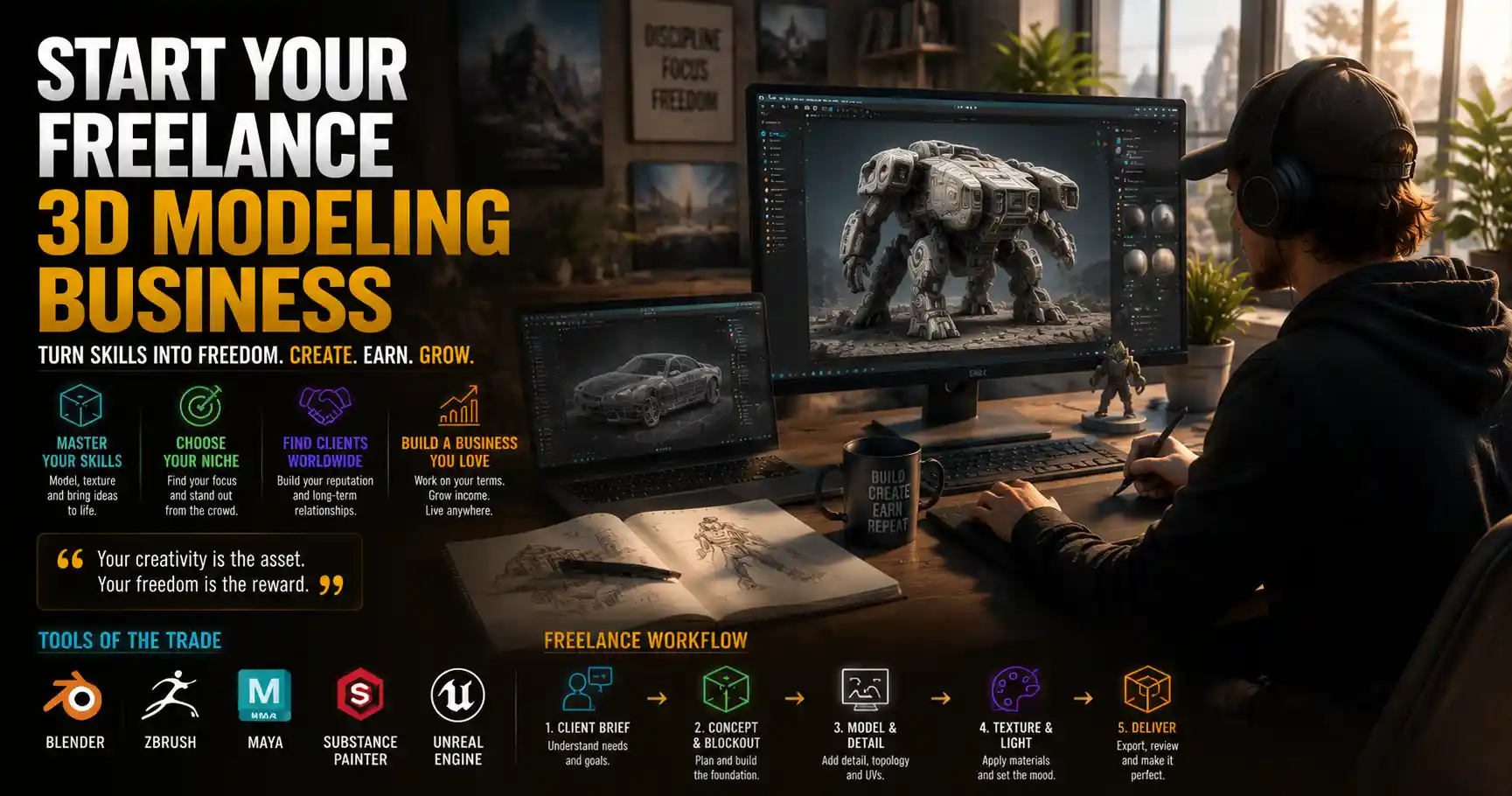
Freelance 3D modeling has grown from a niche creative hobby to a high-demand, well-paying career path, with opportunities spanning video games, film and television, product design, architecture, 3D printing, and even virtual reality. As brands and creators increasingly rely on immersive digital content, skilled 3D modelers can build flexible, sustainable businesses working with clients across the globe from anywhere with an internet connection. Whether you’re a recent design graduate looking to go independent, a traditional 2D artist wanting to expand your skills, or a professional looking to leave your 9-to-5 for more autonomy, this guide will walk you through every step of building a successful freelance 3D modeling business.
Getting Started: Skills and Tools You Need to Launch
Before you can start booking clients, you need to build a solid foundation of technical skills and select the right tools for your niche. Unlike many creative fields, 3D modeling requires both artistic vision and technical precision—you need to understand form, texture, lighting, and how your model will be used in its final context to deliver a usable end product.
Core Skills Every Freelance 3D Modeler Needs
At a minimum, you’ll need to master three core skill areas to succeed as a freelance 3D modeler. First, fundamental modeling techniques include polygonal modeling, NURBS modeling, sculpting, and retopology. Depending on your niche, you may also need to learn procedural modeling for generating repeatable assets like building materials or landscape elements. Second, texturing, shading, and lighting turn a basic mesh into a realistic or stylized finished asset. Even the best topology falls flat without proper UV unwrapping, PBR (physically based rendering) texturing, and lighting that matches the project’s end use. Third, problem-solving and communication are just as important as technical skill. Clients often come to you with vague ideas, and you’ll need to translate their vision into technical specifications, adjust to feedback, and fix issues that arise during integration into games, animations, or 3D prints.
Choosing the Right Software for Your Budget
One of the biggest advantages of 3D modeling today is that you don’t need to invest thousands of dollars in software to get started. There are professional-grade options for every budget:
- Free and open-source options: Blender is the gold standard for free 3D modeling, with a huge community, constant updates, and full functionality for everything from character sculpting to architectural visualization. It’s used by small studios and even major feature films (like the Oscar-nominated Spider-Man: Across the Spider-Verse) so it’s more than capable of professional work. Other free options include SketchUp Free for basic architectural modeling and Wings 3D for polygonal modeling.
- Subscription-based professional tools: Autodesk Maya and 3ds Max are industry standards for film and game development, with monthly subscriptions starting around $20 for individual creators. ZBrush is the go-to for high-poly character sculpting, with a one-time purchase option for permanent licenses that’s more affordable than many subscriptions. Substance Painter and Designer are industry standards for PBR texturing, with reasonably priced individual subscriptions.
- Niche tools: For product design and 3D printing, SolidWorks and Fusion 360 are leading options, with Fusion 360 offering a free license for hobbyists and small businesses. For architectural visualization, SketchUp Pro and Rhino are widely used for their precision and integration with rendering tools like V-Ray.
When starting out, Blender is almost always the best choice. It can handle every type of 3D modeling you’ll need as a new freelancer, and mastering it will make it easy to transition to other tools later if a client requires it. Many new freelancers make the mistake of buying multiple expensive subscriptions before they have consistent income, which eats into your early profits unnecessarily.
Finding Your Niche to Stand Out From the Competition
The freelance 3D modeling market is huge, and trying to be everything to every client will leave you competing on price with thousands of generalist modelers. Finding a specific niche allows you to charge higher rates, build expertise, and attract clients who are actively looking for your specific skill set.
Popular Niche Options for Freelance 3D Modelers
There are dozens of profitable niches in freelance 3D modeling, but these are some of the most in-demand for new freelancers:
- Video game assets: Independent game developers are constantly looking for modular environment assets, character models, weapons, and props. This niche is great for freelancers who enjoy creative worldbuilding and understand the requirements of real-time rendering (like poly count limits and optimized UVs).
- Product visualization and 3D printing: E-commerce brands use 3D product models for marketing, AR previews, and prototyping. 3D printing designers create models for everything from custom figurines to replacement parts for home goods. This niche often has steady, repeat work from small businesses looking to update their product lines.
- Architectural visualization: Architecture firms and real estate developers use 3D renderings and walkthroughs to sell projects before they’re built. This niche requires a strong understanding of perspective, materials, and lighting to create realistic representations of physical spaces.
- Character modeling for animation and VFX: This is one of the most competitive but highest-paying niches, working on feature films, animated series, and commercials. It requires advanced skills in topology, rigging, and facial scanning to create characters that can be animated realistically.
- AR/VR and metaverse assets: Brands are creating virtual experiences for marketing and events, and they need 3D models optimized for real-time virtual environments. This is a fast-growing niche with plenty of opportunities for new freelancers who can adapt to new technology.
When choosing a niche, consider both what you enjoy and what the market demands. If you love playing video games and have experience modding games, game assets are a natural fit. If you have a background in industrial design, product visualization or 3D printing will play to your existing strengths. You can always adjust your niche as you gain experience, but starting with a clear focus will help you build your portfolio faster.
How to Position Yourself in Your Niche
Once you’ve chosen a niche, position yourself as an expert by leaning into the specific requirements of that field. For example, if you specialize in 3D models for 3D printing, you should highlight that you understand wall thickness, tolerances, and support structure requirements—things that generalist 3D modelers often overlook. If you specialize in game assets, you should know the common pipelines for Unity and Unreal Engine, and be able to deliver models that are ready to drop into a game engine without extra work. This level of specialized knowledge is what clients will pay a premium for, even if you’re a newer freelancer.
Building a Portfolio That Wins High-Paying Clients
Your portfolio is the most important asset you have as a freelance 3D modeler. Clients don’t care as much about your education or how many years you’ve been working as they care about whether you can deliver the quality of work they need. A strong portfolio that showcases your best work in your niche will win you more clients than any resume ever could.
What to Include (and What to Leave Out)
When building your portfolio, quality always beats quantity. It’s better to have 5-10 outstanding projects that are relevant to your niche than 50 generic projects that don’t show your specific skills. For each project, include:
- High-quality renderings from multiple angles, showing detail and texture work
- Context that explains what the model was for (e.g., “low-poly tree asset for a mobile open-world game, optimized for 12,000 triangles”)
- Wireframe shots to show your topology and modeling technique—this is a critical detail that many new freelancers leave out, and it helps clients see that you understand technical best practices
- Client testimonials if you’ve done work for paid clients before
If you’re just starting out and don’t have any paid client work, you can create spec projects to showcase your skills. For example, if you want to do game assets, recreate a set of 10 medieval environment assets in the style of your favorite open-world game. If you want to do product visualization, create 3D models of 5 popular consumer products that match the style brands use for e-commerce. Spec work demonstrates your skills just as well as paid work when you’re just starting out.
Leave out any work that isn’t relevant to your niche. If you’re focusing on architectural visualization, your student character sculpting project doesn’t need to be in your main portfolio—you can keep it in a “personal work” section if you want, but it won’t help you attract the clients you want.
Where to Host Your Portfolio
There are dozens of platforms to host your portfolio, and you don’t need to pay for an expensive website right away. Popular options include:
- ArtStation: The industry standard for 3D modelers to showcase their work, with a large built-in audience of clients and recruiters. It’s free to start, and paid plans are reasonably priced for growing freelancers.
- Behance: Owned by Adobe, Behance is another popular platform that gets a lot of traffic from clients looking for creative professionals. It’s great for showcasing larger projects like architectural visualizations or full character packs.
- Personal website: Once you start getting consistent work, a personal website gives you full control over your brand and allows you to add testimonials, a contact form, and a blog to attract clients through search. Platforms like Squarespace and Webflow make it easy to build a beautiful portfolio website without any coding.
No matter where you host your portfolio, make sure it’s easy to navigate and loads quickly. Large 3D renderings can slow down your site, so compress your images to keep load times under a few seconds. Clients won’t wait around for your portfolio to load, and a slow site makes you look unprofessional.
Your portfolio isn’t a collection of everything you’ve ever made—it’s a sales tool that should answer one question for a potential client: “Can this person solve my problem?”
Pricing Your Services and Finding Consistent Work
One of the biggest mistakes new freelance 3D modelers make is underpricing their work to compete with low-cost platforms like Fiverr. The good news is that there is no shortage of high-paying work for skilled modelers—you just need to price your services correctly and know where to find the right clients.
How to Price Your 3D Modeling Services
There are three common pricing models for freelance 3D modeling, and each works best for different types of projects:
- Per-project pricing: This is the most common model, where you quote a fixed price for the entire project based on the client’s requirements. For example, you might charge $500 for a single high-poly character model, or $2,000 for a full set of 10 modular game assets. This is great for both you and the client, because the client knows what their total cost will be upfront, and you don’t have to track hours for small projects.
- Hourly pricing: Hourly pricing works well for long-term ongoing projects, like monthly asset creation for a game studio that needs consistent work. Typical hourly rates for freelance 3D modelers range from $30-$50 per hour for new freelancers, up to $100+ per hour for experienced modelers with specialized skills.
- Passive income with asset packs: Many 3D modelers build passive income by creating reusable asset packs (like a set of 50 kitchen props for game developers) and selling them on marketplaces like TurboSquid, Unity Asset Store, or CGTrader. This doesn’t require ongoing work once you create the assets, and it can provide a steady base income while you look for custom client projects.
When setting your prices, factor in not just the time you spend modeling, but also the time you spend communicating with clients, revising work, handling administrative tasks, and paying taxes. A common rule of thumb is to add 20-30% to your initial quote to account for revisions and unexpected scope changes. It’s also a standard practice to ask for 50% of the payment upfront before you start work, which protects you from non-payment and covers your initial costs.
Where to Find Consistent Freelance Work
There are dozens of places to find freelance 3D modeling work, but some are far better than others for building a sustainable business. Here are the most effective channels:
- Freelance job boards: General job boards like Upwork and Toptal have a constant stream of 3D modeling jobs, and niche job boards like We Work Remotely and Game Dev Jobs often post roles for freelance 3D modelers. Upwork can be competitive when you’re starting out, but it’s a good place to get your first few clients and build testimonials.
- Creative marketplaces: ArtStation, ArtFinder, and CGMarketplace allow clients to find you directly based on your niche and skills. Many freelancers get consistent inquiries from clients who find their portfolio on ArtStation.
- Cold outreach to potential clients: This is one of the most underused but effective ways to get high-paying work. Make a list of companies that need 3D modeling work—for example, if you’re a product visualization specialist, make a list of 20 e-commerce brands that sell physical products and have poor product photos on their website. Send them a short, polite email introducing yourself and explaining how high-quality 3D product renderings can help them increase sales. Most won’t reply, but even one reply can turn into a high-paying long-term client.
- Networking: Join communities for your niche—for example, Reddit’s r/3Dmodeling, Discord servers for indie game developers, or local design meetups. Many clients prefer to hire freelancers through referrals, so building relationships with other creators and business owners can lead to consistent work.
Consistency is key when you’re starting out. Even if you only apply to 2-3 jobs a week, or reach out to 5 potential clients a month, that adds up over time. Most new freelancers give up too early before they start getting consistent clients.
Managing Client Relationships and Scope Creep
One of the biggest challenges new freelancers face is scope creep—when a client keeps asking for more changes and additions that weren’t in the original project brief. The best way to avoid scope creep is to be clear about your process from the start. Put everything in writing: what is included in the price, how many rounds of revisions are included, and how much extra revisions or additional work will cost. For example, you might include 2 rounds of minor revisions in your original quote, and charge $50 per hour for any additional changes beyond that. This sets clear expectations and prevents you from doing extra work for free, which eats into your profits and wastes time that could be spent on other projects.
Scaling Your Freelance Business Long-Term
Once you start getting consistent clients and have a steady stream of income, you can scale your business to increase your earnings and reduce your workload. There are several common strategies for scaling a freelance 3D modeling business:
Passive income streams: As we mentioned earlier, selling pre-made asset packs is a great way to add passive income to your business. Once you create the asset pack, you can sell it hundreds or thousands of times without any additional work. Many freelancers find that passive income ends up being more than their custom client work after a few years.
Raise your rates regularly: As you gain more experience and improve your skills, you should raise your rates every 6-12 months. This not only increases your income, but it also filters out lower-paying clients that take up too much of your time, allowing you to take on fewer higher-paying clients for the same or more income.
Hire other freelancers: Once you have more work than you can handle, you can hire other freelance 3D modelers to help you complete projects, and take a cut of the project fee. This turns you into a project manager, and allows you to take on larger projects than you could handle alone, increasing your overall income without doing all the modeling work yourself.
Specialize further: As you gain experience, you can specialize even further to stand out. For example, instead of just doing product visualization, you could specialize in 3D product models for sustainable outdoor gear brands. This allows you to charge even higher rates, because you’re the go-to expert for that specific type of work.
Conclusion
Building a successful freelance 3D modeling business takes time, practice, and consistent effort, but it’s one of the most rewarding creative careers available today. You get to work on interesting projects with clients across the globe, set your own schedule, and build a business that fits your lifestyle. The key steps are simple: master your core skills, choose a niche that aligns with your interests and market demand, build a portfolio that showcases your expertise, price your work fairly, and consistently put yourself in front of potential clients. As you gain experience, you can scale your business to increase your income and create more flexibility for yourself. Whether you want to work part-time for extra income or build a full-time six-figure business, freelance 3D modeling offers opportunities for anyone willing to put in the work to develop their skills and market themselves effectively.