
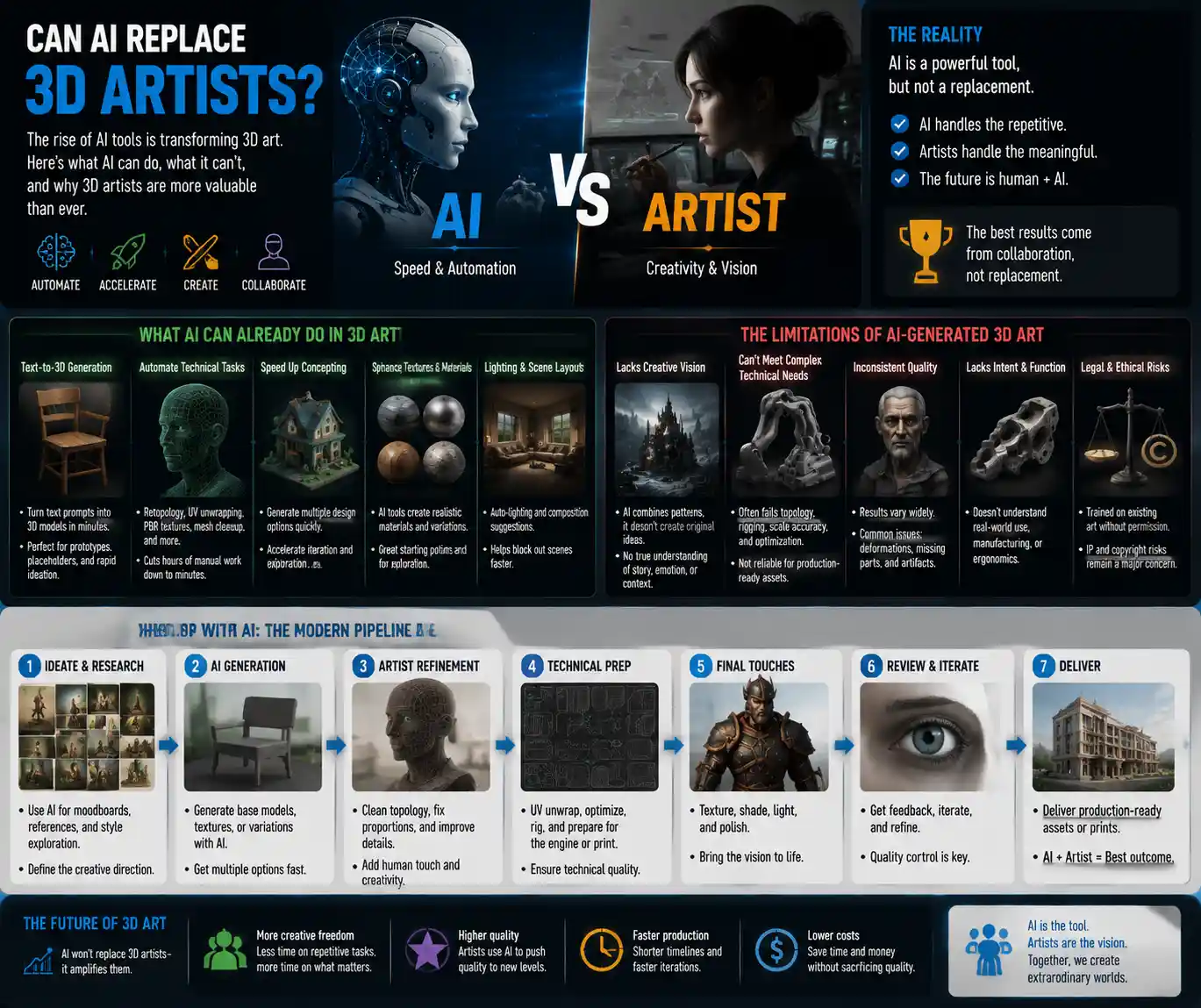
When a freelance 3D artist opens their email one morning and sees a client request that begins “Can you fix this AI-generated 3D render I got for $5?” they’re not alone. Over the past three years, generative AI tools for 3D design—from instant text-to-3D mesh generators to AI-powered texture mapping and automated scene layout—have exploded in popularity, dropping the cost of basic 3D assets from hundreds of dollars to just a few dollars, or even free. For studios and independent creators alike, this shift has sparked a pressing question: can AI actually replace 3D artists entirely, or is it just another tool to make their work easier? The answer isn’t a simple yes or no—it depends on understanding what AI can do, what it can’t, and how the role of 3D art is already evolving alongside new technology.
What AI Can Already Do in 3D Art
To answer whether AI can replace 3D artists, we first need to ground the conversation in the capabilities of current generative AI tools for 3D work, not hypothetical future technology. As of 2024, AI has already automated and streamlined a huge range of routine 3D tasks that once took artists hours or days to complete.
Generating basic 3D assets from text prompts
The most visible use of AI in 3D is text-to-3D generation. Tools like Luma AI, 3DFY.ai, and Tripo AI can turn a simple text description—for example, “a worn wooden coffee table with scuff marks”—into a fully textured 3D mesh in minutes. For hobbyists, indie game developers working on prototype projects, or marketing teams needing simple placeholder assets, this is a game-changer. Where a studio might once have paid a 3D artist $200–$500 for a single basic prop, AI can generate a usable version in less than 10 minutes for a fraction of the cost.
Automating repetitive technical tasks
Much of a 3D artist’s early work on any project is technical grunt work that doesn’t require much creative input, and AI has already mastered most of these tasks. These include:
- Retopologizing high-poly meshes to create clean, game-ready low-poly versions
- Unwrapping UVs for texture mapping
- Generating PBR (physically based rendering) textures from 2D references or scratch
- Cleaning up scanned 3D models to remove noise and missing geometry
- Lighting basic scenes to achieve consistent, natural-looking results
For example, before AI, retopologizing a complex character model could take an experienced artist a full day of work. Today, AI tools can do it automatically in minutes, with only minor manual adjustments needed in most cases. This alone cuts down project timelines significantly and frees up artists to focus on work that requires creative input.
Accelerating concepting and iteration
One of the most valuable uses of AI in professional 3D pipelines is speeding up the concept phase. When a studio is exploring multiple design directions for a game character, product, or architectural visualization, AI can generate 10 different iterations of a concept in the time it would take an artist to complete one. This lets clients and creative leads narrow down their preferences faster, reducing the number of costly revisions later in the process. Even big-budget studios like Pixar and DreamWorks now use AI to speed up concept iteration for background assets and environment design.
The Limitations of AI-Generated 3D Art
For all its progress, current AI has significant gaps that prevent it from replacing skilled 3D artists for most professional projects. These limitations aren’t just temporary growing pains—many stem from how generative AI works, and they’re unlikely to be fully solved in the next decade.
AI lacks creative vision and contextual understanding
Generative AI models create output by learning patterns from millions of existing 3D assets scraped from the internet. They can combine existing patterns, but they can’t develop an original creative vision aligned with a specific project’s goals. For example, if you’re creating 3D assets for a horror game set in an abandoned 1980s shopping mall, AI can generate generic “abandoned mall” props. But it can’t understand that a specific chipped mascot statue needs to be placed in the main entrance to foreshadow a plot twist later in the game, or that the faded wallpaper needs to match the color palette established in the game’s opening scene to build a consistent sense of dread.
This lack of contextual understanding also shows up in small, important details. AI often generates meshes that look correct at first glance but have technical flaws: overlapping faces, incorrect topology, or proportions that work for a still render but break when animated. A 3D artist notices these flaws immediately; AI doesn’t understand what the asset will be used for, so it has no reason to fix them.
AI can’t meet complex technical requirements for production
Professional 3D work for games, film, architecture, and product design isn’t just about making something that looks good. It has to meet strict technical requirements that AI rarely gets right on its own. For example:
- Game assets: A 3D character for a AAA game needs to be rigged to work with the game’s animation system, have a polygon count that fits within the platform’s memory limits, and use a specific shading pipeline to work with real-time lighting. AI-generated models almost never meet these requirements out of the box.
- Architectural visualizations: 3D models of buildings need to match exact architectural plans, material specifications, and local building codes. A client doesn’t just want a pretty picture of a house—they want an accurate visualization that matches what will actually be built. AI can’t interpret architectural plans and translate them into a 3D model that matches precise measurements and specifications.
- Product design: 3D models of consumer products need to be accurate enough for 3D printing or manufacturing. Even a 1mm error can render a 3D model useless for production. AI rarely generates models with the level of precision required for industrial use.
Even when AI generates a good base asset, it almost always requires a skilled 3D artist to clean it up, adjust it to meet technical requirements, and integrate it into the larger project.
AI relies on copyrighted training data, creating legal risk
One underdiscussed limitation of AI-generated 3D is the legal risk for studios and brands. Most current generative AI models for 3D were trained on millions of copyrighted 3D assets uploaded to sites like Sketchfab, ArtStation, and TurboSquid, often without the original creators’ permission. As of 2024, multiple class-action lawsuits are pending against major AI developers over copyright infringement, and courts have already ruled that AI-generated content trained on copyrighted work can lead to legal liability. For brands and studios working on commercial projects, using unmodified AI-generated 3D assets is a huge legal risk. 3D artists create original work that doesn’t carry that risk, making them a safer choice for professional projects.
“AI is a great tool for making the wrong thing faster. It can’t tell you what the right thing is—only a human artist can do that. Clients don’t just need a 3D asset; they need someone who can solve their creative problem, and that’s something no algorithm can do yet.”
— Sarah Mei, lead 3D artist at a AAA game studio based in Vancouver, Canada
How the Role of 3D Artists Is Already Changing
Worry about AI replacing 3D artists often assumes that the role of 3D artists will stay the same as AI advances. In reality, the job has already shifted dramatically, with less time spent on routine technical work and more time spent on creative and strategic work that AI can’t do. Many 3D artists are embracing AI as a tool to make their work faster and more profitable, rather than seeing it as a threat.
From asset creators to creative directors and problem solvers
Ten years ago, a 3D artist’s day might have been 60% technical work (retopology, UV unwrapping, texturing basic assets) and 40% creative work. Today, that ratio is flipped for many professional artists. AI handles the routine technical work, so artists can focus on creative direction, problem-solving, and refining AI-generated assets to fit the project’s needs. For example, instead of modeling 20 background trees for a film scene from scratch, an artist can generate 20 tree bases with AI, then spend their time adjusting them to match the scene’s lighting, pruning unnecessary geometry, and placing them to build the right mood. This lets artists take on more projects in less time, or focus on the high-impact creative work that drives project success.
Many freelance 3D artists have also adapted their service offerings to meet new demand. Instead of selling basic 3D asset creation, they now offer AI asset refinement, custom creative direction, and project management for clients who use AI for base work but need a professional to pull everything together. This is a higher-margin service than basic asset creation, and it’s in high demand as more clients experiment with AI-generated 3D.
New opportunities for specialized 3D artists
Far from eliminating jobs, AI has created entirely new niche specializations for 3D artists. Some of the fastest-growing areas include:
- AI prompt engineering for 3D: Skilled artists who know how to write detailed prompts, refine AI outputs, and curate generations to meet client needs are in high demand, especially for small studios that don’t have in-house 3D teams.
- Virtual world and metaverse design: The growth of virtual events, brand experiences in the metaverse, and Roblox/Ubisoft experiences has created huge demand for 3D artists who can design custom interactive environments. AI can generate basic assets, but it can’t design a cohesive, on-brand interactive experience that meets user experience requirements.
- AI tool training and fine-tuning: Many studios want to fine-tune AI models on their own proprietary 3D asset libraries to match their house style. This requires skilled 3D artists who understand both 3D art and how AI models work to curate training data and adjust outputs.
- Consistency management for large projects: Big-budget films and games require hundreds of 3D assets that all match a consistent style and technical standard. AI often generates inconsistent assets, so artists are needed to review and standardize every asset that goes into production.
A 2023 survey by the game industry trade group IGDA found that 68% of game studios reported increasing their headcount of 3D artists since adopting AI tools, because the speed of AI-generated base assets allowed studios to take on more projects and expand the scope of their work. Only 12% reported reducing their 3D artist headcount.
How 3D artists are using AI to boost their income
Contrary to the narrative that AI is pushing down rates for 3D artists, many artists are using AI to increase their annual income. By cutting down the time it takes to complete a project, artists can take on more clients, or charge for creative strategy instead of hourly work. For example, a freelance artist who once charged $3,000 for a 3D product modeling project that took two weeks can now complete the same project in three days using AI for base work, allowing them to take on three more projects that month. Even if they cut their rate by 25% to remain competitive, their monthly income still increases by 125%. Many artists also report that AI eliminates the worst parts of their job, making work more enjoyable and reducing burnout.
When AI Is a Replacement—and When It’s Not
The question of whether AI replaces 3D artists doesn’t have a one-size-fits-all answer. It depends entirely on the type of project, its requirements, and the scope of work. There are clear cases where AI can replace a 3D artist, and clear cases where it can’t come close.
Projects where AI can replace 3D artists
AI is a fully sufficient replacement for 3D artists for low-budget, low-stakes projects that don’t require custom creative work or strict technical standards. These include:
- Placeholder assets for early-stage game or app prototyping
- Simple 3D props for hobby projects or student films
- Basic marketing renderings for early-stage product concepts that don’t need to be manufactured
- Background elements for low-budget mobile games where performance demands are low
In these cases, the client doesn’t need a perfect, production-ready asset—they just need something that works for testing or early-stage communication. AI can deliver that at a fraction of the cost and time of hiring a professional 3D artist, and that’s a perfectly valid use case. This doesn’t take work away from professional 3D artists, because most professional artists wouldn’t take on these low-budget projects anyway.
Projects where AI can’t replace 3D artists
For any commercial, high-stakes project that requires original creative work, technical accuracy, or brand consistency, AI cannot replace a skilled 3D artist. These include:
- AAA game character and environment art: The technical requirements for rigging, animation, real-time performance, and creative consistency are too high for AI to meet unassisted.
- 3D assets for film and VFX: Assets need to match the film’s existing style, work with complex animation and simulation tools, and hold up on 4K or 8K large screens. AI-generated assets almost always require extensive manual rework to be usable.
- Architectural visualization and construction modeling: Accuracy to architectural plans, material specifications, and building codes is non-negotiable, and AI cannot consistently deliver that level of precision.
- Product design and manufacturing 3D modeling: Even small errors can lead to costly manufacturing defects, so human oversight and refinement is always required.
- Custom brand experiences and virtual world design: AI can’t align assets with a brand’s identity, user experience goals, or narrative vision, which are core to these projects.
In these cases, AI is a tool that speeds up the artist’s work, but it can’t replace the artist’s creative vision, technical expertise, and problem-solving ability. Even studios that heavily invest in AI 3D tools still employ teams of skilled 3D artists to oversee and refine every output.
The Future of AI and 3D Art: What to Expect Over the Next Decade
AI for 3D is advancing rapidly, and it will continue to get better at generating higher-quality, more accurate 3D assets in the coming years. But even with future advances, few industry experts expect AI to fully replace 3D artists. There are a few key trends that will shape the relationship between AI and 3D art over the next 10 years.
First, the gap between entry-level 3D work and skilled professional work will widen. AI will make it even easier for beginners to generate basic 3D assets, which means entry-level artists will need to upskill faster to move beyond routine technical work that AI can automate. This doesn’t mean there will be no entry-level jobs—instead, entry-level roles will focus more on AI asset curation, refinement, and consistency management, rather than building assets from scratch. Art schools and training programs for 3D art are already adjusting their curricula to teach AI tool use alongside traditional 3D skills, which will help new artists adapt.
Second, demand for original, bespoke 3D art will increase as AI-generated generic art becomes more common. Brands and studios increasingly want unique, recognizable 3D art that stands out from generic AI-generated content. A luxury watch brand, for example, doesn’t want a generic AI-generated 3D render of a watch—it wants a custom, perfectly detailed render that matches the brand’s premium identity and highlights the unique craftsmanship of its product. This creates more demand for skilled 3D artists who can deliver original, custom work that AI can’t replicate.
Finally, legal and copyright standards will likely evolve to require clear attribution and originality for commercial 3D work. As courts resolve ongoing copyright cases around AI training data, we’ll likely see more brands and studios require original 3D art created by human artists to avoid legal risk. This will further solidify the need for professional 3D artists for commercial projects.
Some experts predict that AI will eventually be able to generate full production-ready 3D projects from start to finish, but even that scenario wouldn’t eliminate the need for human creative direction. Someone still needs to define the problem, set the creative vision, and review the final output to make sure it meets the client’s needs. That core human element of 3D art can’t be automated.
Conclusion
AI has changed the world of 3D art forever, and it has already replaced 3D artists for certain types of low-stakes, routine work. But for professional commercial projects that require creative vision, technical accuracy, and legal certainty, AI cannot replace skilled 3D artists—instead, it’s become a powerful tool that makes their work faster, more efficient, and more focused on the creative problem-solving that only humans can do. The 3D artists who’ve thrived in the age of AI aren’t the ones who’ve rejected the technology—they’re the ones who’ve learned to use it to eliminate routine work, free up time for creative work, and take on more high-impact projects. Looking ahead, the future of 3D art isn’t AI versus human artists—it’s AI working with human artists, expanding the scope of what’s possible and creating new opportunities for creativity and specialization.