
In 2022, a small indie game studio working on a 2D fantasy platformer faced a crisis: their lead artist dropped out three months before their scheduled launch, leaving them with 120 unique character sprites and 40 environment tilesets still uncreated. With no budget to hire a replacement artist, the team turned to a new generation of AI art generation tools to fill the gap. Six weeks later, they released their game to positive reviews, with many players praising the consistent, cohesive visual style of the assets. This story is no longer an anomaly. Today, AI for game asset creation is transforming how games of all sizes are built, from indie hobby projects to AAA blockbusters from publishers like Ubisoft and Electronic Arts. What started as a experimental tool for concept art has evolved into a core part of the game development pipeline, cutting production time from months to days and opening game development to creators who lack advanced artistic training.
What Types of Game Assets Can AI Create?
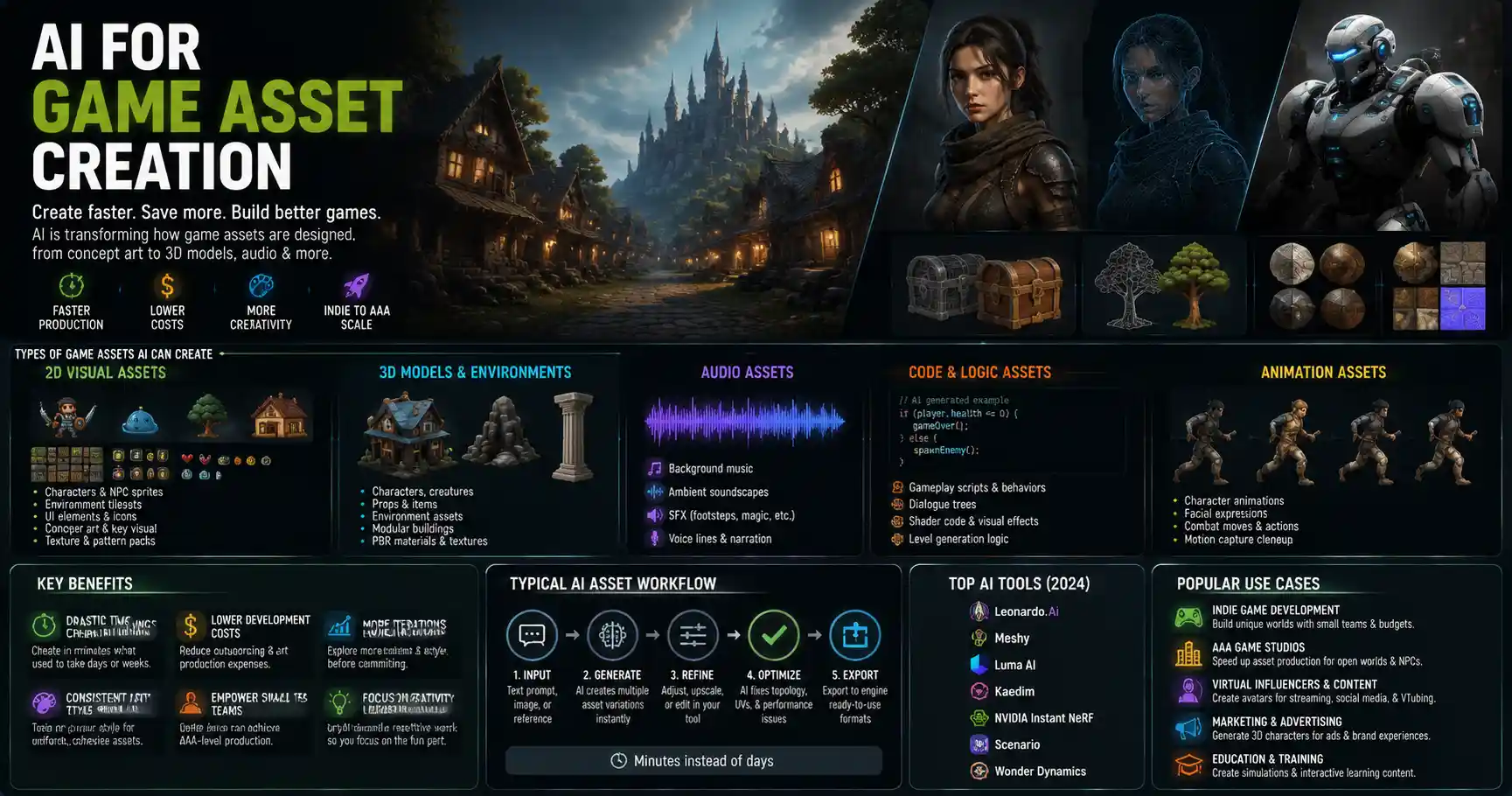
Game assets are any reusable resource used to build a game, ranging from visual art to audio to code snippets. AI tooling has advanced far beyond simple 2D concept art, and today can generate nearly every category of asset a development team needs. The most common use case remains visual assets, but AI is quickly expanding into non-visual categories that were once the exclusive domain of specialized creators.
2D Visual Assets
2D assets were the first category of game content that AI mastered, and they remain the most widely used AI-generated assets in modern game development. For 2D games, AI can create everything from character sprites and environment tilesets to UI elements, texture packs, promotional art, and concept sketches. Tools like Stable Diffusion, MidJourney, and DALL-E 3 are trained on millions of existing 2D game assets, allowing them to generate assets that match specific art styles—from 16-bit pixel art reminiscent of the Super Nintendo era to hand-painted watercolor backgrounds for indie narrative games.
One of the biggest advantages for AI-generated 2D assets is consistency. Modern fine-tuning tools allow developers to train an AI model on a handful of existing custom assets to generate new assets that perfectly match the game’s existing style, eliminating the disjointed look that can come from hiring multiple freelance artists or pulling assets from different stock sites. For example, a developer working on a retro pixel art RPG can fine-tune a model on 10 example sprites, then generate 100 additional enemy and NPC sprites that all match the same color palette, line weight, and art style.
3D Models and Environment Assets
3D asset creation was long considered too complex for AI, but recent advances in generative AI have opened up this category to automated creation. Today, AI tools can generate full 3D meshes, PBR (physically based rendering) textures, and even optimized collision meshes ready for import into game engines like Unity and Unreal Engine. Tools like Luma AI, 3DFY.ai, and NVIDIA’s Instant NeRF can turn a simple text prompt or a handful of 2D concept images into a fully textured 3D model in minutes, a process that used to take a 3D artist multiple days to complete.
For open-world games, AI is particularly valuable for creating modular environment assets. A level designer can generate hundreds of unique rock formations, tree models, or building props that all match the game’s visual theme, making it easier to create large, varied open worlds without repeating the same assets over and over. Ubisoft has already publicly discussed using AI to generate 3D assets for its open-world Assassin’s Creed series, noting that the tooling cuts down on the time 3D artists spend on repetitive prop creation.
Non-Visual Game Assets
AI generation is not limited to visual content. Audio assets, another core category of game content, are now commonly created with AI. AI tools can generate everything from background music and ambient soundscapes to custom voice lines for NPCs and sound effects. For example, a developer can generate 30 minutes of unique ambient forest audio that loops seamlessly, or generate hundreds of unique voice lines for a minor NPC without hiring a voice actor. AI can also generate code for simple in-game behaviors, dialogue trees, and even entire shader programs, allowing designers to test ideas quickly without waiting for engineering support.
Core Benefits of AI Asset Creation for Game Developers
The rapid adoption of AI asset creation across the game industry is not just a trend—it is driven by tangible, game-changing benefits that address longstanding pain points in game development. For studios of all sizes, these benefits translate to lower costs, faster development timelines, and more creative freedom.
Drastically Reduced Production Time and Costs
The most obvious benefit of AI asset creation is the speed and cost savings it delivers. Creating a single 3D character model can take a professional artist anywhere from 3 to 10 days, depending on complexity, with rates ranging from $200 to $2,000 or more per model. AI can generate a comparable base model in minutes, for a fraction of the cost. For indie developers working on tight budgets and with small teams, this difference can be the difference between releasing a game and abandoning the project entirely.
Even for large AAA studios, the time savings add up. Large open-world games require tens of thousands of unique assets, and AI can handle the repetitive work of creating base props and textures, freeing up human artists to focus on high-priority, high-visibility assets like main character models and key story environments. A 2023 survey of game developers by GDC found that 62% of studios using AI for asset creation reported cutting production time for art assets by 30% or more, and 48% reported reducing art costs by at least 25%.
Lowered Barriers to Entry for New Creators
Before AI, anyone who wanted to build a game had two options: learn advanced artistic skills to create their own assets, or spend scarce budget on hiring artists or purchasing stock assets. Stock assets often suffer from lack of consistency and uniqueness, meaning many small indie games end up looking generic because they use the same free assets available to every other new developer. AI changes that dynamic entirely.
Now, a developer with a great game idea but no artistic training can generate hundreds of unique, cohesive custom assets for a few hundred dollars, if not for free using open-source tools. This has led to a boom in independent game development, with more creators releasing small, unique games than ever before. It has also allowed diverse creators from underrepresented backgrounds to enter the industry, who may not have had the resources to attend art school or hire a team of artists to bring their vision to life.
Accelerated Prototyping and Iteration
Game development is an iterative process: creators test ideas, adjust them, and throw out concepts that do not work. In the traditional pipeline, creating assets for a new prototype can take weeks, which discourages creators from testing risky, innovative ideas. With AI, creators can generate new assets for a prototype in hours, allowing them to test more ideas and iterate more quickly.
For example, a gameplay designer testing a new enemy type can generate three different visual concepts in an afternoon, test all three with playtesters, and adjust the design based on feedback—something that would have taken weeks to do with a traditional art pipeline. This ability to iterate faster leads to better, more polished games in the long run, because creators can refine their ideas without long wait times.
AI isn’t going to replace game artists. But it will replace game artists who don’t use AI. The artists who learn to leverage these tools to handle the repetitive work will be able to focus on the creative, high-impact work that makes games memorable.
Common Challenges and Limitations of AI Game Assets
For all its benefits, AI asset creation is not a perfect solution, and it comes with significant challenges that developers need to plan for. Understanding these limitations is key to using AI effectively without running into costly issues down the line.
Legal and Copyright Uncertainty
The biggest and most well-known challenge facing AI-generated game assets is legal uncertainty around copyright. Most major AI generative models are trained on millions of copyrighted images, art, and 3D models scraped from the internet without permission from the original creators. This has led to multiple ongoing lawsuits against major AI tool providers, including Getty Images’ lawsuit against Stability AI and artists’ class-action lawsuits against Stability AI, MidJourney, and DeviantArt.
For developers, the risk is that if a studio releases a game with AI-generated assets, they could face legal action if a court rules that the AI generation process infringes on original creators’ copyright. While no major case has been finalized as of 2024, the uncertainty makes many large studios cautious about using AI-generated assets for high-visibility commercial projects. There are steps developers can take to mitigate this risk, however:
- Use AI models trained exclusively on licensed or public domain content, such as Adobe Firefly, which is trained on Adobe’s own licensed stock content and public domain material
- Fine-tune AI models only on original content your team created or has full rights to
- Use AI-generated assets as a base that is heavily edited and modified by a human artist to create a new original asset
- Purchase copyright insurance that covers AI-generated content, which is now offered by many creative industry insurance providers
Quality and Technical Requirements for Game Engines
AI-generated assets often require significant manual cleanup and modification before they are ready to use in a game engine. For 2D assets, AI can sometimes produce inconsistent anatomy, misaligned tiles, or extra details that do not work for gameplay. For 3D assets, the issue is even more pronounced: AI-generated models often have messy topology, incorrect UV mapping, missing collision data, and overly high polygon counts that will slow down performance in a game.
This means that AI does not eliminate the need for human artists—it just changes what they work on. A human artist still needs to review, clean up, and optimize every AI-generated asset before it can be added to a game. For many studios, this is still a net time saver, but it is not the "push button get asset" solution that some marketing for AI tools claims it is.
Style Consistency and Unique Identity
While modern AI is much better at creating consistent assets than early tools were, it can still struggle to maintain a cohesive style across hundreds of assets, especially for complex projects. Small variations in color, line weight, or proportion can add up to a disjointed look that pulls players out of the game world. AI also tends to regurgitate common tropes from its training data, which can lead to generic assets that feel unoriginal. Many players have commented that early AI-generated games feel same-y because they all draw from the same pool of common visual references.
Creating a truly unique visual identity still requires human direction and curation. A developer can generate 10 AI assets for every one asset they keep, but they still need to select and modify the assets to fit their unique vision. For example, the indie game Midnight Society uses AI-generated base assets, but the team’s artists heavily modify every asset to match their distinctive horror aesthetic, resulting in a game that feels unique, not generic.
Ethical Concerns
Beyond legal issues, there are significant ethical concerns around AI asset creation, particularly around the impact on human artists. Many artists worry that widespread adoption of AI will lower rates for freelance art work and displace entry-level artists who rely on asset creation work to build their portfolios and careers. There are also valid concerns about AI generating assets that are too similar to existing artists’ work, effectively replicating an individual artist’s style without compensation or permission.
Most industry leaders, including Ismail and other advocates for independent developers, agree that the ethical path forward is not to ban AI, but to use it responsibly. This means prioritizing tools that train on licensed content, compensating artists for their work when it is used to train AI models, and using AI to augment rather than replace human artists on development teams.
Best Practices for Integrating AI Into Your Asset Pipeline
When used correctly, AI can be a powerful addition to any game development pipeline, whether you are a solo indie developer or a 100-person AAA studio. Following these best practices will help you get the most out of AI while avoiding the common pitfalls:
- Use AI for repetitive, low-stakes work first. The sweet spot for AI is creating the thousands of generic props, background assets, and tilesets that fill out a game world, work that is time-consuming for human artists but low-risk for AI. Leave high-visibility assets like main character models, key UI elements, and story-critical environments to human artists, where the investment in original, high-quality work pays off the most. This approach not only reduces your legal and quality risk, but also frees up human artists to focus on the creative work that requires human intuition and skill.
- Fine-tune models on your own original content for consistency. Instead of using a general-purpose AI model to generate every asset from scratch, train a custom fine-tuned model on the original assets your team has already created. This ensures that every new asset generated by AI matches your existing art style, color palette, and quality standards. For most projects, you only need 20-50 original example assets to fine-tune a model that produces consistently on-style assets.
- Always have a human artist review and clean up assets. Even the best AI-generated assets require some manual work to be game-ready. Establish a clear workflow where every AI asset is reviewed, edited, and optimized by a human before it is added to the engine. For 2D assets, this might mean adjusting colors, fixing misaligned tiles, or cleaning up line work. For 3D assets, this means retopologizing messy meshes, fixing UV mapping, and adding collision data. This step adds a small amount of work, but it eliminates most quality issues that come from using raw AI output.
- Prioritize licensed, copyright-safe AI tools. To reduce legal risk, avoid general-purpose models trained on scraped content for commercial projects. Instead, use tools like Adobe Firefly, Shutterstock AI Generator, or custom models trained exclusively on content you own or have full rights to. While these tools may have a higher upfront cost, the peace of mind from knowing your assets are legally safe is well worth the investment for commercial projects.
- Document all AI-generated assets in your project. Keep a clear log of which assets in your game are AI-generated, what model was used to create them, and what steps you took to modify them after generation. This documentation will be invaluable if you ever face a legal question about your assets, and it helps your team stay organized as the project grows.
One common mistake new developers make is trying to generate 100% of their game’s assets with AI, without any human input. This almost always leads to lower quality assets, legal risk, and a generic-looking game. The most successful projects use AI as a collaborative tool, augmenting human creativity rather than replacing it. For example, the hit indie game Venba used AI to generate background texture assets for some of the 1980s home environments, allowing the lead artist to focus on character animation and story-driven art that resonated with players.
The Future of AI Game Asset Creation
The AI asset creation space is evolving incredibly quickly, with new tools and capabilities released every month. Looking forward, there are several key trends that will shape the future of the industry over the next five years.
One of the most exciting emerging trends is in-engine AI generation, where developers can generate and iterate on assets directly inside Unity or Unreal Engine, without switching between multiple tools. Unreal Engine 5 already has built-in AI generation tools for textures and environment assets, and Unity has announced similar native AI tools for its 2024 release. This will streamline the asset creation workflow even more, allowing designers to generate assets right where they are using them, cutting down on file management and export/import time.
Another key trend is the growth of custom, licensed training data for AI models. As the legal issues around unlicensed training data become clearer, more tool providers are moving to train models exclusively on licensed content, and more creators are being compensated for their work when their content is used to train AI. This will create a more sustainable ecosystem where artists can benefit from AI rather than being harmed by it. Some platforms are already experimenting with models that allow artists to opt in to having their work used for training, in exchange for royalty payments when their work contributes to generated assets.
We are also likely to see AI become better at generating fully game-ready assets that require little to no manual cleanup. As models improve and become more specialized for game development, they will learn to generate 3D models with clean topology, correct UV mapping, and optimized polygon counts right out of the box, as well as 2D tilesets that line up perfectly and match consistent color palettes. This will reduce the amount of manual work even further, though it is unlikely to eliminate the need for human curation and direction entirely.
Finally, AI will continue to lower barriers to entry for new game developers, leading to even more diversity in the types of games that get made. As more creators from different backgrounds can bring their visions to life without a large budget or a team of professional artists, we will see more unique, personal games that would never have been made under the traditional development model. This is already happening: the 2023 Independent Games Festival featured dozens of games created by solo developers that used AI to create their assets, many of which came from creators who would not have been able to make the game otherwise.
Conclusion
AI for game asset creation is more than just a passing hype cycle—it is a transformative technology that is reshaping how games are made, for better and for worse. It offers incredible benefits: faster production, lower costs, lower barriers to entry for new creators, and more opportunities to iterate on creative ideas. But it also comes with real challenges: legal uncertainty, quality issues, ethical concerns around artist compensation, and the risk of generic, unoriginal games. The future of AI in game development is not about replacing human artists—it is about empowering them to do their best work, by taking over the repetitive, time-consuming parts of asset creation and freeing humans to focus on the creative vision that makes games unique. For developers who approach AI thoughtfully, use it responsibly, and follow best practices to mitigate risk, it is an incredibly powerful tool that can help bring more great games to the world than ever before.