
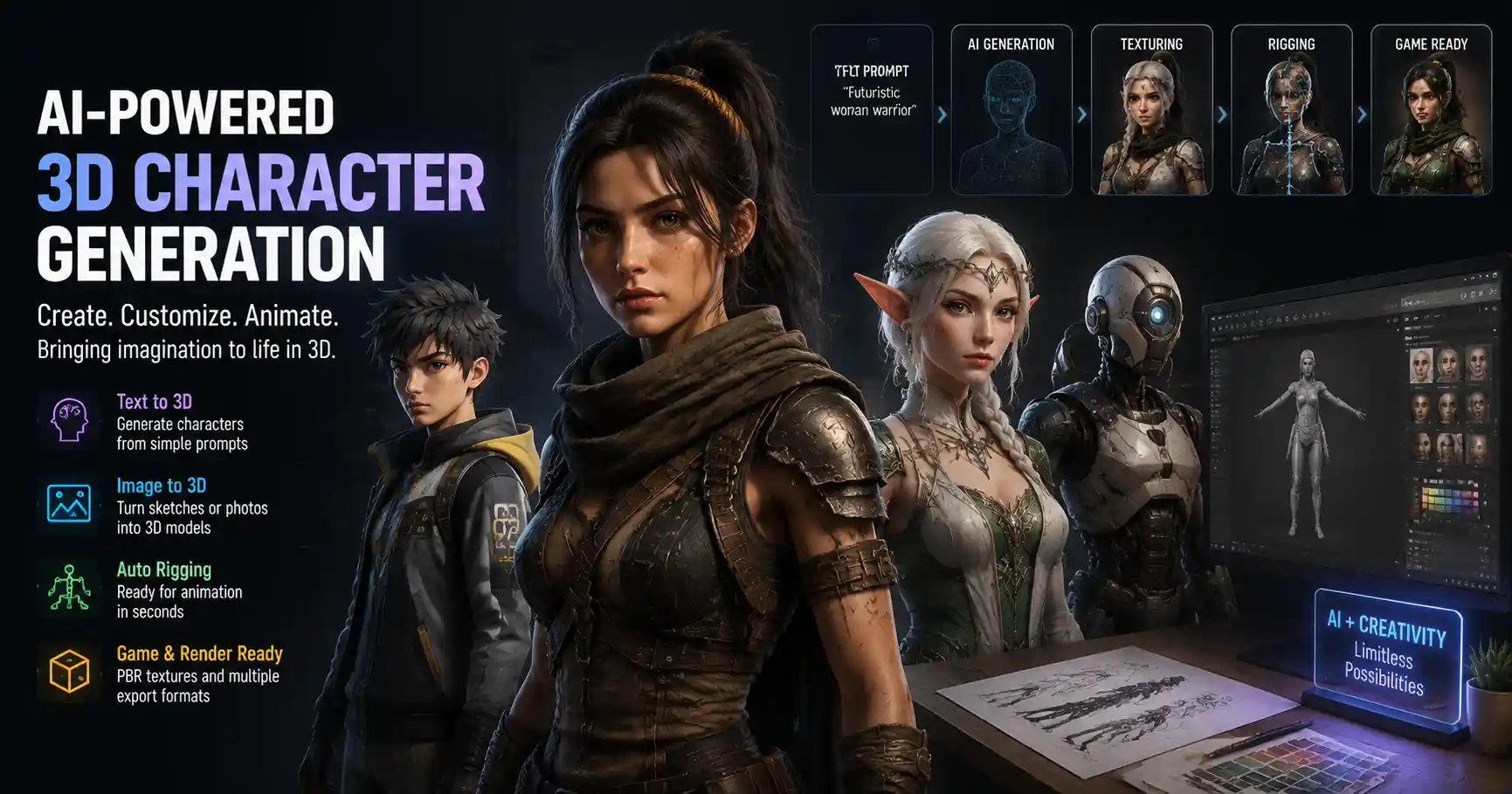
From video game protagonists with custom facial scars to virtual influencers with hyper-realistic skin texture, 3D AI character generators have transformed how digital creators bring imaginary people to life. What once required years of 3D modeling training, thousands of dollars in software, and weeks of manual work can now be completed in minutes, with results that rival professional handcrafted assets. Whether you’re an independent game developer, a content creator, a marketer, or a hobbyist just getting started with digital design, these tools open up creative possibilities that were out of reach just five years ago. Let’s break down how 3D AI character generators work, what they can do, how to choose the right tool for your project, and what the future holds for this rapidly evolving technology.
What Is a 3D AI Character Generator?
At its core, an AI character generator 3D is a software tool that uses artificial intelligence to automatically create fully rigged, three-dimensional digital characters from text prompts, 2D sketches, reference photos, or a combination of inputs. Unlike traditional 3D modeling software that requires artists to manually sculpt every feature, retopologize geometry, and rig the model for animation, AI handles most of these heavy-lifting steps automatically. The result is a ready-to-use 3D character that can be imported into game engines, animation software, or virtual production pipelines with minimal editing.
Early 3D character generation tools were limited to pre-built base models that users could mix and match, with no ability to create truly unique designs from scratch. Modern AI generators, however, leverage diffusion models, generative adversarial networks (GANs), and large language models (LLMs) to interpret creative prompts and generate entirely original geometry, textures, and rigs. This shift has democratized 3D character creation, removing the technical barriers that once kept the craft limited to industry professionals.
Key Capabilities of Modern Tools
Today’s top 3D AI character generators offer far more than just basic model creation. Most include a suite of features tailored to different use cases, from game development to social media content. Common capabilities include:
- Text-to-3D generation: Create a full 3D character from a simple natural language prompt, such as “a elven blacksmith in their 50s with a braided beard and leather armor”
- Image-to-3D conversion: Turn a 2D concept art sketch, reference photo, or even a social media profile picture into a fully realized 3D model
- Automatic rigging and weighting: Prepare the character for animation by generating a functional skeleton and assigning weight to body parts, a step that once took experienced artists hours to complete manually
- Custom texture and PBR support: Generate physically based rendering (PBR) textures that work seamlessly with modern game engines and rendering software, allowing for realistic lighting and material effects
- Stylization controls: Adjust the character’s style to match your project, from hyper-realistic to cartoonish anime-inspired designs
- Export to standard file formats: Export models as GLB, FBX, OBJ, or other common formats that work with Unity, Unreal Engine, Blender, and other industry tools
For independent creators and small teams, these capabilities are game-changing. A solo developer working on a mobile indie game can generate a full cast of 10 unique playable characters in a single afternoon, where that process would have taken months with traditional methods.
Common Use Cases for 3D AI Character Generators
3D AI character generators are used across a wide range of industries, each with different requirements and expectations for output quality. Below are some of the most popular applications, from entertainment to marketing.
Video Game Development
Indie game development is one of the fastest-growing use cases for AI-generated 3D characters. Small teams and solo creators rarely have the budget to hire a team of professional 3D character artists, and pre-made asset packs often leave games looking generic and unoriginal. AI generators let these creators produce unique, custom characters that match their game’s art style at a fraction of the cost and time.
Even large AAA game studios are starting to adopt AI character generators to speed up workflows. While lead characters and key assets are still usually handcrafted by artists, AI is often used to generate background NPCs (non-playable characters), crowd characters, and prototype models for early game testing. This frees up professional artists to focus on high-priority work rather than spending weeks creating dozens of minor characters that players may only see for a few seconds.
Virtual Influencers and Content Creation
Virtual influencers—digital characters that build followings on Instagram, TikTok, and YouTube—have become a multi-million dollar industry, and 3D AI character generators have made it far easier for creators to launch their own virtual personas. Instead of hiring a 3D artist to build and maintain a custom avatar, creators can generate a fully rigged 3D character in minutes, then update its appearance for new content whenever they want.
AI-generated 3D characters are also popular for YouTube content, Twitch streaming avatars, and VRChat or Meta Horizon custom avatars. Hobbyists can create a unique digital version of themselves or a completely original character to use in virtual social spaces without any prior 3D modeling experience.
Marketing and Advertising
Brands are increasingly using 3D characters in advertising, product demos, and immersive brand experiences. A clothing brand, for example, might use a custom 3D character to model new apparel in virtual try-on experiences or social media ads. Instead of paying for a photoshoot with a human model, brands can generate a 3D character that matches their target demographic and adapt its appearance for different campaigns.
AI-generated 3D characters are also used in e-learning, corporate training videos, and explainer animations. They add a personal touch to content without the cost of hiring actors or animators for every project.
Animation and Film Production
Independent animators and small production studios use 3D AI character generators to create character bases for short films, web series, and student projects. For pre-visualization (pre-vis) work, where filmmakers test out scenes and camera angles before full production, AI-generated characters provide a quick way to fill out a scene and get a sense of how the final product will look. Even in big-budget virtual production, AI tools are used to speed up character development for background extras and crowd scenes.
How Do 3D AI Character Generators Work?
To the average user, AI character generation feels like magic: you type a prompt, wait a few minutes, and get a fully finished 3D character. But behind the scenes, the technology relies on advanced machine learning models trained on massive datasets of existing 3D character models. Let’s break down the process in simple terms.
Training the Model
Before a 3D AI character generator can create new characters, developers train it on a dataset that can include hundreds of thousands of existing 3D models, along with their associated text descriptions, geometry, textures, and rigs. The model learns to identify patterns: how human proportions work, what different clothing styles look like in 3D, how facial features correlate with descriptive words like “wrinkled” or “youthful,” and how to structure geometry so it’s easy to rig and animate.
“What makes modern 3D AI generation transformative isn’t just that it creates geometry—it’s that it learns the rules of good 3D character design from millions of existing professional assets. It doesn’t just output a random shape; it outputs a shape that works for animation, rendering, and real-time use.”
Many of the latest models also use 2D image datasets to supplement 3D training, since there are far more 2D concept art and reference images available than labeled 3D models. This helps the model generate more detailed and varied designs that match the creative intent of a prompt.
The Generation Workflow
The exact workflow varies by tool, but most 3D AI character generators follow a similar step-by-step process when creating a new character:
- Input processing: The tool takes your input—whether it’s a text prompt, 2D sketch, reference photo, or combination of inputs—and interprets what kind of character you want to create. Text-based tools use large language models to parse descriptive terms and turn them into structured data the 3D generation model can understand.
- Geometry generation: The AI generates the basic 3D mesh (the shape) of the character, matching the proportions, features, and clothing described in your input. Most tools generate a clean, quad-based mesh that’s ready for further editing, rather than a messy high-poly shape that’s hard to work with.
- Texturing and materials: Next, the AI generates color maps, normal maps, roughness maps, and other PBR textures for the character, adding details like skin pores, fabric texture, metal scratches, and hair color. For stylized characters, it adjusts the texture style to match the requested art style.
- Automatic rigging: Most modern tools add a ready-to-use skeleton to the character and automatically weight the mesh, so the character can be posed or animated right away without additional work. Some tools even add support for inverse kinematics (IK) and facial blend shapes for emotional expressions.
- Export and post-processing: Finally, the tool lets you export the character in a standard file format, and many include basic editing tools to tweak proportions, change colors, or adjust features before exporting.
For more advanced users, many tools allow you to import the generated character into Blender or Maya to make manual edits, just like you would with a handcrafted 3D model. This flexibility means AI works as an assistant to artists rather than a replacement, speeding up the early stages of creation while leaving room for custom creative touches.
Choosing the Right 3D AI Character Generator for Your Project
With dozens of new 3D AI character generators hitting the market in the last two years, choosing the right tool for your needs can feel overwhelming. The best tool for you depends on your experience level, your budget, and what you plan to use the character for. Below are key factors to consider, along with recommendations for popular categories of tools.
Key Factors to Compare
Before you commit to a tool, evaluate these critical features to make sure it matches your project requirements:
- Output quality and style: Some tools specialize in hyper-realistic human characters, while others are better for stylized cartoon or anime designs. Check sample outputs from the tool to make sure the style matches what you need for your project.
- File export options: If you’re importing the character into Unreal Engine or Unity, make sure the tool exports FBX or GLB files with intact rigs and textures. Some consumer-focused tools only let you render images or videos, which won’t work if you need to use the character in a game or animation.
- Licensing rights: This is one of the most overlooked factors, especially for commercial projects. Most top tools grant commercial usage rights to generated characters, but some have restrictions on how you can use them, or require a paid plan for commercial use. Always read the license agreement before using an AI-generated character in a commercial product.
- Customization options: Do you need to tweak specific features, adjust proportions, or change clothing after generation? Some tools let you edit specific parts of the character without regenerating the entire model, while others only let you start over with a new prompt.
- Budget: Many tools offer free tiers for hobbyists that let you generate a limited number of characters per month, while paid plans range from $10 to $100+ per month for professional use. Pay-as-you-go options are also available from some providers, which is ideal if you only need to generate a few characters for a one-off project.
Popular Tools by Use Case
To help you narrow down your options, here’s a breakdown of top tools for common use cases:
For Hobbyists and Beginners: Tools like Character Creator 4 with its built-in AI tools, Ready Player Me, and DALL-E 3’s experimental 3D generation are great for getting started. Ready Player Me is specifically designed for creating avatars for VR and streaming, and it’s free for non-commercial use. Character Creator offers a more intuitive interface for beginners than full traditional 3D software, with AI-powered generation that speeds up the creation process.
For Indie Game Developers: Tools like Luma AI, 3DFY.ai, and Meshy are popular choices for indie developers. All three support text-to-3D generation, export to standard game engine formats, and offer commercial licenses on paid plans. Meshy also includes automatic retopology and PBR texturing, which produces clean models that work well in real-time game environments.
For Professional Artists and Studios: For professional workflows, tools like Autodesk’s Character Generator (part of the Maya/3ds Max ecosystem) and ZBrush with new AI plugins integrate seamlessly into existing pipelines. These tools let artists generate a base character quickly, then bring it into their preferred software for manual refinement, combining the speed of AI with the control of traditional 3D modeling.
Common Pitfalls to Avoid
Even with the best tools, there are a few common mistakes new users make when working with 3D AI character generators. First, don’t skip checking the license: using a character generated with a tool that doesn’t allow commercial use can lead to legal issues down the line if your game or content becomes popular. Second, be specific with your prompts: vague prompts like “a female warrior” will often give generic results, while specific prompts that include age, build, clothing style, art style, and key features will produce far better results. Finally, don’t expect perfection on the first try: most AI-generated characters need at least a small amount of manual tweaking to fix minor issues like distorted fingers or mismatched textures, especially for close-up shots or high-resolution renders.
The Future of 3D AI Character Generation
The technology behind 3D AI character generation is advancing faster than almost any other area of generative AI, and the next few years are likely to bring even more dramatic improvements. One of the most anticipated developments is better consistency and control: right now, it can be hard to generate multiple versions of the same character with different outfits or poses that keep the character’s face and features consistent. Future models will likely allow users to lock in specific features and modify only certain parts of the character, making it easier to create a full cast of consistent characters for a game or series.
Another area of rapid improvement is higher resolution geometry and more detailed features, especially for things like hair, clothing, and fine facial details. Current models often struggle with generating realistic hair that works well for real-time use, but new approaches to 3D generation are already solving this problem, with outputs that rival handcrafted hair cards in quality.
We’re also likely to see deeper integration between 3D AI character generators and game engines, animation software, and virtual production tools. Imagine being able to generate a custom 3D character directly inside Unreal Engine, with one click, and have it ready to animate immediately. That level of integration is already being tested by major game engine developers, and it will become standard within the next few years.
Of course, the growth of AI-generated 3D characters also brings important conversations about copyright and the role of artists. As AI models are trained on existing work created by human artists, there are ongoing debates about compensation, ownership, and how the industry can adapt to this new technology. Many developers of AI character generators are working to address these concerns by using licensed training datasets and offering opt-out options for artists who don’t want their work included in training, but the conversation is still evolving as regulations around AI generative content develop around the world.
Despite these challenges, the overall impact of 3D AI character generators has been overwhelmingly positive for the creative community. By lowering the barrier to entry, they’ve allowed thousands of new creators to bring their ideas to life who would never have been able to afford professional 3D art services. For professional artists, they free up time from repetitive, time-consuming tasks to focus on the creative, high-level work that makes 3D art rewarding.
Conclusion
AI character generator 3D tools have already transformed digital creation, and they’re only going to become more powerful and accessible in the coming years. For hobbyists, they offer a fun, affordable way to create custom avatars and experiment with 3D design. For independent creators and small studios, they level the playing field, letting you compete with larger teams by producing high-quality custom characters at a fraction of the cost. For professional artists, they act as a powerful productivity tool that speeds up repetitive work and opens up new creative possibilities.
Whether you’re building your first indie game, launching a virtual influencer, or just curious about what generative AI can do, there’s never been a better time to try out a 3D AI character generator. Start with a free tier, experiment with different prompts, and see what you can create—you might be surprised at how quickly you can turn your creative vision into a fully realized 3D character.