
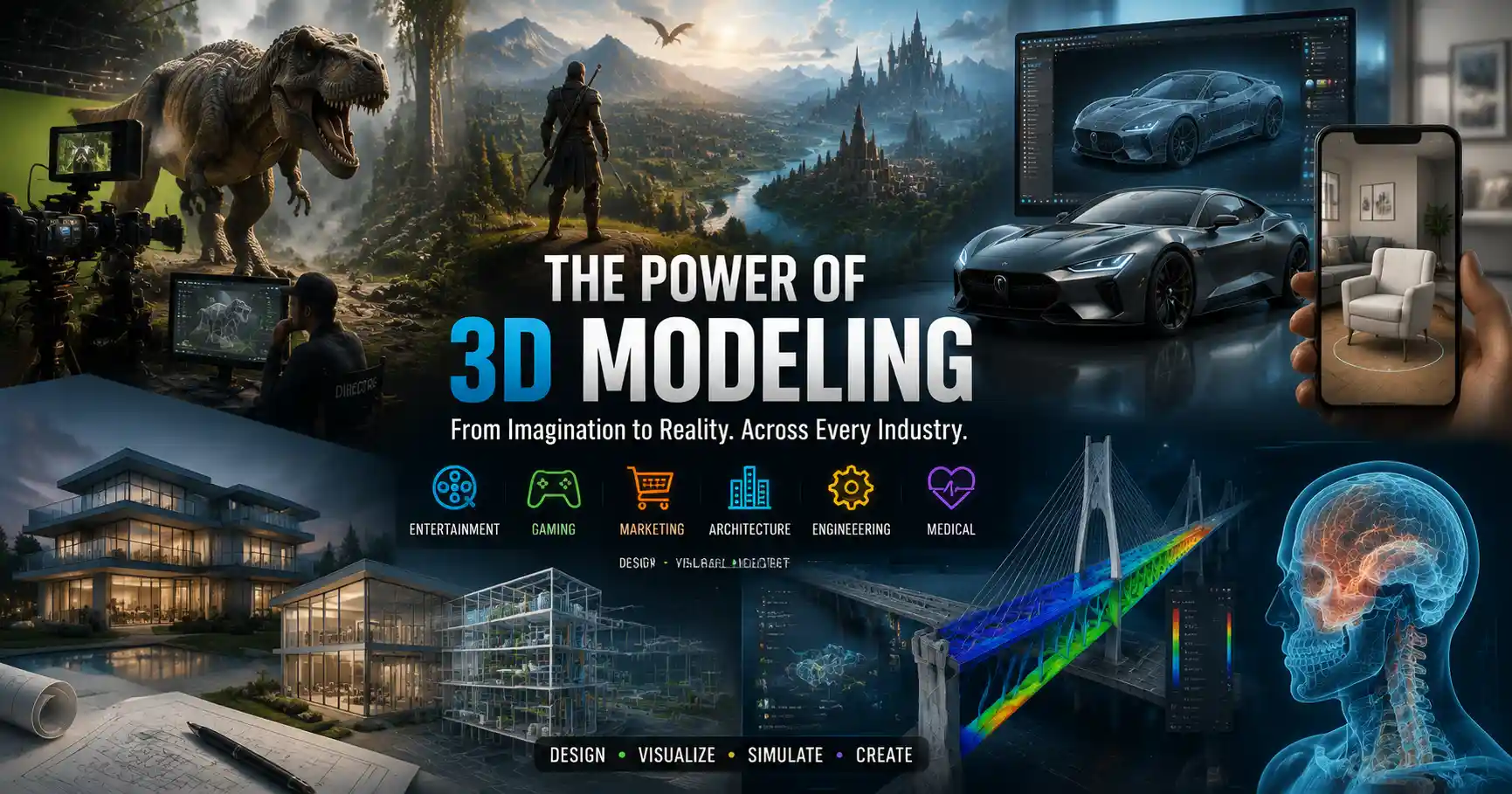
If you’ve ever scrolled through a video game open world, marveled at the lifelike dinosaurs in a blockbuster film, or toured a new apartment development before it’s even built, you’ve experienced the end result of 3D modeling. At its core, 3D modeling is the process of creating a three-dimensional representation of any object or surface using specialized software. Artists, engineers, designers, and scientists manipulate points in virtual space to form meshes and surfaces that can then be textured, animated, or 3D printed. What started as a niche tool for industrial and entertainment designers has grown into a foundational technology across nearly every major industry. Today, 3D modeling touches nearly every part of modern life, often in ways people never notice.
3D Modeling in Entertainment and Media
The entertainment industry was one of the first to adopt 3D modeling at scale, and it remains the largest consumer of 3D artistic work today. From animated feature films to live-action blockbusters, 3D modeling makes it possible to create worlds and characters that would be impossible or prohibitively expensive to build physically. The flexibility of digital 3D assets also allows creators to iterate quickly, test different designs, and reuse assets across multiple projects, cutting down on production time and costs.
Film and Television
In modern film and television, nearly every project uses 3D modeling for at least some part of production. For fully animated films like Disney’s Frozen or Pixar’s Toy Story, every character, prop, and environment is built from scratch as a 3D model. Even live-action films rely heavily on 3D modeling for visual effects: the dinosaurs in Jurassic Park, the superhero suits in the Marvel Cinematic Universe, and the alien planets in Avatar all started as detailed 3D models before being animated and composited into live-action footage.
3D modeling also plays a key role in pre-production, long before filming starts. Directors and cinematographers build 3D models of sets to plan camera angles, lighting setups, and blocking, reducing costly on-set delays. This practice, called previsualization, has become standard for big-budget action and effects-heavy films.
Video Games
The $200 billion global video game industry runs entirely on 3D modeling. Every character, weapon, landscape, and building in a modern console or PC game is a custom-built 3D model optimized to run smoothly in real time. Game developers balance detail with performance: high-resolution models are used for close-up cinematics, while lower-polygon versions are used for gameplay to keep frame rates high.
The rise of open-world games, which can span hundreds of square kilometers of virtual terrain, has created new demand for efficient 3D modeling workflows. Procedural 3D modeling tools can automatically generate landscapes, trees, and buildings, letting developers create massive worlds without modeling every single asset by hand. Independent game developers also benefit from marketplaces where pre-made 3D models can be purchased and modified, lowering the barrier to entry for small teams.
Advertising and Marketing
3D modeling has transformed advertising, allowing brands to create high-quality visual content faster and cheaper than traditional photoshoots. Product brands use 3D models to create photorealistic renderings of new products before any physical prototypes are manufactured. Car companies, for example, regularly use 3D models to create print and digital ads for new models months before production starts.
Augmented reality (AR) advertising, which lets customers try on products like glasses or furniture virtually in their own homes, also relies entirely on 3D models. A customer browsing for a new sofa can place a 1:1 scale 3D model of the sofa in their living room using their phone camera, eliminating much of the uncertainty of online shopping.
3D Modeling in Architecture, Engineering, and Construction (AEC)
The AEC industry has revolutionized its workflow with 3D modeling, replacing traditional 2D blueprints with detailed digital models that contain every layer of information about a project. This shift, driven by Building Information Modeling (BIM) technology, has reduced construction errors, cut costs, and improved collaboration between architects, engineers, contractors, and clients. Today, 3D modeling is a required skill for nearly every professional working in design and construction.
Architectural Design and Visualization
Architects use 3D modeling to explore design concepts early in the creative process. Unlike 2D drawings, which only show specific views of a building, 3D models let architects walk through their design digitally, test how natural light interacts with spaces at different times of day, and adjust proportions before finalizing plans. For clients who don’t know how to read blueprints, photorealistic 3D renderings of the finished building make it easy to understand the design and give feedback.
Real estate developers also use 3D architectural visualizations to market properties before construction is complete. High-quality renderings and 360-degree virtual tours of apartment buildings, shopping centers, and resort developments help sell units months or years ahead of completion, giving developers early access to revenue to fund construction.
Civil and Structural Engineering
Civil engineers use 3D modeling to design everything from bridges and highways to water treatment plants and offshore wind farms. 3D models can be run through structural simulations to test how a design holds up under extreme conditions like earthquakes, heavy wind, or heavy traffic loads. This identifies potential weaknesses in the design early, before construction starts, reducing the risk of catastrophic failure and expensive post-construction repairs.
In infrastructure projects, 3D modeling also helps coordinate different utility systems. A single 3D model of a new highway will include layers for road surface, drainage, electric lines, water pipes, and fiber optic cables, so engineers can spot conflicts where two systems might overlap before construction begins. In the past, these conflicts were often discovered only after excavation started, leading to costly delays.
Construction Planning and Management
General contractors use 3D BIM models to plan every step of the construction process. 4D BIM adds a timeline element to the 3D model, so contractors can visualize how the site will develop over the course of the project and schedule deliveries and labor accordingly. This reduces idle time for workers and equipment, speeding up project completion.
Modern construction sites also use 3D modeling combined with drone scanning to track progress. Drones scan the site every week, creating a 3D point cloud that can be compared to the original design model to check for deviations and make sure work is on schedule.
3D Modeling in Product Design and Manufacturing
Before any physical product goes into mass production, it starts as a 3D model. 3D modeling has completely transformed the product development process, allowing designers and engineers to prototype, test, and refine products faster and more cheaply than ever before. The rise of 3D printing has only deepened this connection: 3D models are the direct input for 3D printers, making digital design an essential first step for any custom or low-volume manufacturing project.
Industrial Design and Prototyping
Industrial designers use 3D modeling to develop everything from small consumer electronics to large home appliances. 3D modeling software makes it easy to iterate on designs, adjust ergonomics, and test how different components fit together. Before 3D modeling, designers had to carve physical prototypes out of foam or wood, a process that could take weeks for a single design iteration. Today, designers can test a dozen different designs in the same amount of time.
Once a digital design is finalized, it can be sent directly to a 3D printer to create a physical prototype in a matter of hours. This lets designers test the feel, fit, and function of a product long before committing to expensive mass production tooling. A list of common product categories that rely on 3D modeling for prototyping includes:
- Smartphones, laptops, and wearable consumer electronics
- Furniture and home goods
- Sporting goods and outdoor equipment
- Automotive parts and accessories
- Medical devices and personal care products
Mass Production and Tooling
For mass production, 3D models are used to design the molds, dies, and cutting tools that will be used to manufacture the final product. Computer Numerical Control (CNC) machines and injection molding machines use instructions directly from 3D models to create these tools, eliminating the error that comes with translating 2D drawings into machine instructions.
3D modeling also enables mass customization, a manufacturing approach that lets companies produce custom products at near-mass-production prices. For example, many insole manufacturers use 3D scanning to create a custom 3D model of a customer’s foot, then cut a custom insole from raw material based on that model. This process is fully automated and costs little more than a generic off-the-shelf insole.
Reverse Engineering
Reverse engineering is the process of creating a 3D model from an existing physical object. This is done using 3D scanners that capture thousands of points on the object’s surface, which are then assembled into a digital 3D model. Reverse engineering is used when an original CAD (Computer-Aided Design) file for a part has been lost, or when designers want to modify an existing part or analyze a competitor’s product.
It’s also commonly used in heritage preservation: archaeologists scan ancient artifacts to create accurate 3D models that can be studied by researchers around the world without risking damage to the original object, or 3D printed for museum exhibits.
3D Modeling in Healthcare and Life Sciences
3D modeling has become a life-saving tool in healthcare, transforming everything from pre-surgical planning to custom medical device design. The ability to create patient-specific 3D models from MRI and CT scan data has given surgeons a new level of insight into complex procedures, improving outcomes and reducing patient risk.
Pre-Surgical Planning and Medical Education
For complex surgical procedures, surgeons often create a 3D model of a patient’s affected organ or body part from their medical scan data. For example, before performing open heart surgery to correct a congenital defect, a surgeon can study a 3D printed model of the patient’s heart to plan the exact incisions and repairs, reducing the time the patient spends under anesthesia and lowering the risk of complications. This is especially valuable for rare or complex conditions where every patient’s anatomy is unique.
3D models also play a key role in medical education. Instead of learning from static 2D textbook illustrations or relying on rare cadaver dissections, medical students can interact with accurate 3D models of human anatomy to practice procedures and study anatomical variations. This has made medical education more accessible and affordable for institutions around the world.
Custom Medical Devices and Prosthetics
One of the fastest growing uses of 3D modeling in healthcare is the creation of custom prosthetics and orthotics. A prosthetic limb designed from a 3D scan of a patient’s residual limb fits far better than a one-size-fits-all generic device, improving patient comfort and mobility. For children who outgrow their prosthetics quickly, 3D modeled and 3D printed devices cost a fraction of the price of traditional custom prosthetics, making them accessible to more families.
Cranial implants, used to repair skull defects after trauma or surgery, are also commonly designed as patient-specific 3D models. The 3D model is matched exactly to the patient’s skull shape, then 3D printed in biocompatible material for implantation.
Pharmaceutical Research and Drug Development
In pharmaceutical research, scientists use 3D modeling to study the structure of proteins and develop new drug compounds. Drug molecules work by binding to specific proteins in the body, and a 3D model of the protein’s structure lets scientists design molecules that fit perfectly into the protein’s binding site. This approach, called structure-based drug design, has sped up the drug development process and led to breakthrough treatments for diseases like cancer and Alzheimer’s.
3D molecular modeling has cut the time to identify potential drug candidates from years to months, enabling the rapid development of vaccines and therapies that would not have been possible with traditional trial-and-error methods.
Emerging and Uncommon Uses of 3D Modeling
As 3D modeling software becomes more powerful and affordable, new use cases are emerging every year. Even industries that haven’t traditionally relied on digital design are starting to adopt 3D modeling to improve efficiency and create new customer experiences.
Education and E-Learning
Schools and universities around the world are using 3D models to create interactive learning experiences. Students can explore a 3D model of the solar system, walk through a 3D model of an ancient Egyptian pyramid, or dissect a 3D model of a frog without any physical lab equipment. This makes hands-on learning accessible to remote students and schools with limited budgets.
Museums and Cultural Heritage
Museums are using 3D modeling to preserve and share cultural heritage. 3D scanning is used to create accurate digital copies of fragile artifacts that can’t be displayed to the public or are at risk of damage from climate change or conflict. These 3D models can be used to create 3D printed replicas for exhibits, or shared online so anyone in the world can explore them. The Google Arts & Culture project, for example, has hundreds of thousands of 3D models of art and artifacts available for free online viewing.
Fashion and Wearable Design
The fashion industry is starting to adopt 3D modeling to streamline the design process and reduce waste. Traditionally, designers create multiple physical samples of a garment to test fit and fabric, most of which end up thrown away. 3D modeling lets designers create digital samples that can be fitted on a virtual model, adjusted, and even textured with fabric scans, eliminating the need for most physical samples before production. 3D modeling is also essential for creating digital clothing for the metaverse and virtual influencers, a fast-growing new market for fashion brands.Environmental Science and Climate Research
Climate researchers use 3D modeling to study everything from glacial melt to ocean currents and deforestation. 3D models of entire ecosystems help scientists predict how climate change will affect different regions and test the effectiveness of different mitigation strategies. Archaeologists also use 3D modeling to map hidden ancient landscapes buried under jungle or desert, identifying new archaeological sites without costly excavation.
For anyone considering learning 3D modeling, the range of career opportunities has never been wider. The most in-demand specializations for 3D modelers today include:
- Game asset modeling, creating characters and environments for video games
- BIM modeling for architecture and construction companies
- Product modeling for CAD and 3D printing
- Medical modeling for pre-surgical planning and device design
- Architectural visualization for real estate development
Conclusion
From creating movie magic to saving lives in surgery, 3D modeling is far more than just a tool for artists and designers. It’s a foundational technology that has transformed nearly every industry, enabling innovation that would have been impossible just a few decades ago. What started as a niche technique for industrial design has grown into a universal tool that connects digital design directly to physical manufacturing through 3D printing and CNC machining, creating a seamless workflow from idea to finished product.
As 3D modeling software becomes more accessible, AI-assisted tools speed up the modeling process, and virtual and augmented reality become more mainstream, the demand for skilled 3D modelers and innovative 3D modeling applications will only continue to grow. Whether you’re a designer, student, or professional in any industry, understanding what 3D modeling can do opens the door to new opportunities and new ways of solving old problems. In a world that’s increasingly digital, 3D modeling is the bridge between the virtual and physical, turning ideas into tangible reality.