
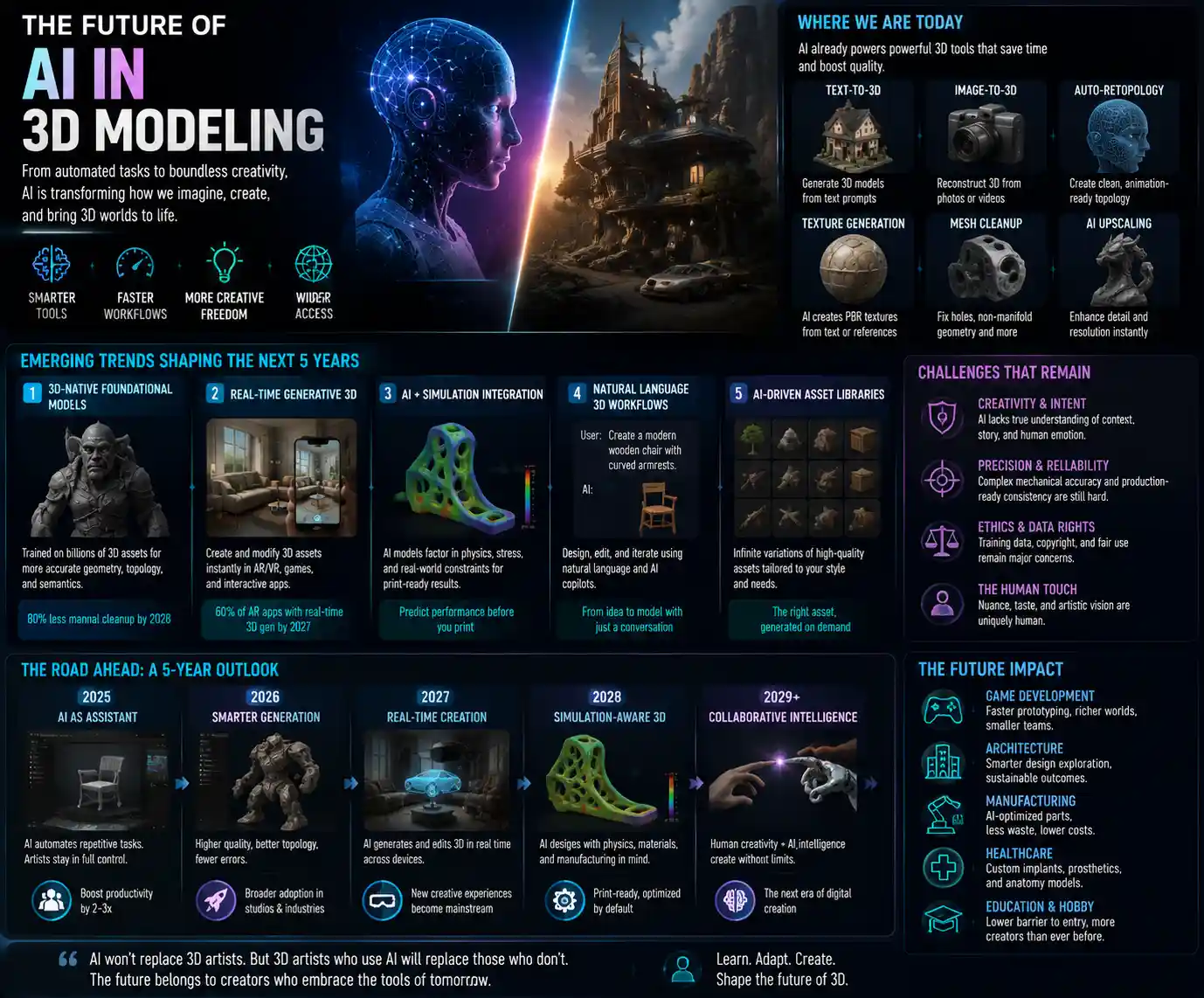
For decades, 3D modeling was a craft reserved for skilled artists who spent weeks sculpting, texturing, and refining digital assets by hand. A single high-quality character model for a blockbuster video game could take months to complete, and small design studios often turned down complex projects due to time and budget constraints. Today, artificial intelligence is upending that tradition, turning hours of tedious manual work into minutes of automated generation and opening 3D design to creators who never mastered traditional modeling software. As generative AI tools mature and integration with existing workflows improves, the future of AI in 3D modeling promises to reshape everything from video game development to architecture, manufacturing, and augmented reality.
The Current State of AI-Powered 3D Modeling
To understand where AI-powered 3D modeling is headed, it helps to ground ourselves in where it stands today. Just five years ago, AI could generate rough, low-resolution 3D shapes that were useless for professional production. Today, tools like NVIDIA Instant NeRF, Blender’s AI Add-ons, Luma AI, and DreamFusion can generate detailed, textured 3D models from simple text prompts, 2D images, or even short video clips. These tools rely on a new generation of diffusion models and neural radiance fields (NeRF) that learn from millions of existing 3D assets to generate new, original geometry that matches a creator’s input.
The biggest shift in the current landscape is the move from research experiments to production-ready tools integrated into the software professional creators already use. Blender, the open-source 3D creation suite used by millions of artists, now includes built-in AI features for auto-retopology, texture generation, and even remeshing. Adobe has integrated 3D AI generation into its Substance 3D collection, allowing designers to generate textures and base models from text prompts without leaving their workflow. Even enterprise CAD tools like AutoCAD and SolidWorks are adding AI-powered features to automate repetitive design tasks.
Key Capabilities of Modern AI 3D Tools
- Text-to-3D generation: Creators can input a simple prompt like “a weathered wooden coffee table with curved legs” and get a usable 3D model in 60 seconds or less
- Image-to-3D reconstruction: AI can turn a single 2D photo or a series of smartphone photos into a detailed 3D model, eliminating the need for expensive 3D scanning equipment
- Auto-retopology and mesh cleanup: AI automatically simplifies complex high-poly models into clean, animation-ready topology, a process that used to take artists hours of manual work
- Texture and material generation: AI generates PBR (physically based rendering) textures that match a prompt or reference image, cutting down the time spent on texturing by 70% or more for many projects
- AI-driven upscaling: Low-resolution 3D models can be upscaled to high-resolution with detailed geometry and textures, making older assets usable for modern high-fidelity projects
Despite these advances, current AI 3D tools still have clear limitations. Most consumer-facing text-to-3D tools struggle with complex geometry, accurate scale, and topological consistency required for manufacturing or animation. Many generated models have overlapping faces, non-manifold geometry, or distorted proportions that require manual cleanup by a skilled artist. For professional use cases, AI is currently a productivity multiplier, not a replacement for human creativity and expertise.
Emerging Trends Shaping the Next Five Years
Over the next five years, rapid advances in AI model training, compute power, and user experience will address many of today’s limitations and unlock new use cases for AI in 3D modeling. Several key trends are already emerging that will define the future of the industry.
Foundational 3D Native Models
Most current AI 3D generators are built on 2D image models, adapted to generate 3D data by rendering multiple views and assembling them into a mesh. This approach works for simple assets, but it often leads to inconsistent geometry and inaccurate details. The next generation of AI 3D tools will be built on 3D-native foundational models trained directly on billions of 3D assets, rather than 2D images. These models will have a deeper understanding of 3D geometry, spatial relationships, and physical properties, leading to more accurate, production-ready outputs.
Companies like NVIDIA, Google, and OpenAI are already investing heavily in 3D-native foundational models, with early research showing significant improvements in model quality and consistency. By 2028, industry analysts expect 3D-native models to become the standard for consumer and professional AI 3D generation, cutting down the time required for manual cleanup by 80% compared to current tools.
Real-Time Generative 3D for Interactive Experiences
Another major trend is the shift from offline 3D generation to real-time generative 3D, which allows creators and users to modify 3D assets on the fly in interactive environments. This is particularly impactful for video games, augmented reality (AR), and virtual reality (VR), where assets need to adapt to user input in real time. For example, an AR interior design app could let a user describe a new couch in natural language and generate the 3D model in real time, allowing them to place it in their living room and adjust it immediately without waiting for generation.
Advances in edge AI, which runs AI models directly on smartphones and headsets rather than cloud servers, are making real-time generative 3D possible. Apple’s latest A17 Pro chip and Meta’s Quest 3 headset already have dedicated AI hardware that can run small 3D generation models locally, and future hardware will only increase this capability. By 2027, analysts predict that 60% of AR shopping apps will include real-time AI 3D generation, allowing customers to generate custom products and visualize them in their space before buying.
AI and 3D Printing Co-Development
The rise of accessible industrial 3D printing is also driving innovation in AI 3D modeling. 3D printed parts require specific geometric properties: they need to be watertight, have consistent wall thickness, and avoid overhangs that require support structures. Traditional 3D models often need extensive modification to be 3D printable, a process that adds time and cost to custom manufacturing. AI is now being trained to automatically generate 3D models that are optimized for 3D printing from the start, taking into account the printer type, material, and desired strength.
“The combination of AI generative 3D modeling and distributed 3D printing will upend global supply chains for custom parts. In 10 years, you won’t order a custom replacement part from a factory overseas – you’ll generate the 3D model with AI on your phone and print it at your local maker space in an hour.”
— Jane Wu, senior analyst at Gartner, covering additive manufacturing and AI
This integration goes beyond just optimization. AI can also generate 3D models based on functional requirements: a user can input “a bicycle crank arm that weighs 200 grams and supports 1000 Newtons of force” and the AI will generate an optimized lattice structure that meets those requirements, something that would take a human engineer days to design. This is already being used in aerospace and automotive industries to create lightweight, high-strength parts that outperform traditionally designed components.
Industry-Specific Impacts and Use Cases
AI-powered 3D modeling is not a one-size-fits-all innovation. It is transforming different industries in unique ways, unlocking new revenue streams and creative possibilities that were not possible with manual 3D modeling alone.
Video Games and Interactive Media
The video game industry is one of the largest consumers of 3D assets, and it is already reaping the benefits of AI 3D modeling. Open-world games require thousands of unique assets: trees, rocks, buildings, furniture, and characters. Before AI, a team of artists would create each asset from scratch, a process that took years and cost millions of dollars. Now, AI can generate thousands of unique variations of a base asset automatically, ensuring that no two trees or buildings look the same without manual work from artists.
For indie game developers, this is a game-changer. A small team of one or two developers can now create a large, detailed open-world game that would have required a team of 20 artists just five years ago. Even large studios are using AI to reduce development time: Ubisoft has publicly discussed using AI to generate 3D assets for its open-world games, cutting down production time for some asset types by 50%. In the future, we can expect AI to generate entire 3D levels from 2D concept art, allowing developers to iterate on level design much faster than today.
Architecture and Construction
Architects use 3D modeling to create visualizations for clients and test structural and energy performance of buildings before construction starts. Traditional 3D architectural modeling can take days to complete for a single building design, slowing down the iteration process. AI can now generate a fully detailed 3D architectural model from a 2D floor plan or even a text description of the design in hours, not days.
Beyond just speed, AI is enabling new levels of customization in residential construction. Homebuyers can describe their ideal home in natural language, adjust room sizes and features in real time, and get a fully rendered 3D model that they can walk through in VR within minutes. This allows architects to show clients multiple design variations much faster, leading to higher client satisfaction and fewer change orders during construction. AI can also automatically optimize 3D building models for energy efficiency, structural integrity, and material use, reducing construction waste and lowering overall project costs.
E-Commerce and Product Design
Online shoppers increasingly expect 3D product models that they can rotate and view from every angle, rather than just static 2D photos. For brands that sell hundreds or thousands of products, creating these 3D models manually is prohibitively expensive. AI can now create a 3D model from a few existing product photos in minutes, at a fraction of the cost of manual modeling. This has already led to a surge in 3D product listings on major e-commerce platforms like Amazon and Shopify, with studies showing that 3D product models increase conversion rates by up to 30% and reduce return rates by 20%.
For custom product design, AI 3D modeling is even more transformative. Customers can design custom furniture, jewelry, or clothing in natural language, generate a 3D model instantly, and have it manufactured on demand. For example, a custom jewelry brand can let customers describe their ideal engagement ring, generate a 3D model, and 3D print the wax mold for casting all in the same day. This reduces lead times for custom products from weeks to days, opening up new markets for small brands that could not afford traditional custom design processes.
Film and VFX
The film and VFX industry relies on high-quality 3D models for everything from background props to digital characters. AI is already being used to speed up the creation of background assets and set extensions, allowing VFX houses to complete projects faster and reduce costs. For example, Wētā FX used AI-assisted 3D generation to create some of the background environments for Avatar: The Way of Water, reducing the time spent on environment modeling by 30%. In the future, AI will be able to generate a fully textured 3D character from a concept art sketch, allowing artists to focus on performance capture and fine-tuning rather than building the base model from scratch.
Challenges and Limitations That Need to Be Addressed
Despite the rapid progress, there are several key challenges that the industry must address before AI-powered 3D modeling reaches its full potential. These challenges are technical, legal, and cultural, and they will shape the development of the industry over the next decade.
Technical Barriers to Production Readiness
Even with the latest advances, AI-generated 3D models still often require significant manual cleanup to be ready for professional use. As mentioned earlier, common issues include non-manifold geometry, overlapping faces, inaccurate proportions, and inconsistent texturing. For use cases like 3D printing or character animation, these issues are not just inconvenient – they can make the model completely unusable. Solving these issues will require better 3D-native training data, more advanced model architectures, and better integration with 3D editing software that can automatically fix common errors.
Another technical challenge is copyright and quality of training data. Most existing 3D datasets are smaller and less curated than 2D image datasets, leading to lower quality outputs. Many 3D assets in public datasets are uploaded without permission from the original creator, raising legal issues that have already led to several high-profile lawsuits against AI 3D companies. Unlike 2D images, 3D assets often require precise attribution and licensing, especially for commercial use, and the industry has not yet developed a standardized way to compensate original creators for the use of their work in AI training.
Job Displacement and Industry Resistance
As with any new technology that automates creative work, AI 3D modeling has raised concerns about job displacement for professional 3D artists. It is true that AI will automate many of the repetitive, entry-level tasks that junior 3D artists have traditionally done, like retopology, texture creation, and base mesh modeling. This has led to resistance from some parts of the 3D artist community, with some artists refusing to use AI tools and calling for boycotts of companies that adopt AI-generated assets.
However, most industry analysts and professional artists agree that AI will ultimately be a productivity multiplier, not a replacement. A 2023 survey of 500 professional 3D artists by ArtStation found that 68% of respondents were already using AI tools to speed up their workflow, and only 15% said they believed AI would replace their job in the next 10 years. The most common response was that AI allows artists to focus on creative work rather than tedious manual work, leading to better overall projects and more time for high-value creative tasks.
That said, the industry will need to adapt to this shift. Entry-level jobs that focused on repetitive tasks will decline, and new jobs focused on prompt engineering, AI model fine-tuning, and AI asset cleanup will emerge. 3D art programs will need to update their curriculums to teach students how to work with AI tools, rather than just teaching manual modeling skills.
Standardization and Interoperability
Currently, AI 3D tools generate models in a wide range of different formats, and many do not export clean, compatible meshes that work with all professional 3D software. There is no industry standard for AI-generated 3D assets, which makes it difficult for creators to use outputs from multiple AI tools in a single project. This is particularly challenging for enterprise teams that use multiple different tools across their workflow. As the industry matures, we can expect standardized formats and better interoperability, but this will take time and collaboration between competing AI and 3D software companies.
Best Practices for Integrating AI Into Your 3D Workflow Today
For creators and studios looking to start using AI 3D modeling right now, there are several practical steps you can take to get the most out of the technology while mitigating its current limitations:
- Start with small, low-stakes assets: Use AI for background props, texture generation, and base meshes, rather than core hero assets that require high precision. This lets you get used to the tool without risking your project.
- Always audit the generated model for errors: Check for non-manifold geometry, overlapping faces, and inaccurate proportions before using the model in your project. Most AI tools will require at least some minor manual cleanup.
- Use AI to generate variations: AI excels at creating multiple unique variations of a base asset, which is perfect for open-world games, architectural environments, and product catalogs.
- Fine-tune AI models on your own asset library: If you create a lot of assets in a specific style, fine-tuning an AI model on your own work will give you much better results than a generic pre-trained model.
- Stay up to date on licensing terms: Make sure you understand the licensing terms of the AI tool you are using, especially for commercial projects. Some tools require you to disclose that assets are AI-generated, while others restrict commercial use for certain types of outputs.
Conclusion
The future of AI in 3D modeling is not about replacing human artists and designers – it is about making 3D design accessible to more people, speeding up repetitive tasks, and unlocking new creative and commercial possibilities that were not possible with manual modeling alone. Over the next five years, we will see 3D-native foundational models deliver production-ready assets that require minimal cleanup, real-time generative 3D power immersive AR and VR experiences, and AI-optimized 3D models transform custom manufacturing and construction.
Challenges remain, from technical limitations to copyright and job transition issues, but these are not insurmountable. The industry is already adapting, with developers working to improve model quality, creators learning new skills to work with AI, and policymakers and companies working to address copyright and compensation concerns. For creators who are willing to embrace the technology, AI 3D modeling will free up time to focus on creativity, rather than tedious manual work, and open up new opportunities for small studios and independent creators that could never compete with large teams in the past. The next era of 3D design is here, and it is being shaped by the combination of human creativity and artificial intelligence.