
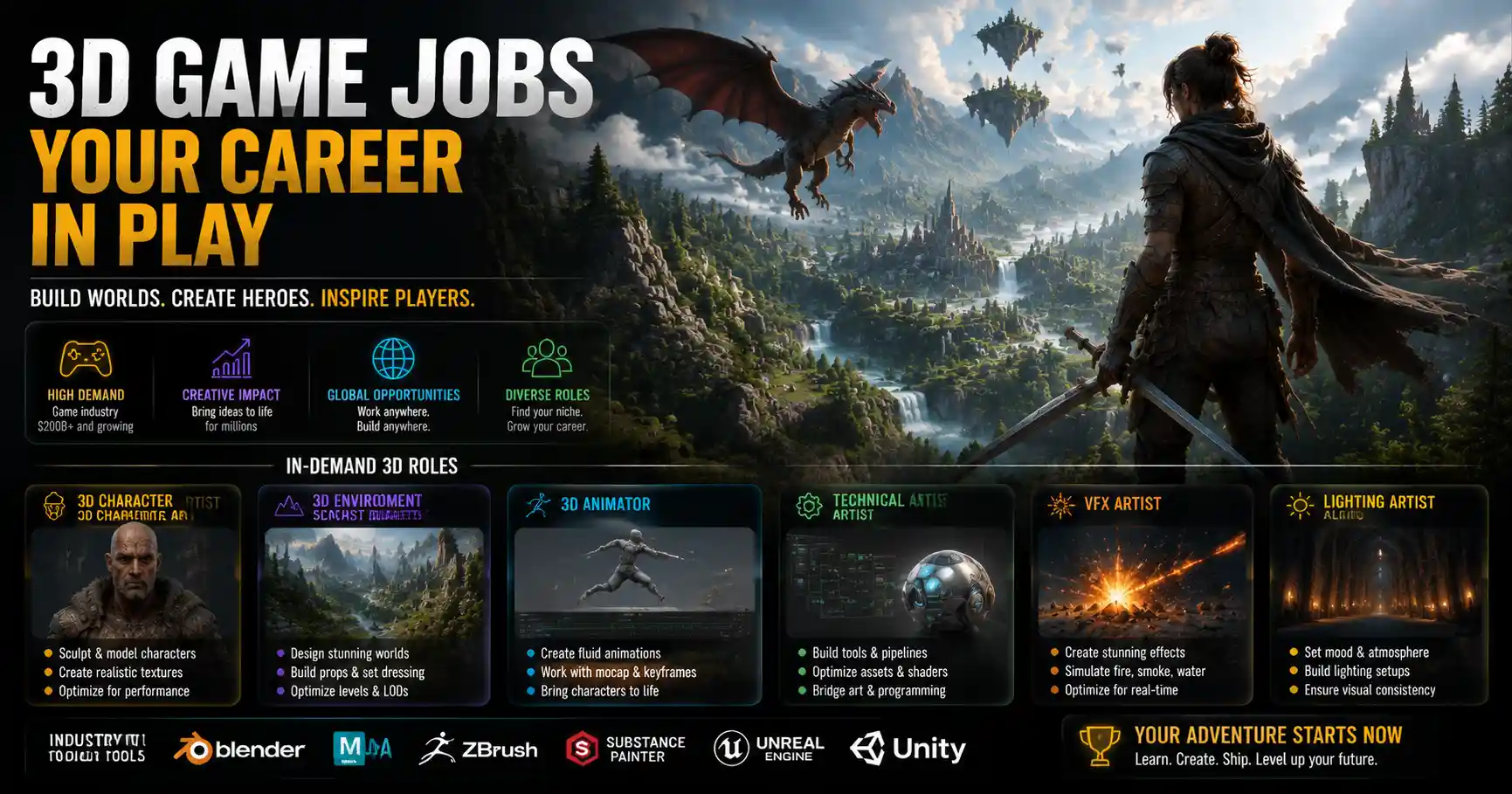
As the global video game industry tops $200 billion in annual revenue and consumer demand for immersive, visually stunning experiences grows, 3D roles have become the backbone of modern game development. From the sprawling, photorealistic open worlds of *The Legend of Zelda: Tears of the Kingdom* to the lifelike character animations in *God of War Ragnarök*, every detail players interact with is shaped by skilled 3D game industry professionals. Whether you’re an aspiring artist considering a career shift, a recent graduate exploring creative tech roles, or a developer looking to specialize, understanding the landscape of 3D game jobs is key to navigating this fast-growing, dynamic field.
The Most In-Demand 3D Roles in Modern Game Development
The 3D game development pipeline is split into specialized roles, each with distinct responsibilities, skill requirements, and career trajectories. As studios adopt more agile development workflows and bigger production budgets, demand for specialists (rather than generalists) has grown, though small indie teams still value developers who can wear multiple hats. Below are the most common and sought-after 3D roles in the industry today.
3D Character Artist
3D character artists create the virtual people, creatures, and enemies that players interact with throughout a game. This role requires a mix of artistic creativity and technical precision: artists must sculpt anatomically accurate models, design detailed textures that match the game’s art style, and ensure models are optimized to run smoothly on consoles, PCs, and mobile devices. Character artists often collaborate closely with concept artists and animators to bring initial designs to life, adapting 2D sketches into fully realized 3D assets. For high-budget AAA games, many character artists specialize further, focusing on either high-poly sculpting for cinematics or low-poly optimization for real-time gameplay.
3D Environment Artist
If character artists build the actors, environment artists build the stage. These 3D professionals create the landscapes, buildings, props, and backgrounds that make up game worlds. From a post-apocalyptic city overgrown with foliage to a cozy fantasy village tucked into mountains, environment artists balance aesthetic appeal with performance, ensuring large open worlds don’t cause frame rate drops or long load times. A key skill for modern environment artists is procedural world generation and level of detail (LOD) optimization, which allows studios to build massive open worlds without sacrificing performance. Many environment artists also work with terrain tools and photogrammetry to scan real-world locations and integrate them into game assets.
3D Animator
3D game animators bring static 3D models to life, creating everything from walking cycles and combat moves to subtle facial expressions that convey emotion. Unlike animators working on animated films, game animators must create animations that work in real time, adapting to player input rather than following a fixed sequence. For example, a game animator might create 10 different variations of a character running up a slope, so the game can smoothly switch between animations based on the player’s movement. With the rise of performance capture, many game animators now work to clean up and refine motion capture data, adding custom keyframes to make movements feel more natural and stylized.
Technical Artist
Technical artists are the bridge between art and engineering teams, solving technical problems that arise during 3D asset creation. Common responsibilities include developing custom tools for artists, optimizing asset performance, setting up shader workflows, and ensuring consistent lighting across all areas of a game. As games grow more complex, technical artists have become one of the most in-demand 3D roles in the industry, with many studios reporting open positions that go unfilled for months due to a lack of qualified candidates. This role requires a mix of artistic understanding and coding skills, making it a great fit for developers who enjoy both creative and technical work.
Other Key 3D Roles
Beyond these core positions, there are a number of niche 3D roles that have grown in popularity in recent years. VFX artists create 3D effects like explosions, weather, and magic. Texture artists specialize exclusively in creating high-quality surface textures for 3D models. Riggers prepare character models for animation by building the internal "skeleton" that allows animators to manipulate movement. Lighting artists set up dynamic lighting and shadows to set the mood of game environments and ensure visual consistency.
Core Skills and Qualifications Required for 3D Game Jobs
Breaking into a 3D game role requires a mix of technical software skills, creative intuition, and industry-specific knowledge. While some professionals enter the field with a formal degree in game art or computer graphics, many successful 3D game artists are self-taught, building their skills through online courses and personal projects. Below are the non-negotiable and nice-to-have skills for most 3D game roles.
Essential Technical Skills
Every 3D game professional needs mastery of the standard tools used across the industry. The specific software depends on the role, but most studios use the same core suite of programs:
- Autodesk Maya or Blender: The industry standard for 3D modeling, rigging, and animation. Blender, the free open-source alternative, has become widely accepted in recent years, making it easier than ever for aspiring artists to learn without investing in expensive software licenses.
- ZBrush: The go-to tool for high-poly sculpting of characters and detailed assets, used in nearly every AAA studio for creating high-resolution models.
- Substance Painter/Designer: The standard for creating and texturing PBR (physically based rendering) assets, which ensure materials look realistic under different lighting conditions in real time.
- Game Engines: Proficiency in either Unity or Unreal Engine is required for most 3D roles, as artists need to import and test their assets to ensure they work correctly in the game environment.
Beyond software skills, understanding core graphics concepts is critical. All 3D game professionals need to know how polygon count, LOD optimization, UV mapping, and PBR workflows work, even if they don’t handle those tasks every day. For technical roles like technical art, additional skills in Python, C++, or shader programming are usually required.
Creative and Soft Skills
Technical skill alone isn’t enough to succeed in 3D game jobs. Artists need a strong foundation in core art principles like anatomy, perspective, color theory, and composition to create assets that look good and fit the game’s artistic vision. For example, a character artist who doesn’t understand human anatomy will struggle to create a realistic protagonist that moves naturally during gameplay.
Soft skills are equally important. Game development is a collaborative process, and 3D artists must be able to accept feedback from art directors, adapt designs to meet changing project requirements, and work within tight deadlines. Communication skills are critical: artists need to explain technical constraints to non-technical team members and understand the design goals that producers and game designers are trying to achieve.
Formal Education vs. Self-Taught Paths
There is no single "right" path to a 3D game job. Many AAA studios require a bachelor’s degree in fine art, computer graphics, game design, or a related field, but an increasing number of studios are prioritizing portfolio quality over formal education. For example, Riot Games, Bungie, and other major studios have publicly stated that they don’t require a degree for most art roles, as long as applicants can demonstrate their skills through a strong portfolio. Online learning platforms like ArtStation Learning, Udemy, and CGMA offer affordable, industry-focused courses that can help aspiring artists build the skills they need, and many self-taught artists have successfully landed jobs at top studios by sharing their work on social media and building a professional network.
Salary and Career Outlook for 3D Game Industry Professionals
The game industry’s rapid growth has translated to strong salaries and high demand for skilled 3D professionals. Salaries vary based on experience, location, studio size, and role type, but the overall outlook is positive for new and mid-career professionals. Let’s break down current compensation trends in major English-speaking markets.
Average Salaries by Role and Region
According to 2024 data from Glassdoor, PayScale, and the Game Developers Association, average base salaries for full-time 3D game roles break down as follows:
- Entry-level (0-2 years experience): $45,000-$65,000 USD in the U.S., £30,000-£40,000 GBP in the UK, CAD $50,000-CAD $70,000 in Canada, and AU $55,000-AU $75,000 in Australia. Entry-level roles are usually junior artist positions, where new hires work under the supervision of senior artists.
- Mid-level (3-5 years experience): $70,000-$95,000 USD in the U.S., £45,000-£60,000 GBP in the UK, CAD $75,000-CAD $100,000 in Canada, and AU $80,000-AU $105,000 in Australia. Mid-level artists work independently on assigned assets and take on more responsibility for project milestones.
- Senior-level (5+ years experience): $95,000-$140,000+ USD in the U.S., £65,000-£90,000 GBP in the UK, CAD $105,000-CAD $150,000 in Canada, and AU $110,000-AU $150,000+ in Australia. Senior 3D artists often lead teams, mentor junior artists, and make key creative decisions for projects. Specialized roles like technical artists or technical art directors can earn 15-20% more than this range due to high demand.
It’s important to note that these are base salaries, and many studios offer additional compensation in the form of project bonuses, profit sharing, stock options, and royalties for successful games. Freelance 3D artists can earn even more, with experienced freelancers charging $500-$2,000 per asset depending on complexity, though income can be less consistent than full-time roles.
Current Career Growth Trends
"The demand for skilled 3D artists hasn’t slowed down in 10 years, and it’s not going to any time soon. Every new console generation pushes the demand for higher quality assets, and the growth of VR, AR, and AI-powered tools means we need more specialized 3D talent than ever before. The biggest gap right now is for professionals who understand both art and technology—technical artists in particular are almost impossible to hire right now."
The global game industry is expected to grow at a compound annual growth rate of 12% through 2030, driven by the rise of cloud gaming, virtual reality, and mobile gaming. This growth is translating to more 3D jobs: the U.S. Bureau of Labor Statistics projects 16% growth for multimedia artists and animators through 2030, more than twice the average growth rate for all occupations.
New technologies are also creating new 3D job opportunities outside traditional AAA and indie game development. Meta, Apple, and other companies building virtual and augmented reality platforms are hiring thousands of 3D artists to build immersive environments for the metaverse and spatial computing. Brands are also creating 3D advergames and virtual experiences, opening up new non-game job opportunities for 3D game artists who want to work outside the traditional game industry.
How to Break Into the Industry: Practical Advice for Aspiring 3D Artists
Breaking into 3D game jobs can feel competitive, especially for new entrants, but with the right preparation, it’s entirely achievable. Many new artists make the mistake of focusing too much on learning software and too little on building a portfolio that demonstrates their skills to studios. Below is actionable advice to help you land your first 3D game job.
Build a Targeted Portfolio That Stands Out
Your portfolio is the most important tool you have to get hired. Recruiters and art directors spend an average of 2-3 minutes reviewing a new portfolio, so it needs to be clear, focused, and demonstrate exactly what you can do. For example, if you’re applying for a character artist role, your portfolio should lead with your best character work, not random environment models or personal projects unrelated to the role.
Here are key tips for building a strong 3D game portfolio:
- Include 3-5 of your best projects, not every piece you’ve ever created. A small number of high-quality projects is better than a large number of mediocre ones.
- Show the full workflow for at least one project: include concept art, high-poly sculpt, low-poly optimized model, texture work, and in-engine screenshots to demonstrate you understand the full pipeline.
- Include at least one personal project that demonstrates your creativity and initiative. Fan art of popular game characters or environments is fine, as long as it’s original and shows your skill.
- Host your portfolio on a dedicated platform like ArtStation, which is the industry standard for game art professionals. Avoid generic social media or hard-to-navigate personal websites.
Network and Gain Experience
Networking is one of the most effective ways to find job opportunities in the game industry. Many roles are never posted publicly, and studios often hire artists who come highly recommended from current employees. Start by joining industry communities like ArtStation, Polycount, Reddit’s r/GameDevClassifieds, and local game development meetups. Attend industry events like GDC (Game Developers Conference) or PAX, even if you go as an attendee, to connect with professionals and learn about the industry.
If you don’t have any professional experience, consider contributing to an indie game project or participating in a game jam like Global Game Jam. Game jams allow you to build a complete game in 48 hours, giving you hands-on experience working with a team and adding a finished project to your portfolio. Even unpaid work on a small indie game can give you the experience and references you need to land your first paid role.
Prepare for the Interview Process
The interview process for 3D game roles almost always includes a technical test, where you’ll be asked to complete a 3D asset creation project within a set time frame (usually 1-2 weeks). This test is designed to assess your workflow, attention to detail, and ability to meet requirements. Always optimize your assets for the game engine as requested, and document your process so the studio can see how you approached the problem.
Before the interview, research the studio’s portfolio of games and understand their art style. If you’re applying to a studio that makes cartoonish party games, don’t bring a portfolio full of hyper-realistic horror game assets—adapt your portfolio to match the type of games the studio makes.
Challenges and Opportunities in the Evolving 3D Game Job Market
The 3D game industry is changing rapidly, driven by new technologies like artificial intelligence that are reshaping how 3D assets are created. These changes bring both challenges and new opportunities for 3D game professionals.
The Impact of AI on 3D Game Jobs
AI-powered 3D tools like Adobe Firefly, 3DFY.ai, and Instant NeRF can now generate basic 3D models and textures from text prompts in minutes, leading some aspiring artists to worry that AI will replace human 3D professionals. But industry leaders agree that AI is a tool, not a replacement, for skilled artists. AI can automate repetitive tasks like creating basic texture variations or generating blockout meshes for environments, freeing up artists to focus on creative work, refinement, and problem-solving.
For example, an environment artist can use AI to generate a dozen base textures for a stone wall, then spend their time refining those textures to match the game’s art style and fix any artifacts the AI generated. This allows artists to create more assets in less time, which means studios can develop bigger, more detailed games—and actually need more artists, not fewer, to handle the increased scope of projects. Artists who learn to integrate AI tools into their workflow will have a major advantage in the coming years, as studios increasingly adopt these tools to speed up production.
Common Challenges in 3D Game Careers
Like any creative industry, 3D game jobs come with unique challenges. Crunch time, where developers work long overtime hours to finish a project before a release deadline, is still common in the industry, though many studios have adopted policies to reduce or eliminate crunch in recent years. Freelance artists face inconsistent income and the need to constantly find new clients, while full-time artists may face layoffs after a project is completed, especially at AAA studios that downsize after big game launches.
Another challenge is the constant need to learn new tools and technologies. The 3D game industry changes quickly, and new software, workflows, and console generations require artists to update their skills regularly throughout their career. Artists who don’t continue learning can find their skills become outdated, making it harder to find new jobs.
New Opportunities for 3D Professionals
Beyond the growth of the game industry itself, 3D game skills are in high demand in adjacent industries. 3D game artists can easily transition to roles in film and animation, architectural visualization, product design, virtual reality, and advertising, all of which need skilled 3D professionals with experience creating real-time assets. This gives 3D game professionals more career flexibility than many other creative roles, allowing them to switch industries if they want a change of pace.
The rise of user-generated content (UGC) in games like Roblox, Fortnite, and Minecraft has also created new opportunities for independent 3D artists to sell their assets directly to players and creators, opening up a new revenue stream that didn’t exist a decade ago. Many 3D artists now earn a full-time income selling assets on platforms like the Unity Asset Store, Unreal Engine Marketplace, and Roblox Creator Marketplace, giving them the freedom to work independently without being tied to a single studio.
Conclusion
3D jobs are the backbone of the modern game industry, offering creative, well-paid career opportunities for skilled professionals with a mix of artistic and technical ability. The demand for 3D talent continues to grow, driven by rising consumer expectations for immersive game experiences, new technologies like virtual reality, and AI tools that streamline production rather than replace human creativity. Whether you’re just starting out or looking to shift your career into game development, success comes down to building targeted skills, creating a strong portfolio that showcases your strengths, and staying adaptable as the industry evolves. For those willing to put in the work to master their craft, a 3D game job offers the chance to create immersive experiences that millions of players around the world will enjoy for years to come.