
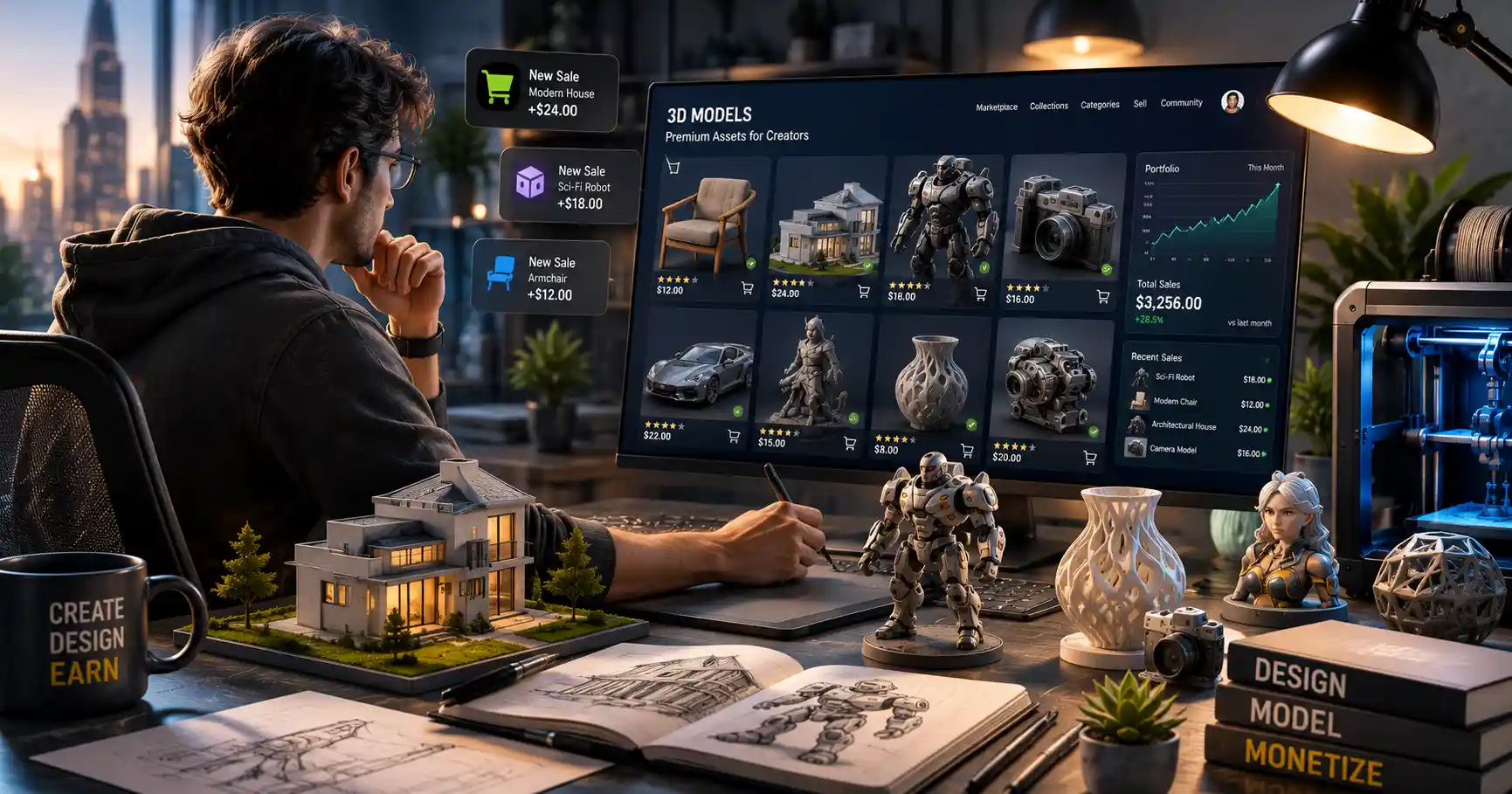
With 3D printing growing more accessible by the year and industries from gaming to architecture relying on digital 3D assets every day, many creative hobbyists and professional designers are asking the same question: can you actually make money selling 3D models? The short answer is yes, but turning 3D modeling skills into a steady income stream takes more than just uploading a few files and waiting for sales. Whether you’re a blender enthusiast creating decorative figurines for 3D printing, a game designer crafting environment assets for indie studios, or an architect sharing premade building models, there’s a growing global market for high-quality 3D models—if you know how to navigate it.
The Current Market for 3D Models: Who’s Buying, and Why?
The 3D model market has exploded over the past decade, driven by two major trends: the mainstream adoption of 3D printing for hobbyist and small business use, and the rapid growth of the global gaming, animation, and extended reality (XR) industries. According to recent industry reports, the global market for 3D modeling services is projected to exceed $40 billion by 2028, with ready-to-use 3D models accounting for a growing share of that revenue. Unlike custom 3D modeling work, which requires one-on-one client collaboration, pre-made 3D models can be sold an unlimited number of times to hundreds of different buyers, making them a great source of passive income for creators.
To understand what sells, it helps to break down the main types of buyers active in the market today:
Hobbyist 3D Printing Enthusiasts
This is one of the fastest-growing segments of the market. Millions of people now own consumer 3D printers, and they’re constantly searching for new files to print—from decorative figurines and cosplay props to household organizers and custom jewelry. Most buyers in this segment are looking for affordable, print-ready files that don’t require extra editing, with clear instructions for different printer sizes and materials.
Indie Game and Animation Developers
Small game studios and independent animators rarely have the budget or time to build every single asset they need from scratch. A single indie game can require hundreds of 3D assets, from character models and environment pieces to furniture, vehicles, and decorative props. Buying pre-made models cuts down development time from weeks to days, making high-quality, low-cost 3D assets extremely valuable for this group.
Architects, Interior Designers, and Real Estate Professionals
Architects use premade 3D models of furniture, fixtures, and landscape elements to speed up the process of creating visualizations for clients. Real estate developers and interior designers also use 3D models to create virtual walkthroughs of properties before construction is complete, saving time and helping clients visualize the finished space.
Advertising, Marketing, and XR Creators
Brands and marketing agencies use 3D models for everything from product visualizations in ads to interactive AR filters on social media. XR developers building virtual reality (VR) experiences or augmented reality (AR) apps also need a constant supply of optimized 3D assets to populate their virtual environments.
“The biggest mistake new 3D model sellers make is trying to appeal to everyone. If you niche down—say, you only create high-quality fantasy figurines for 3D printing, or optimized low-poly trees for indie games—you’ll build a loyal customer base much faster than if you upload a random mix of unrelated models.”
Within each of these segments, demand varies widely. For 3D printable models, popular niches include cosplay, home decor, tabletop gaming miniatures, and personalized gifts. For digital assets used in games and animation, demand is highest for low-poly, game-ready assets that are optimized for real-time rendering. No matter what niche you choose, the core of a successful 3D model business is creating models that solve a specific problem for a specific group of buyers.
Legal Basics: What You Can (and Can’t) Sell
Before you upload your first 3D model for sale, it’s critical to understand the legal rules around 3D model sales. Selling infringing content can get your account banned from marketplaces, lead to copyright strikes, or even result in legal action, so taking the time to get this right is non-negotiable.
Copyright and Intellectual Property Rules
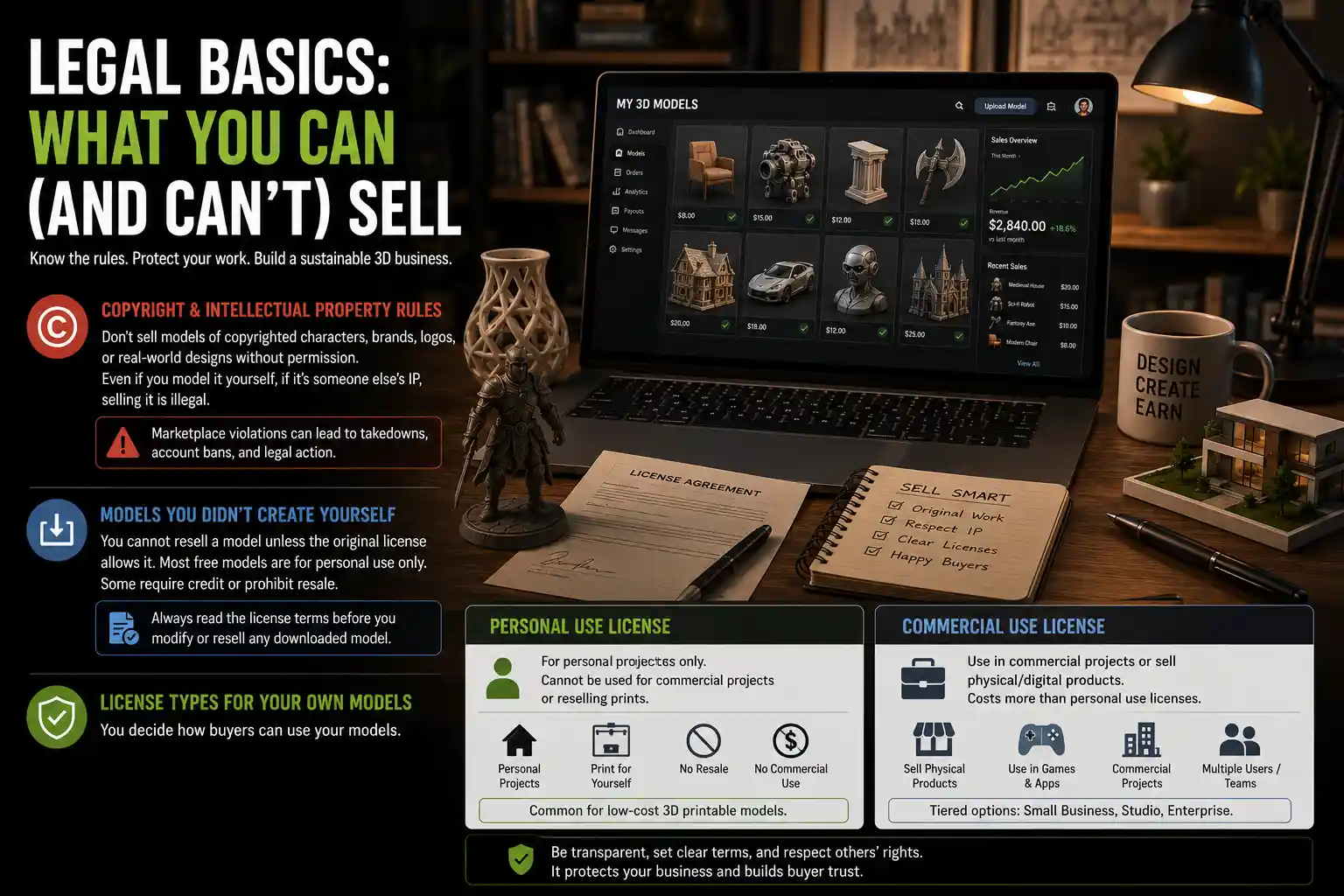
The most common legal pitfall for new sellers is selling models of copyrighted intellectual property (IP). This includes everything from Disney characters, Marvel superheroes, and popular movie franchises to branded products, logo designs, and even architectural designs of famous buildings. Even if you create the model from scratch, if it’s based on someone else’s copyrighted IP, selling it without permission is illegal.
There are a few exceptions to this rule. For example, many fan-made models are sold under the radar on small platforms, but that doesn’t make them legal. Large marketplaces like CGTrader and Thingiverse actively remove infringing content, and repeated violations will result in account termination. If you want to create and sell fan art 3D models, your safest bet is to work out an official license agreement with the IP holder, though this is usually only accessible to established creators.
What About Models You Didn’t Create Yourself?
If you downloaded a free 3D model from another site, can you modify it and resell it? That depends entirely on the license the original creator released it under. Most free 3D models come with a personal use only license, which prohibits reselling, even if you make changes. Some licenses allow commercial use, but many require you to credit the original creator or prohibit reselling the model as a standalone product. Always read the full license terms before you resell any model that isn’t 100% your original work.
License Types for Your Own Models
When you sell your own 3D models, you get to choose what license buyers get. The two most common options are:
- Personal Use License: Buyers can only use the model for their own personal projects (for example, printing a figurine for their own home). They can’t resell prints of the model or use it in commercial projects. This is the most common license for low-cost 3D printable models.
- Commercial Use License: Buyers can use the model in commercial projects, such as including it in a game they sell or printing multiple copies to sell in their own shop. Commercial licenses usually cost more than personal use licenses, and many creators offer tiered pricing for different levels of commercial use (for example, a small business license vs. an enterprise license for large studios).
Most major 3D model marketplaces handle license management for you, so you just have to select the type of license you want to offer and set your price accordingly. Always make your license terms clear upfront to avoid disputes with buyers later on.
Top Platforms to Sell 3D Models
Choosing the right platform to sell your 3D models is one of the most important decisions you’ll make as a seller. Different platforms cater to different types of buyers and take different cuts of your revenue, so it’s important to pick one that aligns with your goals and your niche. Below are the most popular options, broken down by category.
Marketplaces for 3D Printable Models
If you’re selling models designed for 3D printing, these are the most popular platforms to reach buyers:
- Cults3D: Based in Europe, Cults3D is one of the most popular marketplaces for 3D printable designs, with a large global community of buyers. Sellers keep 80-95% of their revenue, depending on your seller level, and there’s no monthly fee. The platform also allows you to sell directly to buyers through your own profile, making it easy to build your own audience.
- CGTrader: CGTrader caters to both 3D printable models and digital assets for games and animation. It takes a 15% cut of sales for most sellers, dropping to 10% for sellers who make over $1000 per month. The platform has a large existing audience of buyers, and it handles payment processing and customer support for you.
- MyMiniFactory: MyMiniFactory allows you to sell 3D models for a 10% commission, and it offers a guarantee that all models on the platform are 3D printable, which gives buyers more confidence. The platform also runs regular design challenges with cash prizes for new creators, which is a great way to get exposure when you’re just starting out.
- Thangs: Thangs is a newer 3D model search engine and marketplace that has grown quickly in popularity thanks to its powerful search tools. It offers flexible seller terms, with creators keeping up to 90% of their revenue.
Many 3D printable model sellers also use Patreon to build a subscription business, where supporters pay a monthly fee to get access to exclusive new models. This can be a much more steady source of income than one-off sales, especially if you release new designs regularly.
Marketplaces for Digital 3D Assets (Non-Printable)
If you’re selling 3D assets for games, animation, or architecture, these platforms are the best places to start:
- TurboSquid: TurboSquid is one of the largest and most well-known marketplaces for professional 3D models. It caters to commercial buyers, and commission rates range from 40% to 60% (meaning you keep 40-60% of each sale, depending on whether you sell exclusively on TurboSquid). The platform has a strict quality review process, so only high-quality models are accepted, which means less competition for sellers who meet the standards.
- Unity Asset Store and Unreal Engine Marketplace: If you create game-ready 3D assets, selling directly on the official marketplaces for Unity or Unreal Engine puts your models in front of hundreds of thousands of game developers. Commission rates are 30% for most sales, which is standard for the industry. These marketplaces drive huge volumes of traffic, so a popular asset can generate thousands of dollars in passive income for years.
- Sketchfab: Sketchfab is a popular platform for sharing and selling 3D models, with built-in 3D viewing that allows buyers to preview your model directly in their browser before purchasing. Commission rates start at 30%, and the platform caters to both commercial buyers and 3D printing enthusiasts.
- Etsy: While Etsy is best known for physical products, it’s also a popular place to sell digital 3D model files, especially for 3D printable designs like jewelry, home decor, and personalized gifts. Etsy charges a small listing fee and a 6.5% transaction fee, which is lower than many dedicated 3D marketplaces, and it has a huge built-in audience of buyers looking for creative digital products.
Selling on Your Own Website
Once you’ve built an audience, you can also sell directly from your own website using tools like WooCommerce, Shopify, or Payhip. Selling on your own site means you keep 100% of your revenue (minus payment processing fees) and you have full control over your brand and your pricing. The downside is that you have to drive all your own traffic, which takes time and marketing effort. Most successful sellers start out on established marketplaces to build an audience, then move a portion of their sales to their own website to increase profits.
Proven Tips to Maximize Your 3D Model Sales
Just uploading your models to a marketplace isn’t enough to generate consistent sales. The 3D model market is competitive, but there are several simple strategies you can use to stand out from the crowd and increase your revenue.
Niche Down to Reduce Competition
As we mentioned earlier, niching down is one of the most effective ways to build a successful 3D model business. Instead of creating “general” 3D models, focus on a specific niche that has consistent demand but not too much competition. For example, instead of creating generic fantasy miniatures, focus on 3D printable Victorian steampunk miniatures for tabletop gamers. Instead of creating generic furniture models for architects, focus on optimized 3D models of modern office furniture for commercial real estate visualizations. Niching down makes it easier for buyers to find you, and it helps you build a reputation as an expert in your specific area.
Prioritize Quality and Usability
One of the biggest complaints buyers have about cheap 3D models is that they’re not ready to use. For 3D printable models, that means the model has errors that prevent it from slicing or printing correctly, or it’s too big for standard consumer printers. For game assets, that means the model has too many polygons, the texture resolution is wrong, or it’s not properly UV-mapped. Taking the extra time to test your model and fix any errors before you upload it will lead to better reviews, repeat customers, and higher rankings on marketplaces.
Small touches that improve usability can also make a big difference. For 3D printable models, include pre-supported versions of the model for different printer sizes, add a README file with printing tips, and include multiple file formats (STL, OBJ, etc.) so buyers can use the file no matter what slicer software they use. For game assets, include multiple LODs (level of detail) versions of the model, and make sure textures are properly packed and named.
Optimize Your Listings for Search
Most buyers find 3D models by searching on marketplaces or Google, so optimizing your listing for search is critical to getting traffic. Include relevant keywords in your title and description that buyers would actually use to search for your model. For example, instead of naming your listing “Blue Vase,” name it “Modern Blue Ceramic Vase 3D Model for Architectural Visualization.” Include details like polygon count, polygon count, texture resolution, file formats, and license terms in your description, because many buyers filter results based on these details.
High-quality previews are just as important as good keywords. Most buyers will decide whether to click on your listing based on your preview images, so take the time to render professional-looking previews that show off your model from multiple angles. For 3D printable models, include photos of the finished printed model if you can—this proves that the model prints correctly and gives buyers confidence to purchase.
Price Your Models Competitively
Pricing your 3D models can be tricky, but the general rule is to price based on the amount of work you put in and the value the model provides to the buyer. Low-detail 3D printable models like small household organizers usually sell for $1-$5, while high-detail cosplay props or large miniatures can sell for $10-$50 or more. Professional 3D assets for games or architecture usually sell for $10-$200+, depending on the complexity and the license.
Offering bundles is a great way to increase your average order value. For example, instead of selling 10 different tree models individually for $5 each, sell a bundle of 10 trees for $30. Buyers get a better deal, and you make more money per sale than you would from individual purchases.
Build Your Audience Outside Marketplaces
Relying solely on marketplace traffic means your business is at the mercy of algorithm changes or account bans. Building your own audience on social media or through an email list helps you drive consistent traffic to your listings and grow your business over time. Many 3D creators share work-in-progress clips, finished prints, and tips on TikTok, Instagram, or YouTube, which helps them attract new followers who then go on to buy their models. If you create consistent content focused on your niche, you can build a large following much faster than you might think.
How Much Money Can You Actually Make Selling 3D Models?
This is the question every new seller wants to answer: how much can you realistically earn? The truth is that income varies wildly depending on your niche, the quality of your work, how many models you have for sale, and how much time you put into marketing.
For hobbyists who just upload a few models in their spare time, it’s common to make anywhere from $10 to $100 per month. This is enough to cover the cost of a 3D printer or new software, but it’s not a full-time income. For creators who upload new models regularly and focus on building an audience, it’s not uncommon to make $500 to $2,000 per month. Many full-time 3D model sellers make $3,000 to $10,000+ per month, especially if they offer subscription memberships on Patreon or their own site in addition to one-off sales.
The biggest advantage of selling 3D models is that it’s largely passive income. Once you create and upload a model, it can stay for sale and generate income for years with no extra work from you. That means the more high-quality models you add to your portfolio over time, the more your passive income will grow. A creator with 100 high-quality models in their portfolio will almost always make more than a creator with 10 models, even if both have the same level of marketing effort.
It’s important to remember that building a successful 3D model business takes time. Most new sellers don’t make hundreds of dollars in their first month. It usually takes 3-6 months of consistently creating and uploading new models before you start seeing consistent sales, and a year or more to build a full-time income. But if you’re willing to put in the work upfront, it can become a very flexible, rewarding source of income.
Conclusion
Selling 3D models is not a get-rich-quick scheme, but it is a legitimate way to turn your 3D modeling skills into extra income or even a full-time career. The market for 3D models is growing every year, driven by 3D printing, indie game development, and the rise of XR content, and there is room for new creators in almost every niche.
To get started, choose a niche that aligns with your skills and interests, make sure you understand the legal rules around what you can sell, pick a platform that fits your goals, and focus on creating high-quality, usable models that solve a real problem for buyers. Over time, as you build your portfolio and your audience, you can scale your income and enjoy the benefits of passive recurring revenue from work you do once.
Whether you’re a hobbyist looking to offset the cost of your 3D printer or a professional designer looking for a new stream of income, selling 3D models is a flexible, accessible opportunity that’s worth exploring. With the right approach, you can start generating sales in just a few months and build a creative business that fits your lifestyle.