

If you’ve spent hours tweaking a 3D model of a gaming character, architectural visualization, or a product prototype for a 3D print, you’ve probably wondered: can I turn this work into real money? The explosion of 3D content demand across gaming, e-commerce, 3D printing, and extended reality (XR) has turned 3D modeling from a niche hobby into a viable side hustle or full-time career for thousands of creators. But how much can you actually expect to make selling 3D models, and what separates casual sellers earning pocket change from full-time creators making six figures? This guide breaks down earning potential by niche, platform, and experience level to give you a clear, realistic picture of what’s possible.
Average Earnings by Niche: Which 3D Model Categories Pay the Most?
Your earning potential depends heavily on the category of 3D models you create. Different industries have wildly different budgets and demand levels, so choosing the right niche is one of the biggest factors that determines how much you can make. Let’s break down the most popular niches and their typical earning ranges.
Gaming & Character Assets
The global video game industry is worth over $200 billion, and indie studios and large developers alike are constantly sourcing pre-made 3D assets to cut down development time. Individual low-poly character models or environment assets (like rocks, trees, or furniture) typically sell for $5–$50 each, depending on complexity. High-poly, fully rigged characters with multiple texture sets can sell for $100–$500+ per model. Many sellers in this niche earn $100–$1,000 per month as a side hustle, while top sellers with libraries of hundreds of popular assets can earn $5,000–$15,000+ per month. The key here is volume: popular game assets get repeated downloads, so a large library of consistent quality generates passive income for years.
Architectural Visualization Assets
Architecture firms and real estate developers rely on 3D visualization to showcase projects before they’re built, and they rarely build every furniture fixture, decor piece, or landscape asset from scratch. Pre-made architectural assets (like kitchen cabinets, sofas, lighting fixtures, or full building facades) typically sell for $10–$200 each. Because these assets are often high-resolution and optimized for professional rendering, they command a premium over generic gaming assets. Full-time creators specializing in this niche often earn $3,000–$8,000 per month, with top sellers earning over $10,000 per month from repeat sales to architecture studios.
3D Printable Models
The consumer 3D printing market has exploded over the past decade, with millions of hobbyists owning their own printers and constantly looking for new models to print. 3D printable models range from small keychains and figurines to functional replacement parts and full-size cosplay props. Small, simple models typically sell for $1–$10, while large, complex cosplay props or articulated figures can sell for $20–$100+. Many hobbyist sellers in this niche earn $50–$500 per month, but successful creators who build a loyal audience on platforms like Patreon or CGTrader can earn $2,000–$10,000+ per month. The biggest advantage of this niche is the high engagement: 3D printing hobbyists often become repeat subscribers, creating consistent monthly recurring revenue.
Product & Advertising Models
E-commerce brands and marketing agencies need high-quality 3D models of products for virtual catalogs, ads, and AR try-on experiences. A single 3D model of a consumer product (like a chair, watch, or bottle) can command $50–$500 for a custom commercial license, while pre-made product assets sell for $20–$200 each. As more brands shift to 3D content for social media and AR shopping, demand for this category is growing faster than almost any other niche. Freelance creators focusing on custom product models can easily earn $4,000–$12,000 per month, with top creators charging thousands of dollars per project for large brands.
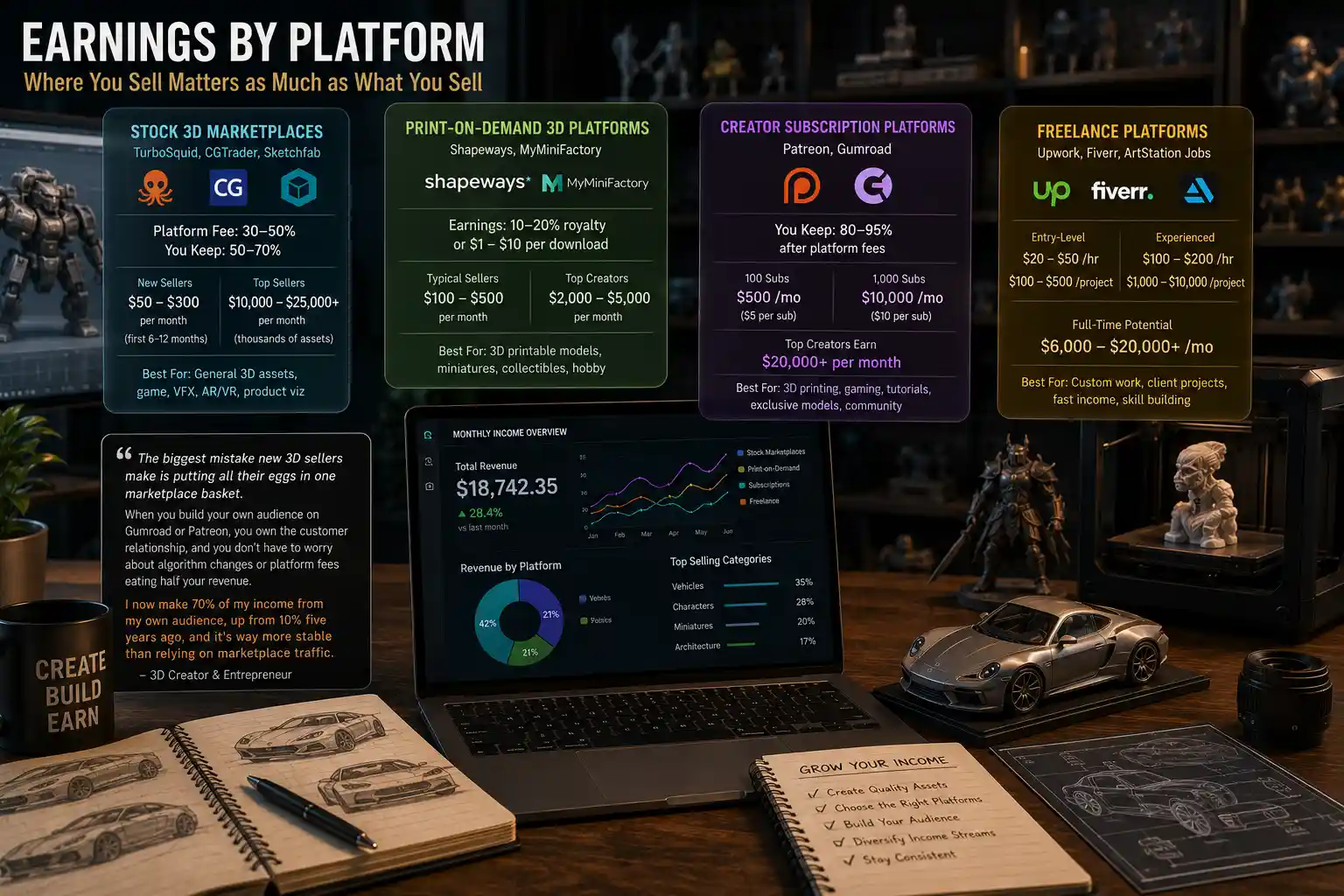
Earnings by Platform: Where You Sell Matters as Much as What You Sell
The platform you choose to sell your 3D models directly impacts your take-home pay, audience size, and long-term growth potential. Each platform has its own fee structure, audience demographics, and earning potential, so it’s important to match your niche to the right platform. Below is a breakdown of earning potential on the most popular platforms for selling 3D models.
Stock 3D Marketplaces (TurboSquid, CGTrader, Sketchfab)
Stock marketplaces are the most common entry point for new sellers, because they handle payment processing, marketing, and customer support, so you only need to upload your models and wait for sales. These platforms take a 30–50% cut of every sale, which means you keep half or less of the purchase price. For new sellers with a small portfolio, it’s common to earn $50–$300 per month for the first 6–12 months as you build your library. Once you have 50+ high-quality models, many sellers earn $500–$2,000 per month. Top sellers on TurboSquid and Sketchfab with thousands of assets regularly earn $10,000–$25,000 per month, thanks to the passive nature of stock sales: a single model can generate sales for years after you upload it.
Print-on-Demand 3D Platforms (Shapeways, MyMiniFactory)
If you create 3D printable models, print-on-demand platforms let you sell physical prints without owning a printer yourself. You upload your model, set your markup, and the platform handles printing, shipping, and customer service. Typically, creators earn a 10–20% royalty on each physical sale, or a $1–$10 royalty per digital model download. Most hobbyist sellers earn $100–$500 per month here, while top creators with popular printable designs earn $2,000–$5,000 per month.
Creator Subscription Platforms (Patreon, Gumroad)
Subscription platforms let you build a direct relationship with your audience, so you keep 80–95% of revenue after platform fees. Many 3D creators, especially in the 3D printing and gaming niches, offer monthly subscriptions that give subscribers access to exclusive new models every month. The earning potential here scales directly with your audience size: a creator with 100 subscribers paying $5 per month earns $500 per month, while a creator with 1,000 subscribers paying $10 per month earns $10,000 per month. Many top 3D Patreon creators earn over $20,000 per month from subscriptions alone, with additional revenue from one-time sales of older models on Gumroad.
“The biggest mistake new 3D sellers make is putting all their eggs in one marketplace basket. When you build your own audience on Gumroad or Patreon, you own the customer relationship, and you don’t have to worry about algorithm changes or platform fees eating half your revenue. I now make 70% of my income from my own audience, up from 10% five years ago, and it’s way more stable than relying on marketplace traffic.”
Freelance Platforms (Upwork, Fiverr, ArtStation Jobs)
If you prefer creating custom 3D models for clients instead of selling pre-made assets, freelance platforms connect you with clients looking for custom work. Entry-level 3D modelers on Upwork typically charge $20–$50 per hour, or $100–$500 per small project, and can expect to earn $1,000–$3,000 per month working part-time. Experienced 3D modelers with strong portfolios can charge $100–$200 per hour, or $1,000–$10,000 per custom project, and earn $6,000–$20,000+ per month working full-time. The downside of freelance work is that it’s not passive: you have to trade time for money, unlike pre-made models that generate sales while you sleep. But it’s one of the fastest ways to start earning a full-time income as a 3D creator, because you don’t need a large library of models to get started.
Factors That Boost Your Earning Potential: What Top Sellers Do Differently
Two creators with similar skill levels can end up with wildly different incomes selling 3D models, because earning potential depends on more than just how good your models look. Below are the key factors that separate casual sellers earning pocket change from full-time creators building sustainable businesses.
Licensing Strategy
One of the easiest ways to increase your revenue per sale is to offer tiered licensing. Most platforms let you sell the same model at different price points for different use cases, which adds up quickly. A common tiered structure looks like this:
- Personal license: $5–$20, for non-commercial use (hobby 3D printing, personal projects)
- Small commercial license: $20–$100, for use by indie studios or small businesses with revenue under $1 million per year
- Large enterprise license: $100–$1,000+, for use by large corporations or mass production
Offering extended licenses can double or triple your revenue per model, because companies that need commercial usage are happy to pay a premium for legal permission to use the asset in their products. Many top sellers report that 30–40% of their revenue comes from extended license sales, even though they make up less than 10% of total transactions.
Library Size and Consistency
For passive income from pre-made models, volume is king. A single model might earn you $10–$100 per month, but a library of 100 well-optimized, popular models can earn you $1,000–$10,000 per month. Marketplaces prioritize sellers with large libraries because they drive more traffic to the platform, so they’re more likely to show your models in search results if you have a consistent track record of uploads. A common goal for new sellers is to upload one new model per week for the first year, which leaves you with 52 high-quality models in your library by the end of the year. Most sellers hit full-time income within 12–24 months of sticking to this schedule.
Optimization for Search and Usability
A great 3D model won’t sell if no one can find it, and if it doesn’t work for the buyer’s use case. Top sellers spend as much time optimizing their models and listings as they do creating the model itself. Key optimization steps include:
- Adding clear, descriptive titles and tags that include keywords buyers actually search for (for example, “fully rigged low poly medieval knight” instead of “knight model”)
- Providing multiple high-resolution preview images and a 3D embed that lets buyers preview the model before purchasing
- Optimizing the model file: reducing polygon counts where possible, including multiple file formats (FBX, OBJ, STL), organizing layers and groups, and including properly unpacked texture files
- Writing a clear description that lists the model’s poly count, number of textures, file formats, and intended use case
Buyers are willing to pay more for models that just work, without having to spend hours fixing broken files or missing textures. That means positive reviews, higher search rankings, and more repeat sales for sellers who prioritize usability.
Niche Specialization
Generalist sellers who upload a little bit of everything rarely do as well as creators who specialize in a specific niche. For example, a creator who only makes 3D printable tabletop terrain for Dungeons & Dragons will build a loyal audience of tabletop gamers much faster than a creator who uploads terrain, characters, keychains, and architectural assets. Specializing lets you become a go-to creator in your niche, command higher prices, and build an audience that buys every new model you release. Common profitable niches for specialized creators include 3D printable cosplay props, low-poly fantasy game assets, modern kitchen architectural assets, and consumer product models for e-commerce.
Real-World Examples: How Much Do Actual Creators Make?
To give you a realistic sense of what’s possible, let’s look at three real examples of 3D sellers at different experience and income levels.
Beginner Side Hustle: $100–$500 per month
Sarah is a college student who learned 3D modeling in her free time and specializes in small 3D printable figurines of popular pop culture characters (she creates original fan art to avoid copyright issues). She uploads one new model every two weeks to CGTrader and MyMiniFactory, and has 12 models in her library after six months. She prices small models at $5 each, with a $10 commercial license option. On average, she makes 15–20 sales per month, earning $120–$300 after platform fees. She also has a small Patreon with 12 subscribers paying $3 per month for early access, adding an extra $30–$40 per month. Total monthly income: $150–$340, which covers her monthly hobby expenses and a little extra for discretionary spending.
Part-Time Side Hustle: $1,000–$5,000 per month
Mike is a former architectural drafter who creates high-quality modern furniture assets for architectural visualization. He started selling on TurboSquid five years ago, and now has 78 furniture models in his library. He prices models at $20–$80 each, with an extended commercial license for $150–$300. On average, he makes 30–40 sales per month, earning $800–$1,800 after TurboSquid’s 45% fee. He also takes one or two small custom architectural projects per month through ArtStation, charging $1,000–$2,500 per project. Total monthly income: $1,800–$4,300, which he uses to pay off his mortgage and build savings. He’s working towards building his library up to 150 models so he can quit his full-time job and focus on selling 3D models full-time.
Full-Time Business: $10,000–$50,000+ per month
Jesse is a full-time 3D creator who specializes in 3D printable tabletop terrain for wargames and tabletop RPGs. He started selling on Patreon four years ago, and now has 1,800 subscribers paying an average of $10 per month for access to his monthly new releases. That adds up to $18,000 per month in subscription revenue, before Patreon’s fees. He also sells older model packs on Gumroad for $15–$30 each, earning an extra $4,000–$6,000 per month in one-time sales. He also sells a small selection of top models on CGTrader and MyMiniFactory, adding another $2,000–$3,000 per month in passive revenue. Total monthly income: $24,000–$27,000 after platform fees. He now works with a small team of three other creators to produce new models every month, and his income has grown steadily as his audience has grown. Top creators in this niche can earn over $50,000 per month with audiences of 5,000+ subscribers.
It’s important to note that these examples are not outliers: thousands of creators are currently earning at each of these income levels. The biggest difference between them is time invested, library size, and audience building. Beginners rarely start out earning full-time income, but consistent growth over 1–3 years can lead to very comfortable earnings.
Common Mistakes That Keep Your Earnings Low (And How to Avoid Them)
Even talented 3D modelers often struggle to earn meaningful money selling their work because they make avoidable mistakes that limit sales. Here are the most common mistakes and how to fix them:
Ignoring copyright rules: Selling fan art of popular copyrighted characters (like Star Wars or Disney characters) might get you a lot of sales at first, but it can lead to your account being banned and all your revenue being seized. Always create original content, or only sell fan art if you have a proper license. This protects your income and your long-term business.
Overpricing or underpricing your work: New sellers often make one of two mistakes: overpricing simple models and scaring off buyers, or underpricing complex models and leaving money on the table. Research what other sellers in your niche are charging for similar models, and price your work accordingly. Tiered licensing helps solve this, because you can offer a low price for personal use and a higher price for commercial use.
Neglecting audience building: Relying solely on marketplace traffic means you’re at the mercy of algorithm changes and platform fee increases. Even if you’re just starting out, set up an Instagram, TikTok, or YouTube account to share your work and build a following. You don’t need millions of followers; even 100 engaged followers can drive a lot of extra sales to your storefront.
Uploading low-quality or broken files: There’s no faster way to get bad reviews and kill your sales than uploading models with missing textures, broken geometry, or incompatible file formats. Always test your model before uploading it to make sure it works as intended. Buyers will pay more for reliable, well-organized files, and good reviews lead to more traffic and more sales.
Conclusion
How much you can make selling 3D models depends on your niche, the platform you choose, how much time you invest, and how well you optimize your work for buyers. Casual side hustlers with a small library can expect to earn $50–$500 per month, part-time sellers with a consistent upload schedule can earn $1,000–$5,000 per month, and full-time creators with large libraries or loyal subscriber audiences can earn $10,000–$50,000+ per month. Unlike many creative fields, selling 3D models offers the best of both worlds: you can start small with passive pre-made sales, and scale up to a full-time income over time by building your library and audience. The key to success is starting small, focusing on a specific niche, prioritizing quality and usability, and building a direct relationship with your audience over time. If you’re willing to put in the work to build your library, there’s never been a better time to turn your 3D modeling skills into consistent income.