
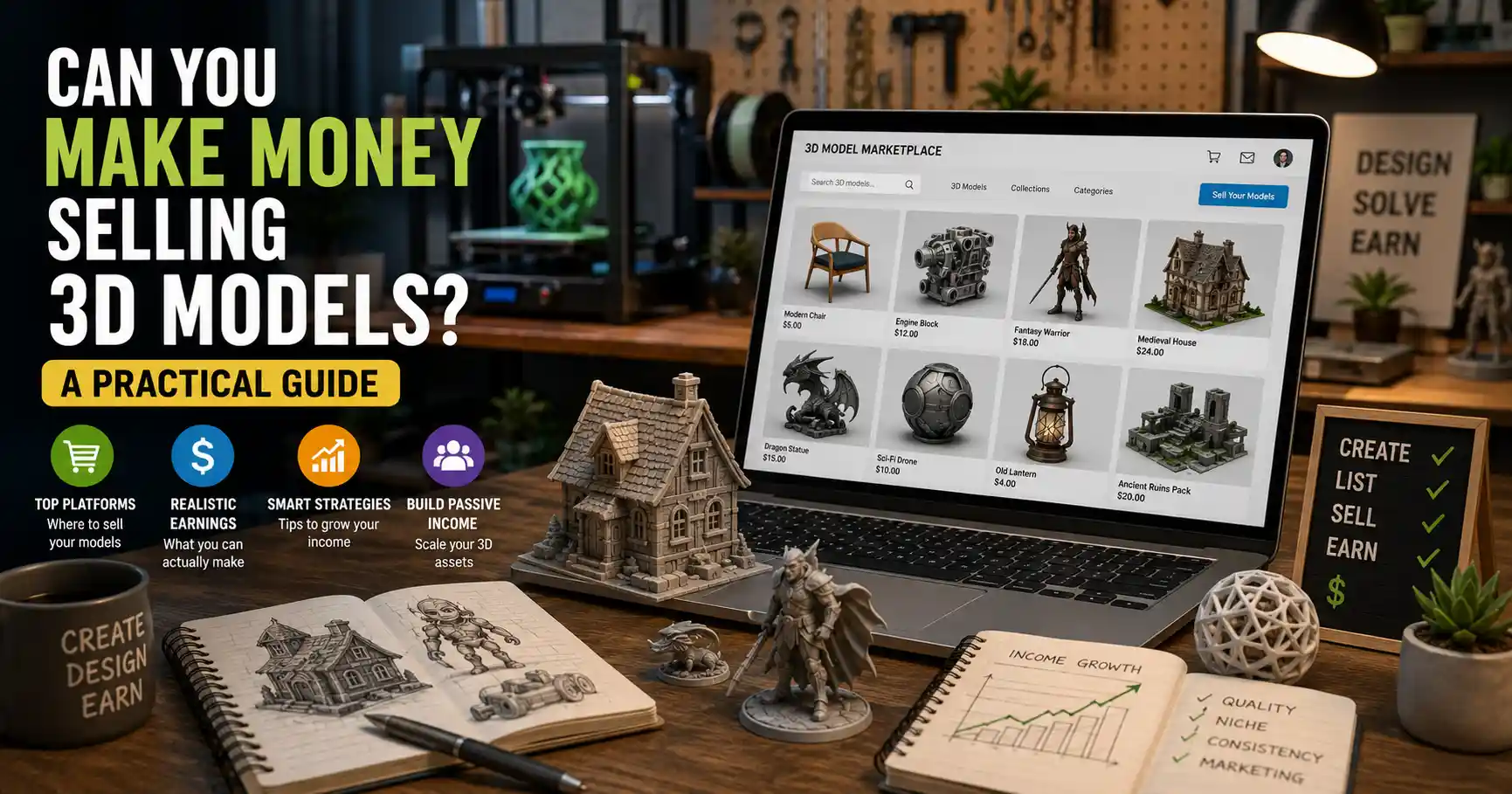
With 3D printing becoming more accessible to hobbyists and businesses alike, and industries from gaming to architecture relying on digital 3D assets every day, you might have wondered if that 3D model you designed for a personal project could actually earn you money. The short answer is yes – but like any creative side hustle or full-time career, turning 3D modeling into income takes strategy, skill, and an understanding of what buyers actually want. Many creators start small, selling a handful of models a month, while others build full-time businesses that generate six figures or more annually. This guide breaks down how selling 3D models works, what opportunities exist, common pitfalls to avoid, and how to maximize your earning potential.
The Current Market for 3D Models
The global demand for 3D models has exploded over the last decade, driven by growth across multiple industries that rely on pre-built digital assets. Where game studios and architectural firms once designed every model in-house, today’s fast-paced production timelines mean teams regularly purchase ready-made assets to save time and reduce labor costs. At the same time, the rise of consumer 3D printing has created a massive new market for printable 3D models that hobbyists can make at home for everything from home decor to cosplay props.
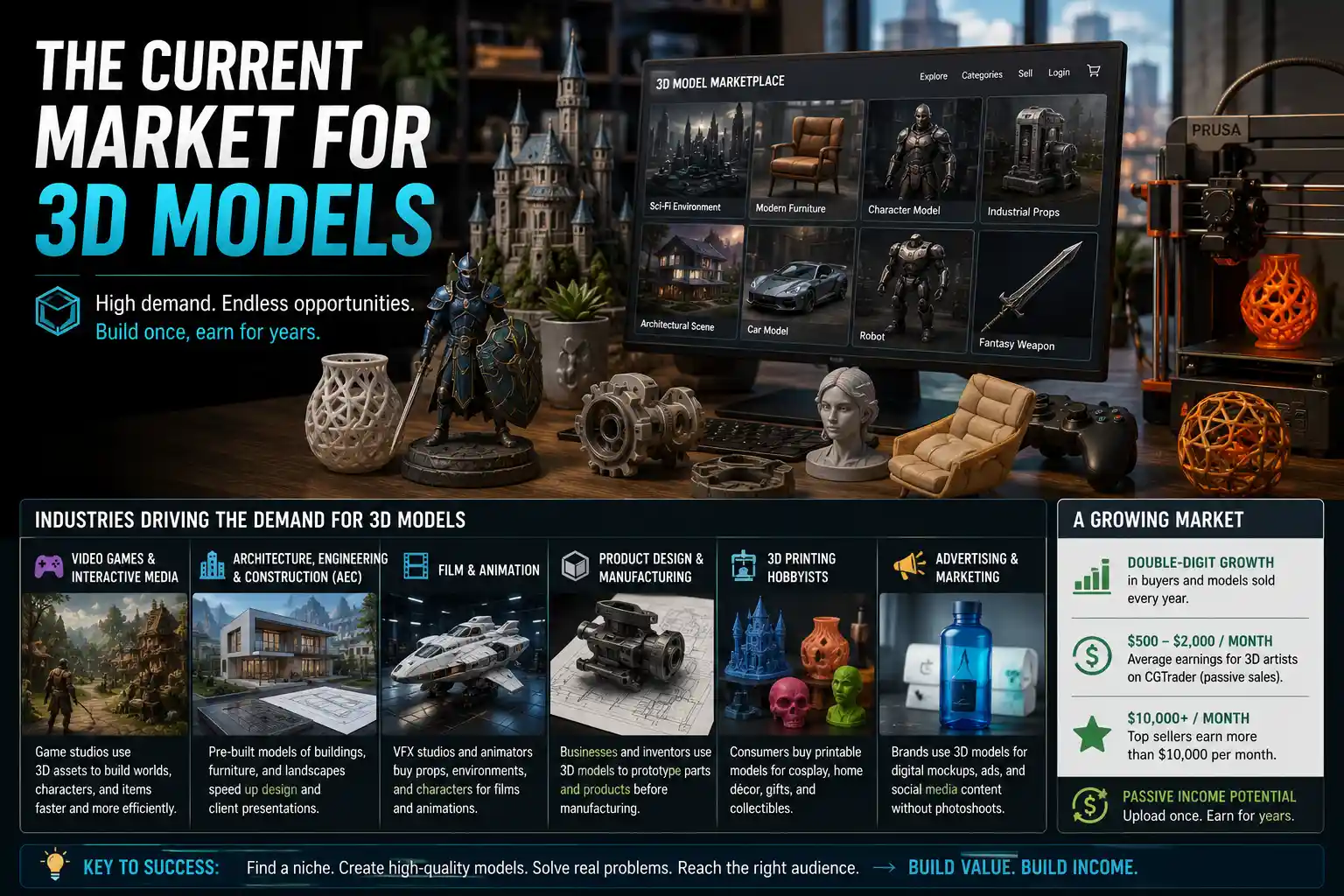
Key industries buying 3D models today
- Video games and interactive media: Indie game studios and large developers alike buy everything from environment assets to character models to speed up development. The rise of user-generated content platforms in games like Fortnite and Roblox has also created new demand for custom 3D assets that players can use within those ecosystems.
- Architecture, engineering, and construction (AEC): Firms use 3D models of building components, furniture, and landscape elements to create realistic renderings and client presentations. Pre-built models cut down the time it takes to draft a full concept design from weeks to days.
- Film and animation: VFX studios and independent animators purchase background assets, props, and even character models for projects ranging from short films to major Hollywood productions.
- Product design and manufacturing: Small businesses and inventors buy 3D printable models of prototypes, custom parts, and finished products to test designs before full production.
- 3D printing hobbyists: Thousands of consumers buy pre-made models to print at home for cosplay, home decor, personalized gifts, and collectibles. This is one of the fastest-growing segments of the market for independent creators.
- Advertising and marketing: Brands use 3D models to create digital product mockups, interactive ads, and social media content without the cost of a physical photoshoot.
Marketplaces like CGTrader, Sketchfab, TurboSquid, and MyMiniFactory report consistent double-digit growth in both the number of buyers and the number of models sold every year. A 2023 report from CGTrader found that the average 3D artist on their platform earns between $500 and $2,000 per month from passive sales of existing models, while top sellers earn more than $10,000 per month. The passive nature of selling 3D models is one of its biggest draws: once you upload a model, it can continue to generate sales for years with no additional work from you.
That said, the market is competitive. As 3D modeling software becomes more affordable and easier to learn, more creators are entering the space. Success depends on finding a niche that matches your skills and caters to unmet demand, rather than uploading generic models that dozens of other creators already offer.
Common Ways to Make Money Selling 3D Models
There is no one “right” way to sell 3D models. The best approach for you depends on your skill level, the type of models you create, and how much time you want to invest in marketing and customer management. Below are the most popular methods, with their pros and cons.
Sell through third-party marketplaces
For new creators, selling through established third-party marketplaces is almost always the best starting point. These platforms already have built-in audiences of active buyers, handle payment processing, and take care of legal and administrative tasks like tax reporting (in most cases). You don’t need to build your own website or drive your own traffic when you start out – you just upload your models and optimize their listings for search.
Some of the most popular marketplaces for 3D models include:
- CGTrader: Caters to both professional digital assets for CG work and 3D printable models, with royalty rates ranging from 70% to 80% for creators.
- TurboSquid: One of the oldest and largest marketplaces for professional 3D assets, preferred by many large studios. Royalty rates start at 40% and go up to 80% for exclusive sellers.
- Sketchfab: Popular for AR/VR and game assets, with a large community of buyers and flexible options for both free and paid sales. Creators keep 70% of each sale.
- MyMiniFactory: Focused exclusively on 3D printable models, with a large audience of hobbyists. It also offers opportunities for paid commissions from brands. Royalty rates are up to 80%.
- Thangs: A fast-growing search engine for 3D printable models, with a premium membership program that pays creators based on how many users download their work.
- Etsy: While not exclusively for 3D models, Etsy has a large market for 3D printable design files, especially for home decor, personalized gifts, and wedding items. Many creators find success here because of the platform’s built-in audience of craft buyers.
The main downside of third-party marketplaces is that they take a cut of every sale, ranging from 20% to 60% depending on the platform and whether your content is exclusive. They also set their own rules, and your account can be suspended if you violate their terms of service. Still, for most new creators, the benefits of built-in traffic far outweigh these downsides when starting out.
Sell on your own website
Once you have an established audience or a strong brand, selling through your own website gives you full control over your business and lets you keep 100% of the revenue (minus payment processing fees, which are typically around 3%). You can set your own prices, run your own promotions, and collect customer data to build long-term relationships with repeat buyers.
Platforms like Shopify, Gumroad, and Payhip make it easy to set up an online store for digital 3D models, even if you have no technical experience. Gumroad and Payhip are particularly popular for digital products because they handle file delivery automatically – when a customer buys a model, they get an instant download link with no extra work from you.
The biggest challenge of selling on your own website is that you have to drive all your own traffic. You’ll need to invest time in social media marketing, search engine optimization (SEO), or paid ads to get buyers to your store. For that reason, many creators use a hybrid approach: they sell some models on their own website to maximize revenue, while still listing lower-cost assets on marketplaces to attract new customers.
Subscription and membership models
A growing number of 3D creators earn consistent monthly income through subscription memberships, most commonly on Patreon. Creators offer new exclusive 3D models every month to subscribers who pay a monthly fee, typically ranging from $5 to $25 per month depending on the content. Many creators combine Patreon with marketplaces: they release older models publicly for sale on marketplaces after a few months, while keeping new releases exclusive for subscribers.
Subscription models work particularly well for 3D printable creators who focus on collectibles, cosplay, or hobbyist content. If you build a loyal following of fans who love your work, recurring subscription income can be much more stable than one-off sales. For example, a 3D character artist who creates popular pop culture collectibles can easily have hundreds of subscribers paying $10 a month, generating $5,000+ in consistent monthly income.
Custom commissions
Beyond selling pre-made models, you can also earn money by creating custom 3D models for clients. Individuals and businesses will pay a premium for a model designed specifically to their requirements, whether that’s a custom 3D printable part for a vintage car, a character model for an indie game, or a prototype for a new product.
Commission work typically pays more per project than passive sales, but it’s not passive – you have to invest time in each new project. Many creators combine passive sales of pre-made models with custom commissions to balance stable income with long-term passive growth.
“The biggest mistake new 3D creators make is trying to be everything to everyone. The sellers who build sustainable income are the ones who pick a niche and become the go-to creator for that specific type of model. If you make the best 3D printable Victorian dollhouse furniture, customers will seek you out far more than if you have 100 generic random models.”
How Much Can You Actually Earn Selling 3D Models?
It’s hard to give a single number for how much you can earn, because income varies wildly based on your skill, niche, the amount of time you invest, and your business model. That said, we can break down realistic earning ranges based on data from creators and marketplaces.
Part-time side hustle earnings
For most creators starting out part-time, earning a few hundred dollars per month is a realistic goal after 6 to 12 months of consistent work. If you upload one new high-quality model per week, after a year you’ll have a portfolio of 50 models generating passive sales. Depending on your niche and pricing, that can translate to $200 to $800 per month in extra income. This is enough to cover the cost of a 3D printer, software subscriptions, or put extra money toward savings or travel.
For example, a part-time creator who specializes in 3D printable cosplay props might price each model between $5 and $20. If they sell 20 models a month across their portfolio, that’s $100 to $400 in revenue, before platform fees. If they add a $5 Patreon subscription with 20 subscribers, that’s another $100 per month, bringing their total to $200 to $500.
Full-time creator earnings
Full-time creators who spend 40 hours a week creating 3D models and growing their brand can earn anywhere from $3,000 to $15,000+ per month, which translates to $36,000 to $180,000 per year. Top creators with large followings and popular niches can earn well over $20,000 per month, especially if they combine passive sales, subscriptions, and custom commissions.
A 2022 survey of full-time 3D printable creators by 3D Printing Industry found that the median annual income for full-time creators was $72,000, with 15% of respondents reporting annual income of more than $150,000. For professional creators selling digital assets to game studios and AEC firms, incomes are often even higher, because professional assets for these industries are typically priced hundreds of dollars each.
Factors that impact your earning potential
Not all 3D models are created equal, and several key factors will determine how much you can earn:
- Niche: Models for professional industries (like architectural assets or CAD parts for manufacturing) typically command much higher prices than models for hobbyists, but they require more specialized skills and knowledge. High-demand niches with less competition often lead to higher earnings than oversaturated general markets.
- Quality and functionality: Buyers will pay more for models that are properly optimized, error-free, and ready to use. A 3D printable model that requires no fixing before printing will get far more positive reviews and repeat sales than a model that needs work from the buyer. For professional digital assets, models that come with multiple file formats, properly mapped textures, and clean topology will always sell for more.
- Portfolio size: Income from selling 3D models is cumulative. Every new model you add to your portfolio increases your potential for passive sales. A creator with 500 high-quality models will almost always earn more than a creator with 50, all else being equal.
- Pricing strategy: Pricing your models too low can leave money on the table, while pricing them too high can reduce sales volume. Many creators find that a mix of low-cost entry models to attract customers and higher-priced premium models for higher profit works best.
It’s important to remember that income from selling 3D models is rarely immediate. Most creators don’t start earning significant money until they’ve built up a portfolio of 20 to 50 high-quality models and optimized their listings for search. It’s a slow build, but the passive nature of the business means that your income can grow over time even as you invest the same amount of work each month.
Common Mistakes New Sellers Make (And How to Avoid Them)
Even talented 3D artists can struggle to make sales when they’re starting out, because many creators focus on making what they like instead of making what buyers want. Below are the most common mistakes new sellers make, and how you can avoid them to start earning faster.
Creating generic, oversaturated models
The biggest mistake new creators make is uploading generic models that are already widely available for free or for low cost on every marketplace. If you upload a generic “coffee cup” 3D model, you’ll be competing with thousands of other coffee cup models, most of which are already free. Instead of creating generic models, focus on niches with specific demand that isn’t being met by existing creators.
For example, instead of creating general home decor models, focus on 3D printable wall hooks for camping gear. Instead of creating general game character models, focus on low-poly fantasy environment assets for indie RPG games. A specific niche lets you stand out and attract buyers who are searching for that exact type of model.
Poor optimization and file organization
Buyers don’t just buy a 3D model – they buy a model that’s ready to use right out of the box. If you upload a 3D printable model that has holes in the mesh, requires supports that aren’t mentioned in the description, or doesn’t slice correctly, you’ll get negative reviews and no repeat sales. For professional digital assets, if you only provide one file format and don’t include properly scaled textures, buyers will move on to a different seller who provides a ready-to-use product.
Always test your models before uploading them. If you sell 3D printable models, print the model yourself to make sure it comes out correctly. If you sell digital assets for games, import the model into Unity or Unreal Engine to make sure it works properly. Include all common file types in your download (for example, STL, OBJ, and FBX) and clearly document any requirements or notes for the buyer.
Bad listing optimization
Most buyers on marketplaces find models through search, so if your listing doesn’t have the right keywords, no one will find your work. Many new creators use vague titles like “Tree Model” instead of specific, keyword-rich titles like “Low Poly Pine Tree Model for Game Development – Optimized for Unity.”
To optimize your listings, think about what terms a buyer would actually search for to find your model. Include those terms in your title and description, and add relevant tags to your listing on marketplaces. For example, a 3D printable Yoda helmet for cosplay should include tags like “Star Wars cosplay,” “Yoda helmet,” “3D printable cosplay helmet,” and “life size wearable helmet.”
High-quality preview images and renders are also critical. Buyers can’t touch or see your model in person before buying, so clear, well-lit previews from multiple angles are essential. A great model with bad previews will not sell as well as a good model with great previews.
Underpricing or overpricing your work
New creators often underprice their work out of fear that no one will buy it, which leads to them working long hours for very little pay. A 10-hour custom commission that you price at $50 ends up paying you $5 an hour, which isn’t sustainable. On the other hand, overpricing a simple generic model will lead to no sales at all.
A good rule of thumb is to look at what other sellers in your niche are charging for similar models, then price your work in the middle of that range. As you build up reviews and a reputation, you can increase your prices. For custom commissions, calculate how long the project will take you, set an hourly rate that’s fair for your skill level, and quote based on that.
Ignoring marketing outside marketplaces
Even if you sell through marketplaces, building an audience outside of those platforms can drastically increase your sales. Many successful creators share work-in-progress shots, finished prints, and tips on social media platforms like Instagram, TikTok, and YouTube. This builds a following of fans who are more likely to buy your models and support your Patreon.
For example, a 3D printable cosplay creator can share time-lapse videos of designing a new helmet on TikTok, which attracts thousands of new viewers who then click through to their store or marketplace profile. This is a great way to stand out from other sellers and build a long-term brand.
Actionable Steps to Start Selling 3D Models Today
If you’re ready to start selling 3D models, you don’t need a lot of expensive equipment or a huge portfolio to get started. Follow these practical steps to launch your business:
- Choose your niche based on demand and your skills: Start by looking at marketplaces to see what’s already selling, and match that to what you enjoy making. If you love 3D printing and cosplay, a niche of 3D printable cosplay props is a great starting point. If you have experience with CAD, consider selling engineering parts or product design assets. If you have experience with game design, low-poly game assets are a consistent high-demand niche.
- Create 3 to 5 high-quality models to start: You don’t need 50 models to launch. Start with 3 to 5 well-designed, tested models that fit your niche. Spend extra time making sure they’re error-free and ready for buyers.
- Choose a marketplace to start: For most new creators, starting with one or two marketplaces is better than spreading yourself too thin. If you sell 3D printable models, start with MyMiniFactory or Etsy. If you sell professional digital assets, start with CGTrader or TurboSquid.
- Optimize each listing for search: Write clear, keyword-rich titles and descriptions, take high-quality preview renders from multiple angles, and add all relevant tags. If you sell 3D printable models, include print settings and notes in the description to help buyers get a good result.
- Promote your work on social media: Set up a free account on TikTok or Instagram and share photos and videos of your work. You don’t need to be a professional influencer – even posting a few times a week of your finished models or prints can attract new buyers.
- Add new models consistently: Aim to add at least one new model per week to grow your portfolio. Over time, each new model adds another source of passive income, so consistent work adds up fast.
- Expand your revenue streams over time: Once you start getting consistent sales, consider adding a Patreon for subscription income, or set up a Gumroad store to sell models directly to your audience and keep more revenue. You can also start offering custom commissions to buyers who reach out to you for custom work.
One important thing to remember is copyright. Never sell 3D models of copyrighted characters, brands, or designs unless you have explicit permission to do so. Selling unlicensed intellectual property (like popular movie characters or branded products) can lead to your account being banned and legal action. Many creators get around this by creating original fan art inspired by popular properties, or focusing on original designs entirely.
Conclusion
Making money selling 3D models is not a get-rich-quick scheme, but it is a realistic way to earn side income or build a full-time creative business for creators who are willing to put in the work. The market demand for 3D assets is only growing, as more industries adopt digital design and 3D printing becomes more mainstream. Success comes down to creating high-quality models that solve a specific problem for buyers, building your portfolio consistently, and marketing your work to reach the right audience.
Whether you’re a hobbyist looking to offset the cost of your 3D printer, or a professional 3D artist looking to build passive income on top of your full-time job, selling 3D models offers flexibility, scalability, and the chance to get paid for doing creative work you enjoy. By starting small, focusing on a niche, and avoiding common mistakes, you can start building your 3D model selling business today and grow your income over time.