
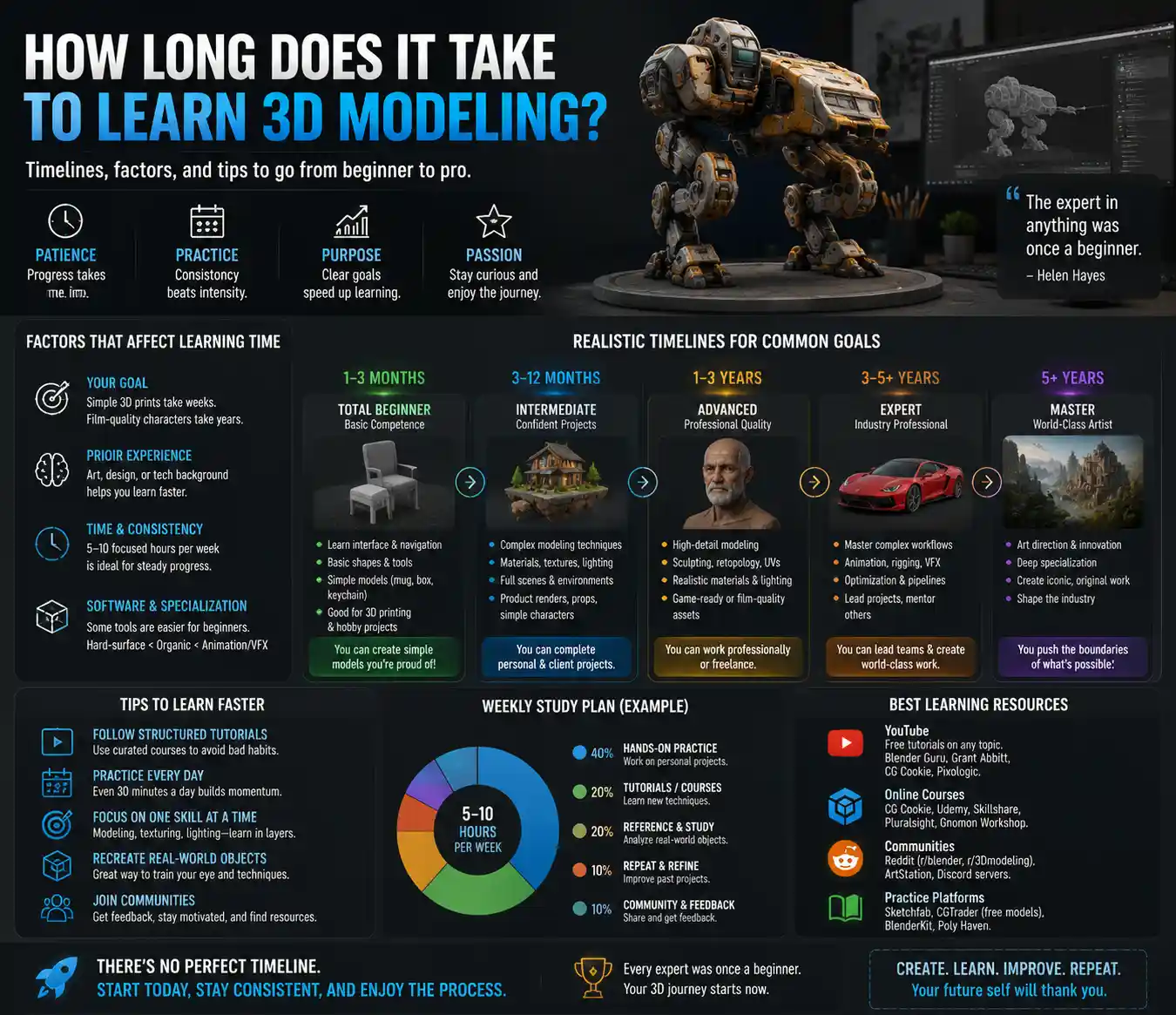
If you’ve ever scrolled through a behind-the-scenes clip of a Hollywood blockbuster, admired a 3D-printed custom figurine, or played a open-world video game with sprawling, detailed landscapes, you’ve seen the work of a skilled 3D modeler. For many people, the art of turning a blank digital canvas into a tangible, three-dimensional object feels like a mysterious, unapproachable skill—one that takes years of training to master. If you’re considering picking up 3D modeling for a hobby, a career change, or a side project, the first question on your mind is almost always: how long will this actually take? The answer depends on far more than just putting in hours. Your goals, prior experience, the tools you choose, and how you practice all play a major role in determining how quickly you can go from total beginner to creating the work you want. In this guide, we’ll break down realistic timelines for every skill level, break down the factors that speed up or slow down progress, and give you practical tips to reach your goals faster.
Factors That Impact How Long It Takes to Learn 3D Modeling
There is no one-size-fits-all timeline for learning 3D modeling. Before we dive into specific timelines for different goals, it’s important to understand the variables that shape your learning journey. These factors can add weeks or even years to your progress, or cut them down significantly if you plan intentionally.
Your End Goal
What you want to do with 3D modeling is the single biggest factor that determines how long you’ll need to learn. A hobbyist who wants to model simple keychains for 3D printing doesn’t need the same skill set as someone aiming to become a lead character modeler at a AAA game studio. Someone who wants to create product mockups for their small business needs far less training than a visual effects artist working on feature films. Clarifying your goal early helps you avoid wasting time learning skills you’ll never use, which speeds up your progress dramatically.
Prior Relevant Experience
Existing skills can translate surprisingly well to 3D modeling and cut down your learning time. If you’ve worked as a 2D graphic designer, illustrator, or traditional sculptor, you already understand core concepts like proportion, lighting, texture, and composition. That background lets you focus on learning the software, rather than mastering both artistic fundamentals and digital tools at the same time. Similarly, if you have experience coding or working with other digital design tools, you’ll likely pick up 3D interface navigation and hotkeys faster than a total beginner with no digital design experience.
Time You Can Dedicate to Consistent Practice
Consistency matters far more than cramming. Learning 3D modeling is all about building muscle memory for tools and developing an intuitive eye for shape and detail. Someone who practices 1-2 hours every day will progress much faster than someone who puts in 12 hours once a week on the weekend. Even 30 minutes of daily practice adds up to 15 hours a month, which is enough to make visible, steady progress for most beginners. Interrupting your practice for weeks at a time will slow you down, as you’ll have to re-learn tools and concepts you’d already started to master.
Your Choice of Software and Specialization
3D modeling is an enormous field, and different tools and specializations require different amounts of time to master. For example, beginner-friendly programs like Blender (free and open source) or Tinkercad (designed for beginners) have a shallower learning curve than industry-standard tools like ZBrush, Maya, or 3ds Max, which are packed with advanced features for professional work. Similarly, specializations like hard-surface modeling (for mechanical objects, architecture, or 3D printing) is often faster to pick up than organic modeling (for characters, animals, or plants), which requires a deeper understanding of anatomy, movement, and subtle surface detail.
Realistic Timelines for Common Skill Levels and Goals
Now that we’ve covered the variables that shape your progress, let’s break down realistic timelines for the most common 3D modeling goals. These timelines assume consistent, focused practice of 5-10 hours per week, which is a sustainable schedule for most people balancing work, school, or other commitments.
Total Beginner: Basic Competence (1-3 Months)
In the first 1-3 months of learning, you can expect to master the core fundamentals of 3D modeling. This includes navigating the 3D viewport, understanding core concepts like polygons, meshes, vertices, and edges, and completing simple, small projects. At this stage, you’ll learn basic modeling techniques like extrusion, beveling, and loop cutting, and you’ll be able to create simple objects like mugs, boxes, furniture, or basic keychains for 3D printing.
If your goal is only to create simple 3D prints or basic product mockups, you may be able to stop here and get the results you want. For example, many hobbyists who design small items for their 3D printers reach this level in a month or two of consistent practice and don’t need advanced skills for their projects.
Intermediate: Confident Personal Projects (3-12 Months)
After 3-12 months of consistent practice, you’ll reach the intermediate level, where you can complete more complex personal projects without constant reference to tutorials. At this stage, you’ll understand how to add materials, textures, and basic lighting to your models, and you can work with more complex shapes. Intermediate modelers can create full room scenes, simple characters, detailed mechanical parts, or product renders that look professional enough for small business use.
Most hobbyists and part-time creators are happy to stop at this level, as it gives them enough skill to complete almost any personal project they want. If you’re looking to start taking freelance 3D modeling gigs for small clients (like local product designers or indie game developers), you can start building a portfolio at this stage, though you’ll likely still need to learn advanced skills for higher-paying work.
Advanced: Professional Proficiency (1-3 Years)
Reaching a level where you can work full-time as a professional 3D modeler typically takes 1-3 years of consistent practice and learning, even if you’re studying full-time. This timeline accounts for learning advanced techniques specific to your specialization, like retopology, UV unwrapping, rigging, texturing for PBR (physically based rendering), or dynamic simulation for VFX. Professional 3D modelers also need to master additional tools beyond just modeling—for example, a game modeler needs to understand optimization for real-time rendering, while a character modeler needs to work with animators to ensure models deform correctly.
It’s important to note that even professional modelers continue learning throughout their careers. New software updates, new techniques, and changing industry standards mean that there’s always something new to learn, even after you land your first full-time job.
The beautiful thing about 3D modeling is that you don’t have to wait until you’re “perfect” to start creating things you’re proud of. You can make useful, fun, beautiful work as a beginner, and you grow as you go. Mastery is a journey, not a destination.
Timelines by Specialization: How Your Niche Changes the Equation
As we mentioned earlier, your chosen specialization has a huge impact on how long it takes to reach professional proficiency. Let’s break down the most common 3D modeling niches and what you can expect for each:
- 3D Printing Hobbyism: For most hobbyists who want to print small functional parts, cosplay props, or decorative items, you can reach your goal in 1-3 months of consistent practice. Hard-surface modeling for 3D printing is very accessible for beginners, and you only need to learn basic design and file preparation (like exporting as an STL) to get started. If you want to create complex, articulated figurines or detailed cosplay armor, you may need 6-12 months to master more advanced techniques.
- Indie Game Development: If you’re an indie dev making your own small game, you can learn enough 3D modeling to create basic assets in 3-6 months. If you want to create a full open world with high-quality characters and environments, expect to spend 1-2 years mastering the specialized skills you need, including optimization, rigging, and PBR texturing.
- Product Design and Visualization: For designers creating product mockups or pre-visualization for manufacturing, you can reach competence in 3-6 months for simple products. High-end product visualization for marketing, which requires advanced texturing, lighting, and rendering skills, typically takes 1-2 years to master for professional work.
- Film and VFX: Working in feature film or high-end television VFX requires one of the steepest learning curves. Most professional VFX modelers have 2-4 years of dedicated training, including a foundation in art and design, before they land their first industry job. The level of detail required for close-up shots and seamless integration with live-action footage demands advanced skills in topology, texture work, and matching real-world lighting that take years to develop.
- Character Modeling for Games: Creating high-quality, game-ready characters takes 1-3 years of dedicated practice. You need to master organic shape, anatomy, retopology, UV mapping, texturing, and working with riggers to ensure your models deform correctly when animated. Even many full-time character modelers continue to refine their skills after years of work.
It’s worth noting that many successful 3D modelers specialize in a niche early on, which helps them reach professional proficiency faster. Instead of trying to learn every type of modeling, focusing on one specific area lets you put all your practice time into the skills that actually matter for your goals.
Proven Tips to Speed Up Your 3D Modeling Learning Curve
While there are no real shortcuts to building skill, there are proven strategies that can help you progress faster and avoid common beginner mistakes that waste time. These tips work for every goal, from hobbyism to a full-time career change.
Start with a clear, specific goal
One of the biggest mistakes beginners make is trying to learn everything at once. Instead of jumping between character modeling, architectural visualization, and 3D printing, pick one specific goal to focus on first. For example, “I want to learn to model simple keychains to 3D print for my friends” or “I want to create product renders for my Etsy shop” or “I want to become a hard-surface modeler for AAA games.” A clear goal lets you prioritize the skills you need to learn first, and you’ll see visible progress much faster, which keeps you motivated.
Follow structured learning, don’t just jump from tutorial to tutorial
It’s easy to waste months jumping between random free YouTube tutorials, learning disconnected skills without building a solid foundation. A structured course, even a low-cost one on platforms like Udemy or Skillshare, guides you from core fundamentals to advanced skills in a logical order, which cuts down on the time you spend figuring things out on your own. That said, don’t fall into the trap of just watching tutorials—you learn more by doing than by watching. Pause the tutorial regularly and try the technique yourself before moving on.
Build complete projects from start to finish, don’t just do drills
Practice drills are helpful for learning specific techniques, but nothing speeds up progress like building full, complete projects. Finishing a project teaches you how all the different steps of 3D modeling work together, from blocking out a basic shape to adding textures and rendering the final image. It also gives you a piece you can add to your portfolio, if you’re looking for work. Start small: your first project can be a simple coffee mug, then a chair, then a full room. Each completed project teaches you something new that drills can’t.
Seek feedback regularly to fix bad habits early
It’s almost impossible to spot your own mistakes as a beginner. Bad habits, like messy topology or incorrect proportion, can become ingrained over time and take months to unlearn. Joining a community of other 3D modelers (like Reddit’s r/blender, ArtStation, or local design meetups) and asking for constructive feedback helps you fix mistakes early, before they become habits. Even paying for a few 1-on-1 feedback sessions with an experienced modeler can save you months of guesswork.
Focus on one software first
Many beginners waste time jumping between different programs, trying to find the “perfect” software. The truth is, almost every major 3D modeling program can do everything you need for most projects, and the core concepts are the same across all tools. Pick one software that matches your goal and stick with it until you reach the skill level you want. If you’re a beginner on a budget, Blender is an excellent choice—it’s 100% free, has a massive global community, and is powerful enough for professional work in almost every niche. Once you master one program, switching to another is much easier later on, since you already understand core 3D concepts.
- Write down your specific 3D modeling goal (e.g. “design 3 printable board game pieces by the end of the month”)
- Pick one software that fits your goal and budget, and commit to learning it for at least 3 months
- Enroll in one structured beginner course to build your foundation
- Schedule 5-10 hours of practice per week, broken into 30-60 minute daily sessions
- Complete at least one full project per month, from blocking to final render
- Share your finished project with a community and ask for specific feedback
- Adjust your next project to address the feedback you received
Following this simple 7-step process keeps you focused and ensures you make steady progress every month, regardless of your end goal.
Common Myths About Learning 3D Modeling (That Slow You Down)
There are a lot of persistent myths about learning 3D modeling that hold beginners back and make the process take longer than it needs to. Let’s debunk the most common ones:
Myth: You need to be a naturally talented artist to learn 3D modeling. Many people assume that if you can’t draw, you can’t learn 3D modeling. That’s simply not true. While artistic talent helps for specialized roles like character design, many successful 3D modelers are self-taught and don’t have a formal art background. Hard-surface modeling, architectural modeling, and 3D printing for functional parts rely more on spatial reasoning and attention to detail than natural artistic ability. You can learn proportion, composition, and other art skills as you go—you don’t need to have them before you start.
Myth: You need expensive software and a high-end computer to learn. Another common myth is that you need to spend thousands of dollars on software and a top-tier gaming PC to start learning 3D modeling. Today, free tools like Blender are just as powerful as most paid software for beginners and even many professional use cases. And while you will need a relatively powerful computer for complex projects with millions of polygons, you can learn the basics on almost any modern laptop. You can upgrade your hardware as your skills and projects get more complex—you don’t need to invest thousands before you even start.
Myth: You have to be done learning after a few years. Many beginners get discouraged because they think they should be “done” learning after a few months, and they feel like they’re not progressing fast enough. The truth is, even 3D modelers with decades of experience learn new techniques and tools all the time. The industry changes constantly, with new rendering technology, new software features, and new demands from clients and studios. Learning is a permanent part of being a 3D modeler, and that’s part of what makes the job interesting—you never stop growing.
Myth: You need a formal degree to get a professional job. While many professional 3D modelers have a formal degree in art or design, it’s not a requirement. More and more studios are hiring self-taught modelers who have a strong portfolio of work, regardless of their educational background. If you’re willing to put in the practice to build a great portfolio, you can land a professional job without a four-year degree. That said, a degree can speed up the process for some people by giving you access to structured learning, feedback, and industry connections, but it’s not the only path.
Conclusion
So how long does it actually take to learn 3D modeling? For most beginners, you can expect to learn the basics and create simple projects in 1-3 months of consistent practice. You can master enough skill to complete complex personal projects or start taking small freelance gigs in 3-12 months. If you want to work full-time as a professional 3D modeler, you can expect to put in 1-3 years of consistent practice and learning to reach professional proficiency, depending on your chosen niche.
What matters most isn’t the timeline—it’s starting where you are, with the tools and time you have. You don’t need to wait until you have the perfect setup or years of free time to start. Even 30 minutes of daily practice will get you creating work you’re proud of in just a few months. The most important step is the first one: pick your goal, pick your tool, and start building.