
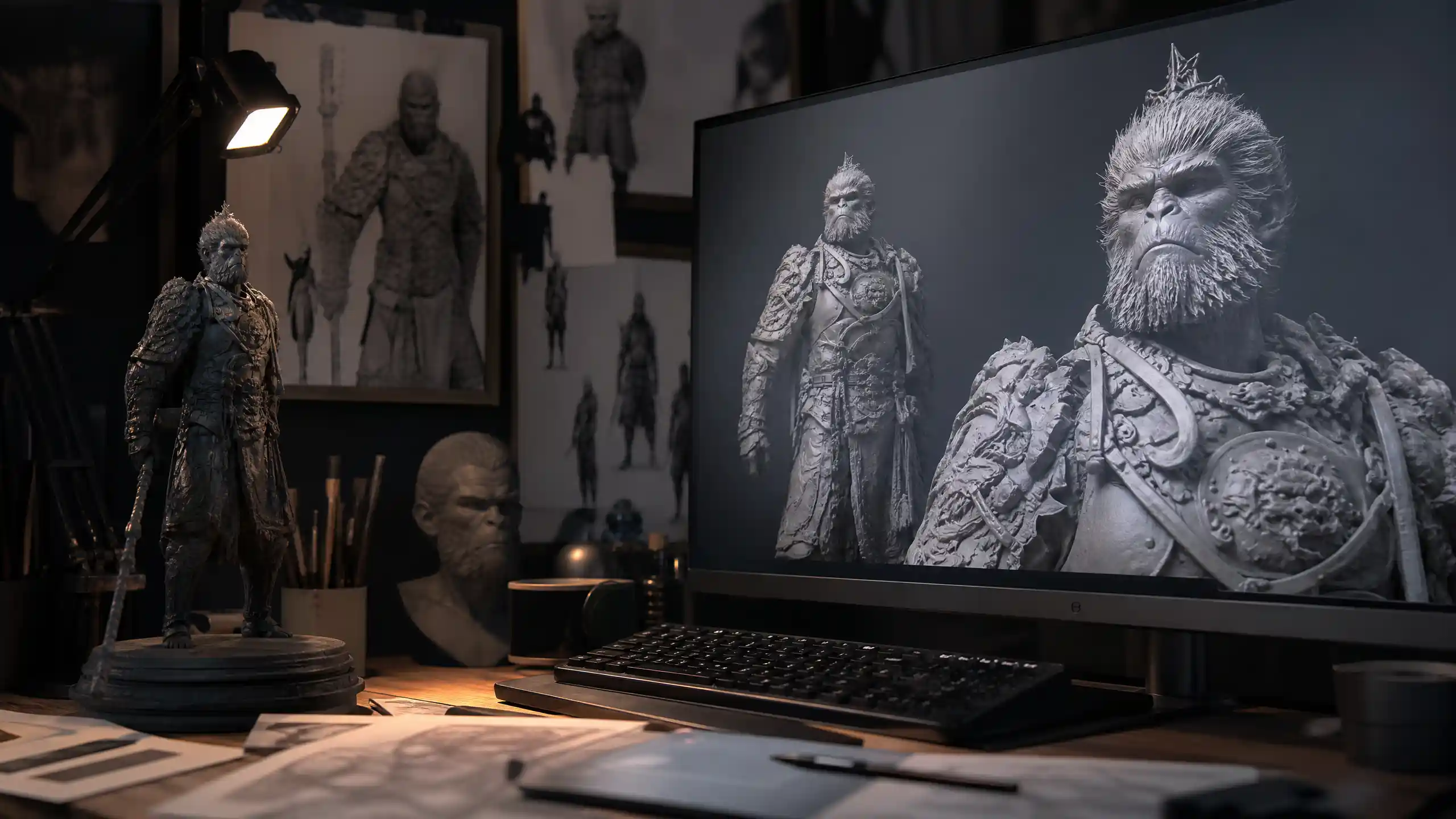
From the hyper-realistic characters in the latest Oscar-winning animated film to the custom 3D-printed prosthetics that change patients’ lives, 3D modeling touches nearly every industry today. Whether you’re scrolling through a social media filter, touring a new home development virtually, or playing a blockbuster video game, you’re interacting with the work of a skilled 3D modeler. But building a successful career in this fast-growing field takes more than just downloading Blender or Maya and clicking around. Mastering 3D modeling requires a mix of technical know-how, creative problem-solving, and soft skills that many new artists overlook. If you’re wondering what it takes to turn a love of 3D art into a sustainable profession, we’ve broken down the core skills every aspiring 3D modeler needs to develop.
Core Creative and Artistic Fundamentals
Many new 3D modelers assume the job is 100% technical, but every great 3D model starts with a strong foundation in traditional artistic principles. These fundamentals help you create models that look natural, communicate a clear message, and resonate with viewers, regardless of whether you’re working in entertainment, product design, or architecture.
Understanding of Form, Perspective, and ProportionAt its core, 3D modeling is the process of creating three-dimensional objects in a digital space. To do that well, you need to intuitively understand how objects exist in 3D space, how light interacts with their surfaces, and how their dimensions relate to each other and to the world around them. Form refers to the physical shape and volume of an object: a sphere isn’t just a circle, a cube isn’t just a square, and a human hand has dozens of small, interconnected forms that give it shape and movement. Perspective helps you place that object correctly in a larger scene, so a distant building doesn’t look the same size as a coffee mug sitting on a table in the foreground. Proportion ensures that all the parts of your model make sense relative to each other – for example, a character’s head isn’t too big for their body, or a chair’s legs aren’t too short to support its seat.
Even if you never plan to paint a traditional portrait or draw a landscape, practicing 2D sketching is one of the best ways to build these skills. Sketching forces you to observe objects closely and translate what you see onto a 2D plane, training your eye to spot errors in proportion and form that you might miss when working only in 3D software. Many professional 3D modelers start every project with a series of quick sketches to map out their ideas before they ever open their 3D modeling program.
Knowledge of Light, Shadow, and Color TheoryOnce you’ve built the form of your model, you need to make it look realistic or stylized in a way that feels intentional. That’s where an understanding of lighting and color comes in. Light doesn’t just illuminate a scene – it creates depth, defines texture, and directs the viewer’s eye to the most important parts of the image. Soft shadows create a gentle, calm mood, while sharp, high-contrast shadows build tension and drama. If you don’t understand how light bounces off different surfaces, even a perfectly proportioned model can look flat and unnatural.
Color theory, meanwhile, helps you choose materials and textures that fit the project’s tone and purpose. A children’s toy will use bright, saturated colors, while a luxury watch will rely on muted, sophisticated tones and subtle surface variations. For 3D modelers working in commercial industries like product design or advertising, understanding how color influences consumer perception is a critical skill that can make or break a project.
Spatial Reasoning and CompositionSpatial reasoning is the ability to mentally visualize how objects fit together in 3D space – and it’s one of the most underrated creative skills for 3D modelers. When you’re modeling a complex object like a car engine or a robot character, you need to be able to picture how all the individual parts connect before you start building them. This skill also helps when you’re troubleshooting issues like non-manifold geometry or boolean errors that can break a 3D model meant for 3D printing or animation.
Composition, on the other hand, is the skill of arranging your models within a scene to create a clear, engaging final image. Whether you’re presenting an architectural design to a client or creating a promotional render for a new product, a strong composition guides the viewer’s eye and highlights the most important features of your work.
Technical Software and Geometry Skills
Once you’ve built your artistic fundamentals, you need to master the technical skills that let you turn your creative vision into a usable 3D model. This category covers everything from navigating 3D software to understanding how geometry works in a digital environment.
Proficiency with Industry-Standard SoftwareThe specific software you’ll need to learn depends on your niche, but most 3D modelers need to master at least one primary modeling tool, plus a suite of supporting programs for texturing, rendering, and post-processing. The most popular industry-standard tools include:
- Autodesk Maya: The go-to choice for character modeling and animation in film and games, with a wide range of tools for hard-surface and organic modeling
- Blender: A free, open-source option that’s grown massively in popularity in recent years, with capabilities that match many paid programs for everything from modeling to rendering
- ZBrush: The industry standard for high-detail organic sculpting, used to create everything from character skin textures to intricate product details
- Autodesk 3ds Max: A common choice for architectural visualization and hard-surface modeling, with strong rendering tools for product visualizations
- SolidWorks: The leading tool for 3D modeling in engineering and manufacturing, designed for creating precise, print-ready models for industrial production
You don’t need to master every program on this list to get a job, but you do need to be deeply proficient in the tools used in your target industry. A 3D modeler working in game development needs different skills than one working in industrial design, so it’s important to focus your learning on the tools that match your career goals. Most employers also expect you to be able to learn new software quickly as industry tools evolve, so adaptability is just as important as mastery of one specific program.
Understanding of 3D Geometry and TopologyBeyond software proficiency, the most critical technical skill for any 3D modeler is a deep understanding of topology – the arrangement of vertices, edges, and faces that make up a 3D mesh. Good topology ensures that your model is clean, efficient, and usable for its intended purpose. For example, a character model that will be animated needs a topology that deforms smoothly when the character moves – bad topology will cause weird stretching or pinching at the joints when the animator poses the model. A model meant for 3D printing needs to be completely closed and free of non-manifold edges (edges that are connected to more or fewer than two faces) or it will fail to print.
Topology is the skeleton of your 3D model. You can cover it with the most beautiful texture in the world, but if the skeleton is broken, the whole thing falls apart.
There are two main types of 3D modeling that require different approaches to topology: organic modeling and hard-surface modeling. Organic modeling covers things like characters, plants, and animals – objects with curved, irregular surfaces that often need to deform for animation. Hard-surface modeling covers things like buildings, furniture, cars, and tools – objects with rigid, geometric shapes that don’t need to deform. Mastering both styles takes practice, but even specializing in one requires a solid understanding of how topology works.
Texturing, Rendering, and UV UnwrappingBuilding the mesh is only half the process of creating a finished 3D model. Once your mesh is complete, you need to add textures to give it color, roughness, metallicity, and surface detail, then render it to create a final 2D image or animation. To add textures, you first need to master UV unwrapping – the process of unfolding your 3D mesh into a 2D map so you can apply 2D texture images to it correctly. Bad UV unwrapping causes stretched or distorted textures, which can ruin even a perfectly modeled mesh.
Modern workflows also rely heavily on PBR (physically based rendering) texturing, which uses a set of standard maps to simulate how light interacts with real-world materials. Understanding how to create and adjust PBR textures is a non-negotiable skill for most 3D modelers working in entertainment, product visualization, and architecture today. You also need to understand how to adjust lighting and camera settings in your renderer to create a final output that matches your creative vision, whether you’re producing a high-resolution print-ready image for a client or a low-poly optimized model for a mobile game.
Industry-Specific Specialized Skills
3D modeling is used in dozens of different industries, and each has its own unique requirements that go beyond general artistic and technical skills. A modeler who works in character animation for film will need a completely different skill set than one who creates 3D models for medical devices or architecture. Understanding these niche requirements before you start your career helps you focus your learning and stand out to employers.
Game Development and AnimationFor 3D modelers working in games and animation, optimization is one of the most important specialized skills. Game models have to run in real time on a wide range of hardware, from high-end gaming PCs to mobile phones, so you need to be able to create detailed models that use as few polygons as possible. That means you need to understand how to bake high-detail details from a high-poly mesh onto a low-poly mesh using normal maps and occlusion maps, so you get the look of high detail without the performance cost.
If you’re working on character models for animation, you also need to understand how rigging works, even if you’re not a rigger yourself. Knowing how a rig will deform your mesh when you build the topology helps you create a model that’s easier for the rigging and animation team to work with, which makes you a much more valuable member of the team. You should also understand weight painting and how different edge loops affect deformation at joints like knees and elbows.
Architectural Visualization and Product DesignIn architectural visualization (ArchViz) and product design, accuracy and attention to real-world scale are everything. A client hiring you to visualize a new housing development needs to know that the room sizes, door heights, and furniture dimensions match the architectural plans exactly. You also need to understand how to work with computer-aided design (CAD) files that architects and engineers provide, and how to clean up and optimize those files for rendering.
For ArchViz specifically, you also need strong skills in creating realistic environment assets, from landscaping to furniture to materials like brick, glass, and wood. Clients expect ArchViz renders to look photorealistic, so you need to master advanced lighting techniques – including global illumination and HDRI environment mapping – to create images that look indistinguishable from a real photo. For product design, you’ll often need to create multiple variants of the same product with different colors or materials, so efficiency and organization are key skills to avoid rework.
3D Printing and Manufacturing3D modeling for 3D printing and industrial manufacturing requires an even higher level of precision than other industries. Your model has to conform to specific tolerances and design rules to be printable or manufacturable, and small errors can lead to failed prints or parts that don’t fit together. Key skills for this niche include:
- Understanding of design for additive manufacturing (DfAM) principles, including knowing how to add support structures, compensate for warping, and design parts that don’t require excessive post-processing
- Ability to create watertight meshes free of non-manifold geometry, overlapping faces, and other errors that will break 3D printing slicer software
- Knowledge of material properties, including how different 3D printing materials expand or contract during printing, and how to adjust your model dimensions to account for that
- Familiarity with industry file standards like STL and STEP, which are used to transfer models to 3D printers and manufacturing equipment
For modelers creating functional parts (rather than decorative 3D prints), you also need a basic understanding of engineering principles like stress distribution and load capacity, to ensure your part works as intended in real-world use.
Critical Soft Skills for Long-Term Success
Even if you have perfect artistic and technical skills, you won’t get far in 3D modeling without strong soft skills. This is a collaborative, project-based field, and employers and clients value modelers who can communicate well, adapt to changes, and solve problems on the fly.
Attention to Detail and Problem-Solving3D modeling is a field where small errors can have big consequences. A single non-manifold edge can ruin a 3D print, a proportion error on a character’s face can make the whole model look uncanny, and a wrong dimension on an architectural model can lead to a client rejecting the entire project. That’s why a keen eye for detail is one of the most valuable soft skills you can have. Great 3D modelers know how to step back from their work, spot small errors, and fix them before they become bigger problems.
You’ll also run into problems constantly – whether it’s a mesh that won’t boolean correctly, a render that’s taking hours to complete, or a client that changes their entire brief halfway through a project. The ability to troubleshoot issues calmly and find creative solutions is far more important than memorizing every single software shortcut. Many new modelers get stuck when something goes wrong, but experienced modelers know how to experiment, research solutions, and try different approaches until they get the result they need.
Communication and CollaborationNearly all 3D modeling jobs are collaborative. A 3D modeler working in film will work with art directors, animators, texture artists, and VFX supervisors to bring a project to life. A freelance 3D modeler will work directly with clients to understand their vision and adjust the model to meet their feedback. That means you need to be able to communicate clearly about your process, ask the right questions at the start of a project, and accept feedback gracefully.
You also need to be able to organize your files in a way that other team members can understand. For example, if you pass your model to a rigger, they need to be able to quickly find the right mesh, separate the parts they need, and understand how you’ve organized the layers and groups. A disorganized file can slow down an entire production pipeline, so good file management is a soft skill that many employers prioritize when hiring.
Time Management and Adaptability3D modeling projects almost always have tight deadlines, and it’s easy to lose hours tweaking small details that don’t matter for the final output. Good time management helps you prioritize the most important parts of a project, meet your deadlines, and avoid scope creep that eats into your profits (if you’re freelance). You need to be able to judge when a model is “good enough” for its intended purpose – a low-poly model for a background object in a game doesn’t need the same level of detail as a main character’s face.
The 3D modeling industry is also constantly changing. New software, new tools, and new workflows are introduced every year, and what was cutting-edge five years ago is outdated today. Successful 3D modelers are lifelong learners who enjoy adapting to new technology and updating their skills. For example, the rise of AI generative 3D tools has changed the workflow for many modelers in recent years, and those who’ve adapted by learning to use AI as a tool to speed up their work (rather than seeing it as a threat) have been able to take on more work and increase their productivity.
The Impact of AI on 3D Modeling Skills
It’s impossible to talk about modern 3D modeling without addressing the rise of generative AI tools that can create a 3D model from a text prompt in seconds. Many aspiring modelers wonder if AI will make their skills obsolete, but the reality is that AI is a tool that changes what skills are needed – it doesn’t eliminate the need for skilled 3D modelers.
AI is great at generating a rough base mesh or coming up with initial concepts quickly, but those AI-generated models almost always need a lot of cleanup and refinement from a skilled modeler. AI models often have bad topology, incorrect proportions, and errors that make them unusable for production or 3D printing without human intervention. That means the skills we’ve covered in this article – artistic fundamentals, topology knowledge, attention to detail, problem-solving – are still just as important as ever. If anything, AI has increased the value of these skills, because it handles the repetitive initial work and lets skilled modelers focus on refining and perfecting the final product.
That said, learning to use AI generative tools as part of your workflow is becoming an increasingly valuable skill for 3D modelers. AI can help you speed up concepting, create base meshes to build from, and generate texture variations quickly, which lets you take on more projects and work faster. The most successful modern 3D modelers aren’t competing with AI – they’re using it to amplify their own skills.
Conclusion
3D modeling is a dynamic, rewarding field that offers opportunities in everything from entertainment to engineering. The core skills needed to succeed combine artistic fundamentals, technical proficiency, industry-specific knowledge, and soft skills that help you collaborate and adapt to change. You don’t need to master every skill overnight – many successful modelers start by building their artistic fundamentals, learn one software deeply, and expand their skills as they gain experience. With the rise of AI tools, the role of the 3D modeler is changing, but the demand for skilled artists who can turn a creative vision into a clean, usable 3D model is higher than it’s ever been. Whether you’re just starting out or looking to advance your career, focusing on these core skills will help you build a sustainable, successful career in 3D modeling.