
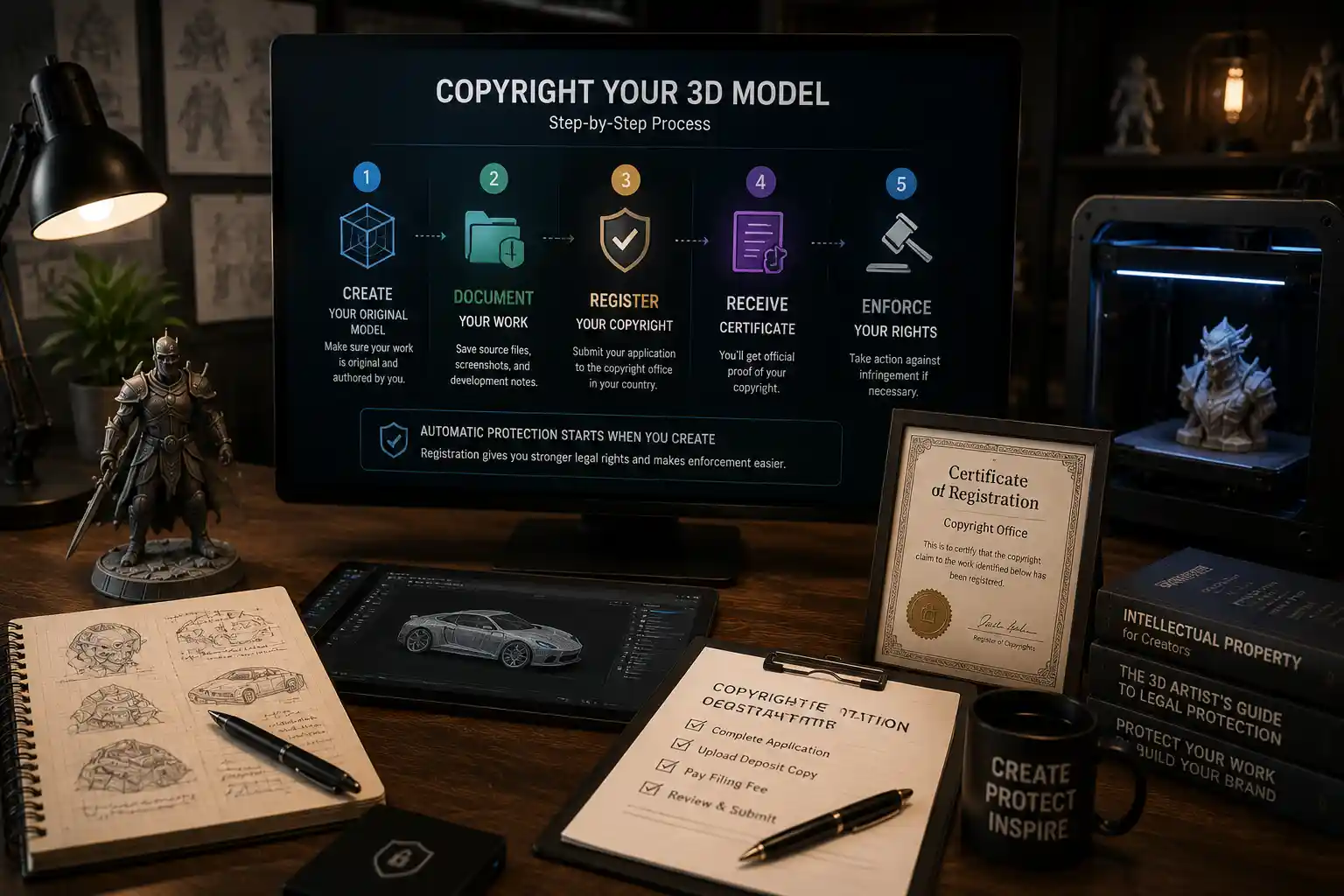
As 3D printing, digital manufacturing, and immersive media like virtual reality and video games grow in popularity, 3D models have become valuable intellectual property. Whether you’re a freelance 3D artist designing assets for games, an engineer prototyping a new product, or a hobbyist sharing custom prints online, protecting your original work with a copyright is one of the most effective ways to stop unauthorized copying, distribution, or commercial use of your creation. Many creators new to 3D design wonder if digital models even qualify for copyright protection, and what steps they need to take to secure their rights. This guide breaks down everything you need to know about copyrighting a 3D model, from understanding eligibility to registering your work and enforcing your rights globally.
Understanding Copyright Eligibility for 3D Models
Before you start the copyright process, it’s important to confirm that your 3D model qualifies for protection. In most major copyright jurisdictions (including the United States, the European Union, the United Kingdom, Australia, and Canada), original creative works are automatically protected by copyright the moment they are fixed in a tangible form. For 3D models, this fixed form can be a digital file saved to your computer, a 3D printed physical object, or both. But not all 3D models qualify: copyright only protects original, creative expression, not ideas, processes, or functional designs.
What qualifies as an original 3D model?
Originality is the core requirement for copyright. For your 3D model to be original, you must have created it independently, and it must show a minimal degree of creative choice. For example:
- An original 3D model of a fantasy character you designed from scratch, where you chose the shape, proportions, textures, and overall aesthetic, qualifies for copyright.
- A custom 3D model of a unique piece of decorative furniture you designed meets the originality requirement, even if it’s 3D printable for home use.
- A 3D scan of an existing public domain sculpture (like the Venus de Milo) is generally not original enough for a new copyright, because you didn’t make creative choices about the shape or design. Some exceptions apply if you heavily modify the scan to create a new, transformative work.
The difference between creative expression and functional designs
One of the most common points of confusion for 3D creators is the distinction between creative expression and useful articles. In many jurisdictions, copyright does not protect the functional aspects of a design. A useful article is defined as an object that has an inherent practical use, beyond just portraying appearance or conveying information. For example, a 3D-printed wrench is inherently functional, while a 3D-printed statue is purely expressive.
This doesn’t mean functional 3D models can’t be protected at all. In the United States, for example, the artistic aspects of a useful article can be separated from its functional purpose, and those separable artistic elements qualify for copyright. If you designed a 3D printable phone case with a unique, original sculpted pattern on the back, the pattern itself is creative expression that can be copyrighted, even if the basic shape of the phone case that fits your device is functional. For fully functional designs that don’t have separable creative elements, you may want to explore patent protection instead of copyright, though patents are much more expensive and time-consuming to obtain.
It’s also important to note that you cannot copyright a 3D model that copies someone else’s original work. If you create a 3D model of a popular movie character based on someone else’s existing design, that’s a derivative work that infringes on the original copyright holder’s rights, and you cannot claim copyright for it yourself (unless you have explicit permission from the original creator).
"3D models blur the line between digital art and industrial design, which is why creators need to understand what copyright actually protects. It doesn’t stop someone from making a similarly functional object, but it does stop them from copying your exact creative expression — which is enough for most independent creators."
— Sara Kannan, intellectual property attorney specializing in digital media
Automatic Copyright vs. Official Registration
Many new creators are surprised to learn that in almost all countries, your 3D model is protected by copyright as soon as it is created and fixed in a tangible form. That means if you save your finished STL or OBJ file to your hard drive, you already have automatic copyright protection. But automatic protection has significant limitations, especially if you ever need to enforce your rights in court. That’s where official registration comes in.
Benefits of official copyright registration
While automatic copyright gives you the exclusive right to reproduce, distribute, and modify your work from day one, official registration provides concrete legal benefits that make enforcement much easier:
- Registration creates a public, official record of your ownership of the copyright. This makes it much easier to prove that you created the work on a specific date, which is critical in infringement disputes.
- In the United States, you must register your copyright before you can file a lawsuit for infringement. If you register within three months of publishing your work, or before an infringement occurs, you can also claim statutory damages and attorney’s fees from the infringer. Without registration, you can only claim actual damages, which are often hard to prove and much lower than statutory damages.
- Registered copyright makes it easier to enforce your rights against online platforms. Most stock sites, 3D model marketplaces, and social media platforms require proof of copyright ownership to process a takedown request under the Digital Millennium Copyright Act (DMCA) in the US, or similar laws in other countries.
- If you ever want to sell or license your 3D model to a third party, official registration adds credibility to your ownership claim and makes the transfer of rights smoother.
When is automatic copyright enough?
For some creators, automatic copyright may be sufficient for their needs. If you are a hobbyist who shares non-commercial 3D prints with a small online community and has no plans to monetize your work or enforce your rights aggressively, automatic protection gives you the legal foundation of ownership without the time and cost of registration. However, if you are selling your 3D models commercially, licensing them for use in games or products, or have invested significant time and money into creating an original design, official registration is almost always worth the investment.
Step-by-Step Guide to Registering Your 3D Model Copyright
The registration process varies slightly by country, but the core steps are similar across most major jurisdictions. This guide focuses on the process for the United States (the most common jurisdiction for creators selling 3D models globally), with notes for creators based in other regions.
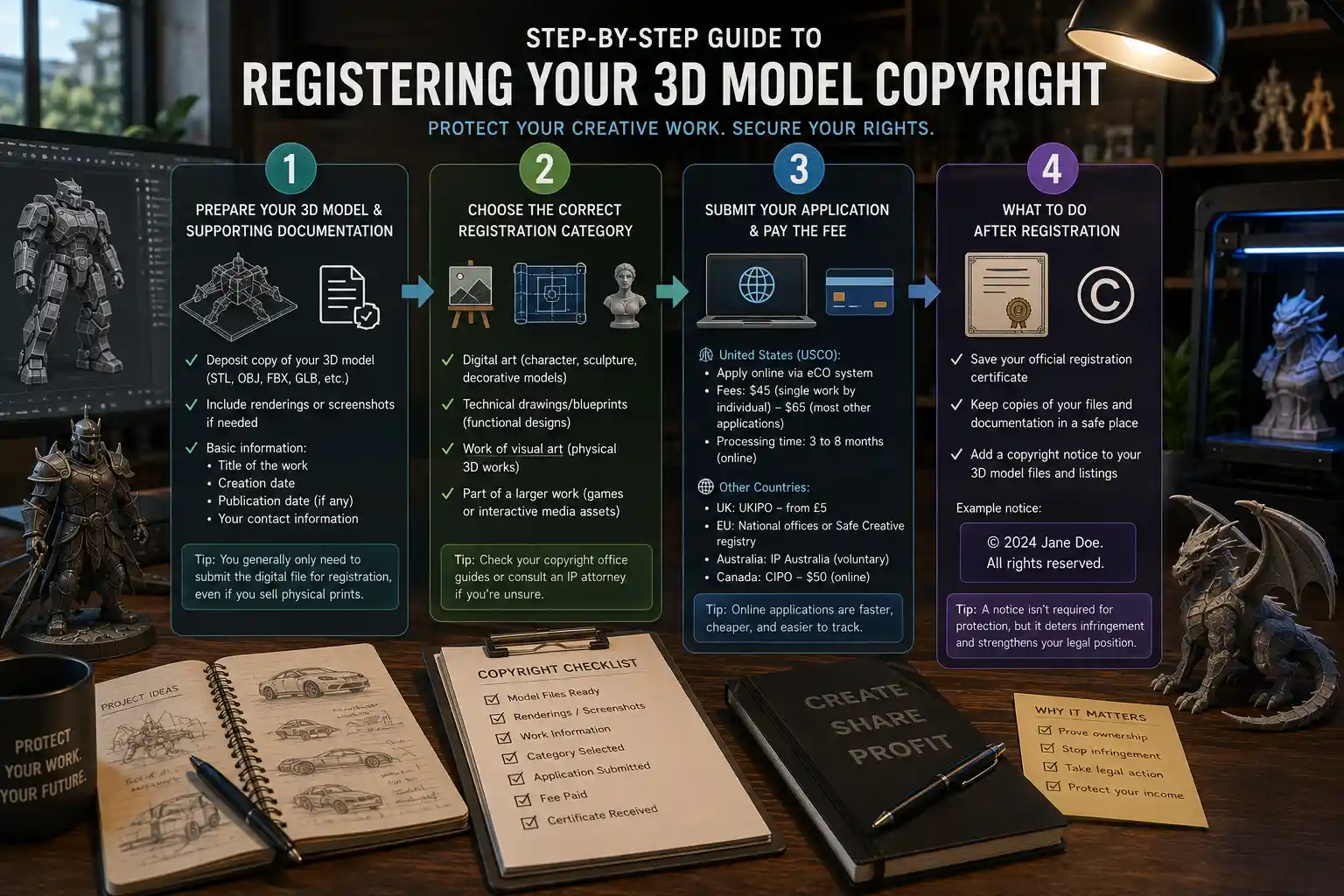
1. Prepare your 3D model and supporting documentation
Before you submit your application, you need to gather all the required materials to submit with your registration. The most important requirement is a deposit copy of your 3D model, which is a copy of the work that the copyright office will keep on file. Requirements for digital deposits depend on the file type:
- Most copyright offices accept common 3D model file types including STL, OBJ, FBX, and GLB. Some may require you to also include renderings or screenshots of the finished model to show the final visual appearance, especially if the file itself is hard to preview.
- If your 3D model is both digital and physical (for example, you sell both the digital file and the 3D printed product), you generally only need to submit the digital file for registration. For purely physical 3D works, you will need to submit clear photos or a 3D scan of the finished object.
- You will also need basic information about your work, including the title of the model, the date you created it and the date you first published it (if you released it publicly), and your contact information as the creator and copyright claimant.
2. Choose the correct registration category
When filling out your application, you will need to select the correct category for your work. For 3D models, the most common categories are:
- Digital art: If your 3D model is purely artistic (for example, a character model for a game or a decorative sculpture), this is usually the correct category.
- Technical drawings/blueprints: This category may apply if your 3D model is a technical design for a functional object, though many creators still register it as digital art if there are creative elements.
- Work of visual art: For physical 3D works, this is the standard category in many jurisdictions including the US.
- If your 3D model is an asset for a video game or interactive media, you may also be able to register it as part of a larger work, or as a separate visual asset.
If you are unsure which category to choose, most copyright offices have guidance documents on their websites, or you can consult with an intellectual property attorney for a small fee to avoid mistakes.
3. Submit your application and pay the fee
In the United States, the entire registration process can be completed online through the United States Copyright Office (USCO) website, using the electronic Copyright Office (eCO) system. Online applications are faster, cheaper, and easier to track than paper applications. Current fees for online registration range from $45 for a single work by an individual creator, to $65 for most other applications. Processing times vary, but most applications are processed within 3 to 8 months for online submissions.
For creators based in other countries:
- In the United Kingdom, you can register your copyright through the UK Intellectual Property Office (UKIPO) for a fee starting at £5 for digital works.
- In the European Union, there is no pan-European copyright registration system. You can register your work through your national copyright office (for example, the Institut National de la Propriété Industrielle in France, or the German Patent and Trade Mark Office in Germany). Many EU creators also rely on the Safe Creative registry, an independent service that provides official date-stamped proof of ownership, which is accepted in most European courts.
- In Australia, you can register your copyright through IP Australia, though automatic protection is still valid, and registration is not required for enforcement.
- In Canada, the Canadian Intellectual Property Office offers voluntary copyright registration for a $50 fee for online applications, which provides a presumption of ownership in court.
4. What to do after registration
Once your application is approved, you will receive an official copyright registration certificate from your national copyright office. You should save a digital copy of this certificate, and keep a physical copy in a safe place along with your original 3D model files. It is also good practice to add a copyright notice to your 3D model files and any pages where you publish or sell them. A standard copyright notice looks like this: [Year] [Your Name]. All rights reserved. For example: © 2024 Jane Doe. All rights reserved.
Adding a copyright notice is not required for protection, but it puts potential infringers on notice that you claim ownership of the work, which can deter unauthorized use in the first place. It also makes it easier to prove that an infringer was aware of your copyright, which can help in court if you need to file a lawsuit.
1. Prepare your 3D model and supporting documentation
Before you submit your application, you need to gather all the required materials to submit with your registration. The most important requirement is a deposit copy of your 3D model, which is a copy of the work that the copyright office will keep on file. Requirements for digital deposits depend on the file type:
- Most copyright offices accept common 3D model file types including STL, OBJ, FBX, and GLB. Some may require you to also include renderings or screenshots of the finished model to show the final visual appearance, especially if the file itself is hard to preview.
- If your 3D model is both digital and physical (for example, you sell both the digital file and the 3D printed product), you generally only need to submit the digital file for registration. For purely physical 3D works, you will need to submit clear photos or a 3D scan of the finished object.
- You will also need basic information about your work, including the title of the model, the date you created it and the date you first published it (if you released it publicly), and your contact information as the creator and copyright claimant.
2. Choose the correct registration category
When filling out your application, you will need to select the correct category for your work. For 3D models, the most common categories are:
- Digital art: If your 3D model is purely artistic (for example, a character model for a game or a decorative sculpture), this is usually the correct category.
- Technical drawings/blueprints: This category may apply if your 3D model is a technical design for a functional object, though many creators still register it as digital art if there are creative elements.
- Work of visual art: For physical 3D works, this is the standard category in many jurisdictions including the US.
- If your 3D model is an asset for a video game or interactive media, you may also be able to register it as part of a larger work, or as a separate visual asset.
If you are unsure which category to choose, most copyright offices have guidance documents on their websites, or you can consult with an intellectual property attorney for a small fee to avoid mistakes.
3. Submit your application and pay the fee
In the United States, the entire registration process can be completed online through the United States Copyright Office (USCO) website, using the electronic Copyright Office (eCO) system. Online applications are faster, cheaper, and easier to track than paper applications. Current fees for online registration range from $45 for a single work by an individual creator, to $65 for most other applications. Processing times vary, but most applications are processed within 3 to 8 months for online submissions.
For creators based in other countries:
- In the United Kingdom, you can register your copyright through the UK Intellectual Property Office (UKIPO) for a fee starting at £5 for digital works.
- In the European Union, there is no pan-European copyright registration system. You can register your work through your national copyright office (for example, the Institut National de la Propriété Industrielle in France, or the German Patent and Trade Mark Office in Germany). Many EU creators also rely on the Safe Creative registry, an independent service that provides official date-stamped proof of ownership, which is accepted in most European courts.
- In Australia, you can register your copyright through IP Australia, though automatic protection is still valid, and registration is not required for enforcement.
- In Canada, the Canadian Intellectual Property Office offers voluntary copyright registration for a $50 fee for online applications, which provides a presumption of ownership in court.
4. What to do after registration
Once your application is approved, you will receive an official copyright registration certificate from your national copyright office. You should save a digital copy of this certificate, and keep a physical copy in a safe place along with your original 3D model files. It is also good practice to add a copyright notice to your 3D model files and any pages where you publish or sell them. A standard copyright notice looks like this: [Year] [Your Name]. All rights reserved. For example: © 2024 Jane Doe. All rights reserved.
Adding a copyright notice is not required for protection, but it puts potential infringers on notice that you claim ownership of the work, which can deter unauthorized use in the first place. It also makes it easier to prove that an infringer was aware of your copyright, which can help in court if you need to file a lawsuit.
Protecting Your Copyright Online and Enforcing Your Rights
Registering your copyright is only the first step. Once your 3D model is online, whether you sell it on a marketplace like CGTrader or Thingiverse, or share it on social media, you need to actively monitor for infringement and know how to enforce your rights if someone copies your work.
Best practices to prevent infringement
There are several simple steps you can take to reduce the risk of unauthorized use of your 3D model:
- Watermark preview images of your 3D model on your website or marketplace listing. This makes it harder for people to steal your previews and pass the work off as their own.
- Disable direct downloading of your original files except for authorized buyers. If you share files for free, use terms of service that clearly outline what users can and cannot do (for example, non-commercial use only, no redistribution).
- Embed metadata into your 3D model files that includes your name, copyright information, and license terms. Most 3D modeling software allows you to add custom metadata to files when you export them.
- Use a clear license that outlines permitted uses. Even for free models, a Creative Commons license makes it clear what others can do with your work, which reduces accidental infringement. For commercial use, you can use an End User License Agreement (EULA) that outlines terms for buyers.
How to handle infringement
If you find someone using your copyrighted 3D model without your permission, follow these steps to enforce your rights:
- Gather evidence: Save screenshots of the infringing post or listing, note the date you found it, and collect your proof of copyright ownership (your registration certificate and original creation files).
- Send a takedown notice: Most online platforms (including 3D marketplaces, YouTube, and social media sites) have a formal process for copyright takedown requests under laws like the DMCA. If your copyright is registered, this process is usually straightforward, and most platforms will remove the infringing content within a few business days.
- Send a cease-and-desist letter: If the infringer is not using a platform (for example, they are selling 3D prints of your model on their own website), you can send a formal cease-and-desist letter demanding that they stop using your work. You can draft this yourself, or hire an attorney to send it for you, which carries more weight.
- Consider legal action: If the infringer refuses to stop, and the damages are significant enough to justify legal costs, you can file a lawsuit for copyright infringement. If you registered your copyright in advance, you have a much stronger case, and you may be able to recover attorney’s fees and statutory damages.
It’s important to note that copyright protection only applies in the countries where you have registered it, or where your country has copyright treaties in place. Most countries are signatories to the Berne Convention, which means that a copyright created in one Berne member country is recognized in all other Berne member countries. This means if you are a US creator, your copyrighted 3D model is automatically protected in all 181 Berne Convention countries, though enforcement may follow the local laws of that country.
Common myths about 3D model copyright
There are a lot of misconceptions about copyright for 3D models that can get creators into trouble:
- Myth: If it’s available online for free, it’s in the public domain. Fact: Almost all creative work online is protected by copyright, even if it’s free to download. The creator still owns the copyright, unless they explicitly release it into the public domain.
- Myth: I can modify a 3D model I found online and call it my own. Fact: Creating a derivative work based on someone else’s copyrighted model without permission is still copyright infringement, unless the modification counts as fair use (a narrow exception that usually applies to commentary, criticism, or parody, not a modified model you sell commercially).
- Myth: I only need to copyright my work once, and that covers all future versions. Fact: If you make significant changes to a 3D model that create a new, original version, you should register the new version separately to protect the changes. Minor updates generally don’t require a new registration.
Licensing Your 3D Model vs. Copyrighting
Copyright gives you exclusive rights to your 3D model, but that doesn’t mean you have to keep all those rights. Many 3D creators choose to license their models to others for specific uses, which can be a great source of income. Copyright is the foundation of any license, because you can’t license a right you don’t own. Registering your copyright makes licensing easier, because it proves you own the rights you are licensing.
There are two main types of licenses that 3D creators commonly use: open licenses and commercial licenses. Open licenses like Creative Commons allow you to grant permission for specific uses up front, for free. For example, you can choose a Creative Commons license that allows non-commercial use, requires attribution, and prohibits derivative works. This is a good option if you want to share your work freely with the community but still retain commercial rights for yourself.
For creators who sell their 3D models, a commercial license outlines what the buyer can do with the model. Common terms include:
- Whether the buyer can use the model for personal use only, or can use it for commercial purposes (for example, selling 3D printed copies of the model).
- Whether the buyer can modify the model or redistribute the original file.
- Whether the buyer can use the model in a larger product (like a video game or a commercial 3D print farm).
Having a registered copyright makes it much easier to enforce the terms of your license. If a buyer violates the license terms, that is also copyright infringement, and you can take action to stop them just like you would with any other unauthorized use.
Conclusion
Copyright protection for 3D models is more accessible than many creators think. Your original work is automatically protected from the moment you save it, but taking the extra step to register your copyright gives you powerful legal benefits that make enforcement easier and help you safeguard your investment of time and creativity. By understanding what qualifies for copyright, following the step-by-step registration process for your jurisdiction, and taking simple steps to prevent and address infringement online, you can protect your 3D models while still sharing or monetizing your work on your own terms. Whether you’re a hobbyist sharing designs with the community or a professional creator selling assets commercially, registering your copyright is a small investment that can save you significant time, money, and stress down the line if someone uses your work without permission.