
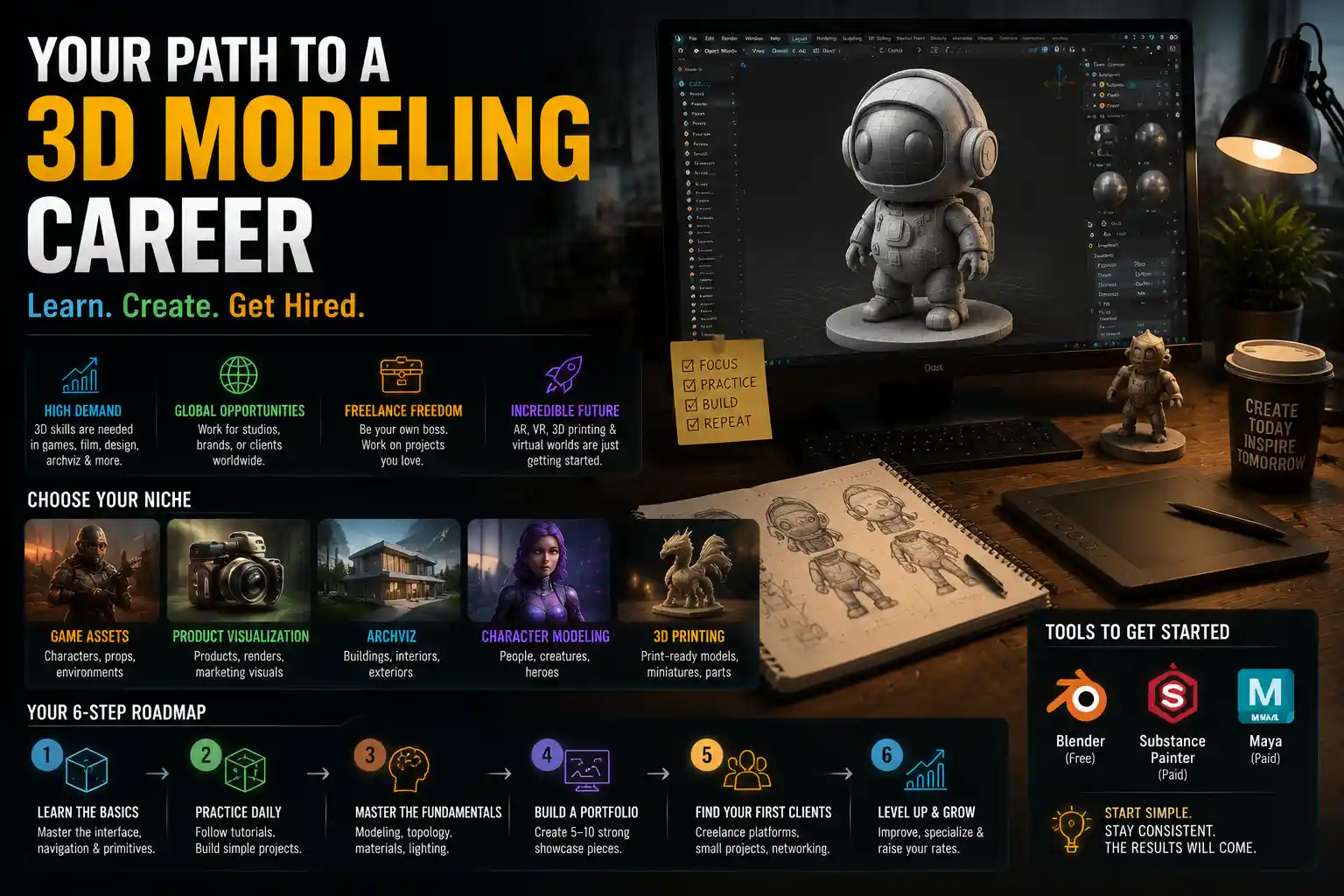
If you’ve ever stopped to admire the lifelike characters in a AAA video game, the sleek product render on a tech company’s website, or the elaborate visual effects in a modern blockbuster, you’ve experienced the work of a skilled 3D modeler. What started as a niche skill limited to big-budget film and architecture studios has become one of the most in-demand creative careers in the global digital economy, with entry points for beginners that don’t require a four-year art degree or a six-figure investment in equipment. Whether you’re a recent high school graduate looking for a creative career, a graphic designer wanting to expand your skill set, or a hobbyist ready to turn your passion into paid work, a beginner career path in 3D modeling is more accessible than ever before. This guide breaks down every step of building your career from scratch, from choosing the right software to landing your first paid gig.
Assess Your Interests to Narrow Your Niche
3D modeling is an umbrella term that covers dozens of distinct industry use cases, each with its own tools, expectations, and career trajectories. One of the biggest mistakes beginners make is trying to master every type of 3D modeling at once, which leads to burnout and shallow skills that don’t appeal to employers. Instead, starting by narrowing down your niche aligns your learning with your interests and helps you build a targeted portfolio faster.
The most popular entry-level niches for beginners
Each niche has different barriers to entry and demand for new talent, so it helps to understand the basics of the most common paths before you commit:
- Game asset modeling: Game studios of all sizes, from independent developers to major AAA publishers, need constant new 3D assets like character models, environment props, weapons, and architecture. Entry-level roles are plentiful, and many beginners start with freelance work creating assets for indie teams or stock 3D marketplaces. This niche prioritizes efficient modeling and optimization for real-time rendering, so you’ll learn skills that translate to other fast-growing fields like augmented reality (AR) and virtual reality (VR).
- Product visualization: Every company that sells a physical product—from furniture brands to consumer electronics to beauty companies—needs high-quality 3D renders to showcase their goods. Product visualization is one of the most consistent sources of freelance work for beginners, as small e-commerce brands often don’t have the budget for in-house 3D teams but need regular asset updates. This niche focuses on clean topology, accurate scaling, and photorealistic rendering, which are foundational skills for all 3D modeling work.
- Architectural visualization: Architecture firms and real estate developers use 3D models to show clients what finished buildings or interiors will look like before construction begins. This niche tends to pay well for consistent work, but it requires a strong understanding of perspective, lighting, and building codes. Many beginners start by creating 3D models of existing small residential properties to build their portfolio before moving to conceptual work.
- Character modeling for animation: If you love drawing people or creatures and are interested in film or animation, character modeling might be a good fit. This is one of the most competitive niches, as it requires a deep understanding of anatomy, topology, and rigging, but there is consistent demand for skilled modelers at animation studios and VFX houses. Many beginners start with fan art of existing characters to build their portfolio before moving to original work.
- 3D printing modeling: The rise of affordable consumer 3D printers has created a massive new market for 3D modelers who create printable files for hobbyists, small businesses, and custom product creators. This niche requires specific knowledge of model watertightness, support structures, and scaling for print, but it’s easy to start from home and even sell your own designs directly to customers on marketplaces like Etsy or CGTrader.
Once you have a rough idea of your niche, spend a week browsing job boards like Upwork, Indeed, and ArtStation to see what skills employers are actually asking for. This will help you avoid learning skills that don’t translate to paid work in your chosen area. For example, if you’re interested in product visualization, most job listings will ask for proficiency in Blender and KeyShot, so you can prioritize learning those tools over software that’s more common in VFX, like Houdini.
Build Your Foundation: Learning Core Skills and Choosing Tools
One of the biggest misconceptions about starting a career in 3D modeling is that you need to spend thousands of dollars on professional software and a high-end computer to get started. In reality, there are powerful free and low-cost options for beginners, and you can learn all the core skills you need for an entry-level role through free or affordable online courses. The key is to focus on foundational skills first, not flashy tools or advanced techniques.
Choosing the right software for beginners
Your software choice should align with your niche and your budget. For most beginners, Blender is the clear first choice: it’s 100% free, open-source, and has become an industry standard across game development, product visualization, and even small VFX studios. It has every tool you need for modeling, rendering, rigging, and animation, so you won’t need to buy multiple programs to get started. If you’re interested in architectural visualization, Autodesk offers free 1-year licenses for students and beginners for AutoCAD and 3ds Max, which are still widely used in the industry. For product visualization, KeyShot has a low-cost monthly subscription that’s accessible for beginners and is the industry standard for fast, high-quality product renders. Avoid the temptation to jump between multiple programs in your first six months; master the core tools of one program first, and switching to another software later will be much easier.
Core skills every beginner 3D modeler needs to master
No matter what niche you choose, there are core foundational skills that you’ll need to master to land paid work. Focus on these in order before moving to advanced techniques:
- Blocking out basic shapes: Every 3D model starts with blocking out the overall form and proportions before adding details. This skill helps you avoid wasting time refining details that will end up being changed later. Practice blocking out 10 different simple objects (like a chair, a mug, or a house) in a single day to build this muscle.
- Clean topology: Topology refers to the arrangement of polygons that make up your 3D model. Clean topology (with evenly spaced polygons and no unnecessary geometry) is essential for animation, 3D printing, and editing later. Bad topology can cause rendering errors, make it impossible to 3D print a model, and increase file sizes for game development. This is one of the first skills employers check for in a portfolio, so prioritize it early.
- UV unwrapping: UV unwrapping is the process of unfolding a 3D model so you can apply 2D textures (like wood grain, fabric patterns, or skin details) to it. It’s a tedious skill for many beginners, but it’s non-negotiable for almost every type of 3D modeling.
- Texturing and shading: Texturing and shading give your model its final look, from a matte plastic product to a rough stone game asset. Today, beginner-friendly tools like Substance Painter and Quixel Megascans offer free access to thousands of pre-made textures, so you don’t need to create every texture from scratch, but you do need to learn how to adjust them to fit your model.
- Lighting and rendering: Good lighting can make a simple model look professional, while bad lighting can make a detailed model look unpolished. Learning basic three-point lighting and how to adjust exposure and shadow settings will instantly improve the quality of your portfolio work.
There are dozens of high-quality learning resources for beginners, many of which are free. YouTube channels like Blender Guru, CG Geek, and Art of Levi offer step-by-step tutorials for beginners that are updated regularly for the latest software versions. For structured learning, platforms like Coursera, Udemy, and Skillshare offer affordable complete courses that take you from absolute beginner to portfolio-ready. Many beginners also find success joining community learning groups on Discord or Reddit, where you can share your work and get feedback from more experienced modelers.
The biggest mistake I see new 3D modelers make is spending six months learning every advanced tool before they ever finish a single model. Finish ten simple, clean models first, and you’ll learn more than you would in a year of half-finished projects.
Build a Portfolio That Gets You Hired
In the 3D modeling industry, your portfolio is far more important than your education or where you learned your skills. Employers and clients don’t care if you have a master’s degree in fine art if your portfolio doesn’t show that you can do the work they need. For beginners, the goal of a portfolio is to prove you have the core skills and fit the niche the employer is hiring for.
What projects to include as a beginner
If you don’t have any paid client work yet, that’s completely fine. Employers expect beginners to have mostly personal or practice projects in their early portfolios. Focus on including 5-10 high-quality projects that are relevant to your niche, not dozens of low-effort unfinished projects. A good rule of thumb is that one great project is more impressive than ten mediocre ones. Good beginner projects include:
- Replicating a real-world product (like a coffee machine or a chair) for product visualization portfolios
- Fan art of a popular game character or environment to show your character modeling skills
- A 3D model of a real small building or interior room for architectural visualization portfolios
- An original 3D printable collectible or functional object for 3D printing niche portfolios
- A full game prop pack with 5-10 optimized assets for game development portfolios
When presenting your work, don’t just show the final render. Include wireframe shots of your model to show off your clean topology, and explain what your process was for each project. This gives employers insight into how you work, which is just as important as the final result. For example, if you optimized a character model for a game, note what the final polygon count is and what steps you took to optimize it.
Hosting your portfolio: Where to showcase your work
Today, there are multiple easy, low-cost ways to host your portfolio online, tailored to creative professionals. ArtStation is the industry standard for 3D modelers, and it’s free to set up a basic profile and upload your work. It’s used by every major studio and client to find new talent, so it’s non-negotiable to have a presence there. For a more personalized portfolio, you can use website builders like Squarespace, Wix, or Carrd to build your own custom site for under $20 a month. If you’re planning to do freelance work or sell your own models, include a contact page that’s easy to find so clients can reach you directly.
One common tip that many successful beginner modelers swear by is to share your work-in-progress and final projects on social media platforms like Instagram, TikTok, or X (Twitter). Short time-lapse videos of your modeling process often go viral among creative communities, and can attract clients or employers without you having to actively apply for jobs. Many beginners have landed their first paid work simply by sharing their projects on ArtStation and social media.
Land Your First Paid 3D Modeling Work
Once you have a solid portfolio of 5-10 projects, it’s time to start looking for paid work. For most beginners, this means either starting with freelance work to build experience or applying for entry-level full-time roles. Both paths are viable, and the right choice depends on your risk tolerance and career goals.
Freelance work for beginners: Building experience and income
Freelance work is a popular first step for beginners because it’s easier to land entry-level freelance gigs than full-time roles, and it gives you the flexibility to work on different types of projects to build your skills. The most common places to find beginner freelance 3D modeling work include:
- Freelance job boards: Upwork, Fiverr, and Toptal are the largest platforms for freelance creative work. As a beginner, start by offering niche services like “3D product modeling for e-commerce” or “3D printable models for cosplay” to stand out from generalist modelers.
- Local small businesses: Reach out to local e-commerce brands, furniture makers, real estate agents, and architecture firms in your area to offer your services. Many small businesses don’t have an in-house 3D artist and are happy to hire a beginner for affordable, high-quality work.
- Sell pre-made models: Stock 3D marketplaces like CGTrader, TurboSquid, and Sketchfab let you upload pre-made models and earn a commission every time someone downloads or buys them. This creates passive income over time while you look for more active work.
- Indie game developer communities: Platforms like Itch.io and Discord servers for indie game developers often have job boards for 3D modelers, and many teams are willing to hire beginners for project-based work or revenue-sharing roles that can turn into full-time positions.
When you’re starting out as a freelance beginner, avoid underpricing your work. Many beginners make the mistake of charging $5 per model to get work, which leads to burnout and trains clients to see 3D modeling as low-value work. Instead, charge an hourly rate that reflects your time, or a flat project rate that covers at least your minimum living expenses for the time you’ll spend on the project. As you gain more experience and positive reviews, you can gradually raise your rates.
Entry-level full-time roles: What employers look for
If you prefer steady income and the opportunity to learn from more experienced artists, a full-time entry-level role is a great choice. The most common entry-level titles for 3D modeling are Junior 3D Modeler, 3D Artist, Asset Creator, and Visualization Specialist. To prepare for applying, tailor your portfolio to the company you’re applying to. For example, if you’re applying to a game studio that makes fantasy RPGs, highlight any fantasy environment or character work you’ve done in your portfolio, instead of leading with product visualization work.
Many beginners worry that they don’t have a college degree in art or design, but that’s rarely a barrier for entry-level roles in 3D modeling today. A 2023 survey of 100 game and VFX studios by ArtStation found that 78% of hiring managers prioritize portfolio quality over a college degree for entry-level 3D roles. That said, if you’re struggling to get interviews, an internship (paid or unpaid) at a small studio can give you professional experience to add to your portfolio and make you more competitive for full-time roles later.
Grow Your Career and Increase Your Earning Potential
Once you’ve landed your first paid work, the next step is to grow your skills and your career to increase your earning potential and open up new opportunities. 3D modeling is a field that’s constantly evolving, with new tools and new use cases emerging every year, so continuous learning is key to long-term success.
Expand your skill set to open new opportunities
As you gain experience, adding complementary skills to your toolkit will make you more valuable to employers and clients. For example, if you’re a 3D modeler for games, learning basic rigging or animation will let you take on more complete projects and charge more. If you’re a product visualization modeler, learning basic graphic design will let you create complete marketing assets for clients, not just 3D renders. Some of the most in-demand complementary skills for 3D modelers today include:
- Real-time rendering for AR/VR applications, which is a fast-growing field with high demand for skilled modelers
- Basic 3D printing design knowledge, even if you don’t focus on 3D printing full-time, which opens up work with product development teams
- 3D scanning, which is used in industries from healthcare to automotive to fashion to create accurate 3D models of existing objects
- Basic script writing or automation for tools like Blender or Python, which can help you speed up repetitive tasks and take on more work
Networking is another key part of growing your career. The 3D modeling community is very open to beginners, and attending industry events (in-person or virtual), joining Discord communities, and connecting with other artists on social media can lead to job opportunities that never get posted on public job boards. Many full-time roles are filled through referrals from current employees, so building relationships with other artists in your niche pays off long-term.
Long-term career paths for 3D modelers
After a few years of experience, you have multiple options for long-term career growth. If you’re working full-time, you can move up to Senior 3D Artist, Lead Artist, or Creative Director roles, which come with higher pay and more responsibility. If you prefer freelance work, you can build a long-term client base that gives you steady work at higher rates, or even start your own 3D studio hiring other modelers to work on larger projects. Many 3D modelers also create passive income streams by selling online courses, selling pre-made model packs, or creating Patreon content for aspiring artists, which can add a lot of stability to a freelance career.
In terms of earning potential, entry-level 3D modelers in the United States earn an average of $45,000 to $60,000 per year for full-time roles, while experienced full-time 3D modelers can earn $80,000 to $120,000 or more, depending on their niche and location. Freelance modelers can earn similar or higher amounts, depending on how many clients they take on and their rates.
Conclusion
A beginner career in 3D modeling doesn’t have to be overwhelming or out of reach. By starting with a clear niche, mastering foundational skills first, building a targeted portfolio, and taking intentional steps to land your first paid work, you can turn your passion for 3D art into a sustainable, rewarding career. The most important thing is to start small, finish consistent projects, and embrace continuous learning as the industry evolves. Unlike many creative careers, 3D modeling offers a clear path from beginner hobbyist to paid professional, with growing demand across dozens of industries that show no signs of slowing down. Whether you want to work full-time at a game studio, build a freelance business serving small businesses, or sell your own 3D prints to customers around the world, there has never been a better time to start your 3D modeling career.