
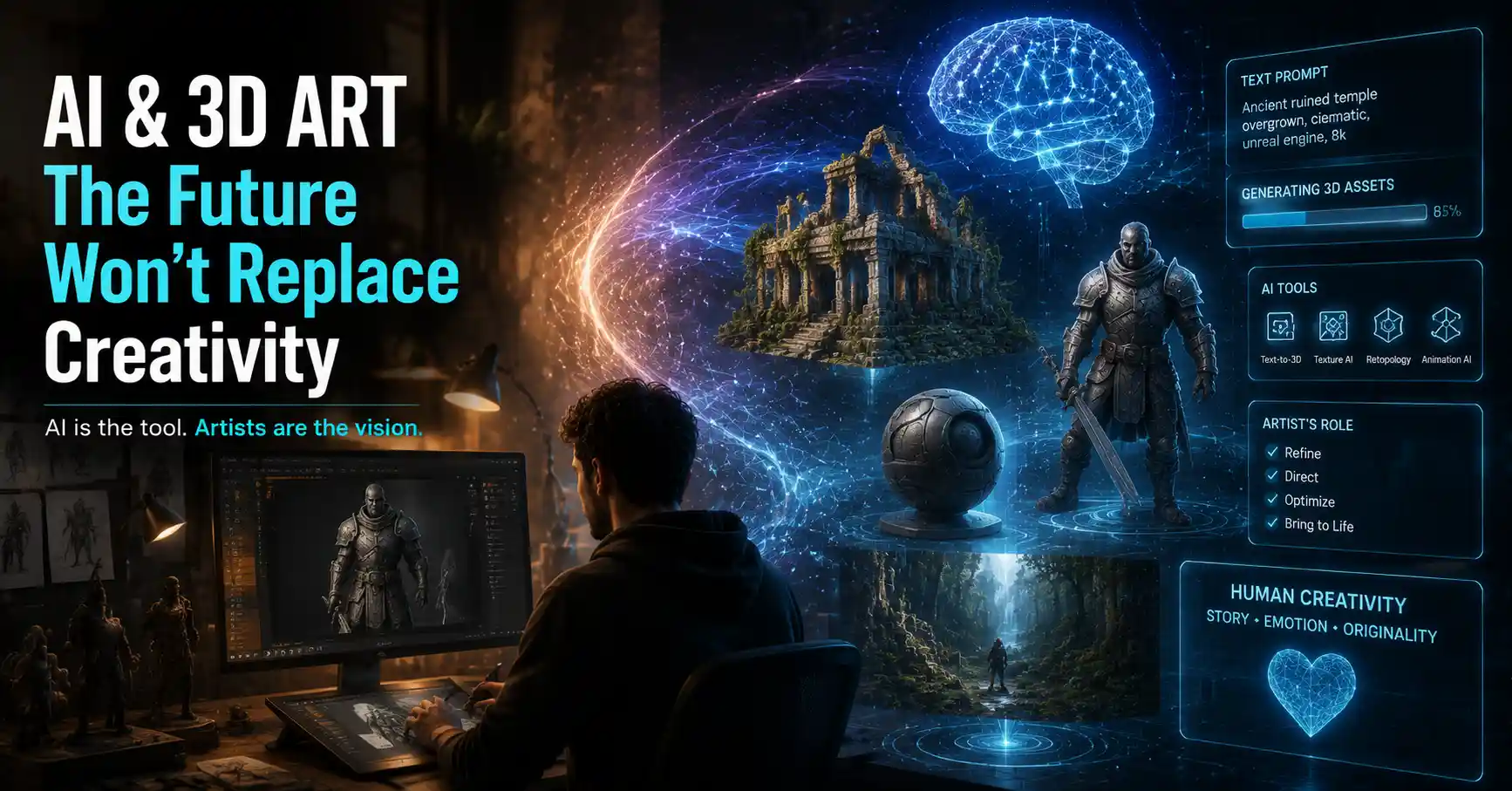
When a major animation studio announced in 2023 that it would integrate generative AI into its 3D content pipeline, 3D artists around the world took to social media to share their fears: Is this the beginning of the end for our profession? Headlines claiming "AI will replace 90% of 3D artists by 2025" have circulated widely, leaving both new graduates and seasoned professionals wondering if their skills will soon be obsolete. The rapid evolution of AI tools that can generate 3D models, textures, and even full scenes from a simple text prompt has turned this abstract question into a pressing, daily concern for anyone working in 3D design, game development, visual effects, or architectural visualization. But do these tools actually replace human 3D artists, or are they just another evolutionary step in an industry that has always adapted to new technology?
What Current AI 3D Tools Can (and Can’t) Do
To understand the debate around AI replacing 3D artists, it’s first important to ground the conversation in what today’s generative AI tools are actually capable of. Over the past three years, tools like Luma AI, Tripo AI, NVIDIA Instant NeRF, and Adobe Substance 3D AI have moved far beyond basic experimental features, offering accessible functionality that even non-artists can use. But their capabilities are still bounded by clear limitations that only human artists can overcome right now.
Capabilities of modern AI 3D tools
AI has made massive inroads into automating repetitive, time-consuming parts of the 3D creation workflow that used to take artists hours or days to complete. Some of the most common and effective use cases today include:
- Generating base meshes and concept models from text prompts or 2D images, cutting down the time spent blocking out initial scenes from days to minutes
- Creating procedural textures and PBR materials at scale, eliminating the need to manually source or paint textures for every asset in a large environment
- Automating retopology of high-poly scans, a tedious step that once required manual tweaking of every edge to prepare models for real-time use in games
- Generating crowd animations or background props for large visual effects shots, reducing the manual work required to fill out empty space in a scene
- Light-blocking and initial camera framing for architectural visualizations, giving artists a starting point to refine rather than starting from a blank screen
For example, a 3D environment artist working on a open-world video game can now use AI to generate 50 unique base tree models in the time it once took to sculpt one. That’s a huge productivity gain that allows teams to create larger, more detailed worlds than they could afford before.
Key limitations of AI 3D generation
For all their progress, AI tools still struggle with core requirements of professional 3D work that human artists handle intuitively. One of the biggest gaps is technical compliance: AI-generated models often have messy topology, non-manifold geometry, incorrect scale, or inconsistent UV mapping that makes them unusable for professional production without extensive fixes. For industries like product design or aerospace, where 3D models need to be 100% dimensionally accurate for manufacturing, AI outputs are almost never ready to use straight out of the tool.
Another major limitation is creative consistency and adherence to a specific artistic vision. AI can generate a impressive scene from a generic prompt like "medieval fantasy castle," but it cannot reliably maintain the specific art style, color palette, and narrative requirements of a feature film or AAA game across hundreds of assets. For example, if a game’s art director has specified that all orc armor must have a specific curved shoulder shape and a worn, rusted texture to fit the game’s lore, AI will often generate inconsistent results that require a human artist to adjust or rebuild from scratch.
Copyright and source material bias are also ongoing issues. Many AI 3D models are trained on millions of existing assets scraped from public platforms, which means outputs can sometimes unintentionally replicate copyrighted work. Only a human artist can verify that an asset is original and safe to use commercially, a non-negotiable requirement for professional studios.
The Evolving Role of 3D Artists in the AI Era
Instead of replacing 3D artists, AI is reshaping what the job entails. For decades, the 3D artist role has evolved alongside technology: when 3D modeling software became mainstream in the 1990s, it replaced manual physical model-making for most productions, but it also created thousands of new jobs that never existed before. The same shift is happening now with AI.
From manual creators to creative directors
The biggest shift we’re seeing today is that 3D artists are moving away from spending most of their time on repetitive technical tasks to focusing on high-level creative direction. Where an entry-level 3D artist 10 years ago might have spent their first year on the job only texturing assets or retopologizing models, they now spend more time curating, refining, and directing AI outputs to fit the project’s needs.
"AI won’t replace 3D artists, but 3D artists who use AI will replace 3D artists who don’t."
This shift doesn’t just apply to senior artists. Even entry-level roles now require proficiency with AI tools as a baseline skill. For example, at Epic Games, job postings for 3D artist roles now list experience with AI generation tools as a preferred qualification, not just a nice-to-have. The job no longer requires just the ability to sculpt a model from scratch; it requires the ability to generate 10 base models with AI, pick the best one, refine it to fit the project’s technical and artistic requirements, and troubleshoot any issues the AI created.
New specializations emerging for 3D artists
Far from eliminating jobs, AI has created entirely new specializations within the 3D art industry that didn’t exist five years ago. Some of the fastest-growing roles today include:
- AI 3D Asset Curators: Artists who specialize in refining AI-generated assets, fixing technical issues, and ensuring consistency across large libraries of content for games and VFX
- AI Fine-Tuning Specialists: Artists who train custom AI models on a studio’s proprietary art style to ensure consistent outputs, reducing the amount of refinement required for each asset
- AI Workflow Integrators: Technical 3D artists who build custom pipelines that connect AI tools to existing studio software, ensuring seamless collaboration between AI and human creators
- Concept Design Leads: Senior artists who use AI to rapidly iterate on dozens of concept options, then pick and refine the best concepts to present to clients or directors
Architectural visualization is one industry that has seen this shift play out dramatically. Firms that once employed teams of junior artists to model every cabinet and countertop in a residential project now use AI to generate the base model from architectural blueprints, and senior artists spend their time refining lighting, adding branded assets, and creating the emotional narrative that sells the project to clients. This allows firms to take on more projects than ever before, and senior artists get to spend more time on the creative work that actually drives client satisfaction, rather than manual modeling.
Industry Perspective: Which Roles Are Most At Risk, Which Are Most Secure
Not all 3D artist roles are equally affected by AI. To understand the current landscape, we can break down roles by how repetitive their core work is, how much creative input they require, and how much technical accuracy matters for the final output.
Roles facing the biggest disruption
Entry-level and freelance roles that focus on generic, mass-produced 3D assets are the most likely to see disruption from AI. For example, freelance artists who sell generic stock 3D assets (like basic furniture, trees, or household objects) on platforms like TurboSquid or CGTrader have already seen pricing pressure from free AI-generated assets that are good enough for many hobbyist or low-budget projects. Artists who used to charge $50 for a basic couch model now find themselves competing with free AI-generated models that clients can download in minutes.
Other roles facing disruption include outsourced 3D teams that focus on repetitive asset production for large game studios. Before AI, studios would often outsource the creation of hundreds of background props to low-cost teams in other countries. Now, many studios can generate those base assets in-house with AI, and only need a small team of in-house artists to refine them, reducing the need for large outsourced workforces.
It’s important to note that disruption doesn’t always equal full replacement. Many freelance asset artists have shifted their business models: instead of selling generic assets, they now sell custom, AI-augmented assets tailored to specific client needs, or offer refinement services for AI-generated assets that clients can’t fix themselves.
Roles that remain largely secure
Roles that require high levels of creative vision, technical precision, and narrative alignment are almost entirely secure from replacement by AI in the near future. These include:
- Lead Character Artists: Creating a main character for a feature film or game requires understanding the character’s backstory, personality, and how they will move and interact with the world. AI cannot replicate the nuance that goes into designing a memorable character that audiences connect with, and even when AI is used to generate base concepts, a lead character artist will refine every line and detail to fit the character’s identity.
- Product and Industrial 3D Designers: 3D models for manufacturing, consumer products, or medical devices require 100% dimensional accuracy and compliance with engineering requirements. AI cannot yet consistently deliver that level of precision, and a human designer must always verify and adjust the model to meet safety and functional standards.
- VFX Supervisors and Senior Environment Artists: Building a world for a film or game requires understanding the narrative, mood, and pacing of the story. A VFX supervisor needs to create a 3D environment that supports the story’s emotional beats, from the lighting to the placement of every prop. That requires contextual creative judgment that AI does not possess.
- Architectural Visualization Senior Artists: While AI can generate a base model from blueprints, creating a render that convinces a client to buy a property requires understanding what the client values, from highlighting natural light to showcasing custom design features. A human artist can tailor the visualization to that specific audience, while AI can only generate a generic output.
A 2024 survey of 500 professional 3D artists by ArtStation found that 78% of respondents reported they were using AI in their workflow, but only 12% reported that AI had replaced any full-time positions at their studio. Most studios reported that they were using AI to take on more projects, not reduce their headcount.
How 3D Artists Future-Proof Their Careers Against AI Disruption
For 3D artists at any career stage, the best defense against AI disruption is adapting your skill set to leverage AI as a tool, rather than competing against it. There are practical, actionable steps artists can take right now to future-proof their careers, regardless of their current experience level.
Build skills that AI can’t replicate
The most valuable skills for 3D artists in the AI era are the creative and soft skills that AI cannot do well. Focus on building these strengths to stand out:
- Art direction and creative vision: Learn how to develop a consistent artistic style and align your work with a broader narrative or brand vision. This is a skill that comes with practice and study, not just technical modeling ability. Take courses on color theory, composition, and storytelling to build this muscle.
- Problem-solving and troubleshooting: AI outputs almost always have technical issues that require a skilled artist to fix. Mastering topology, UV mapping, rigging, and other technical skills that fix AI mistakes will keep you in high demand.
- Client communication and project management: Most clients don’t just want a 3D asset; they want someone who can understand their needs, adjust to feedback, and deliver a final product that meets their specific goals. AI cannot manage client relationships or iterate based on nuanced feedback, so this is a huge competitive advantage for human artists.
- Concept development: AI can generate variations on existing concepts, but it can’t come up with entirely original creative ideas that break new ground. Artists who can develop original IP and new creative directions will always be in demand.
Integrate AI into your workflow to boost productivity
Instead of rejecting AI, successful artists are learning how to use it to do more work in less time, and take on more creative projects that pay better. Some of the most common ways artists integrate AI today include:
- Using AI to rapidly iterate on concept ideas during the early stages of a project, allowing you to explore more options in less time before settling on a final direction
- Automating repetitive tasks like retopology, UV unwrapping, and basic texturing, freeing up time to focus on creative refinement
- Generating background and filler assets for large scenes, so you can focus your time on the hero assets that are most visible to the audience
- Creating quick mockups to show clients to get approval before investing hours into a full build, reducing the number of costly revisions later
For example, a freelance 3D artist specializing in product visualization told Creative Bloq in 2024 that using AI has cut his project turnaround time from three days to one day, allowing him to charge 20% less per project while increasing his monthly income by 60% because he can take on twice as many clients. He doesn’t compete with AI on price; he competes on the quality of his final refined output and his ability to deliver faster than other artists who don’t use AI.
Pivot to higher-value work
For artists who have been working in generic asset production, pivoting to higher-value work that requires more creative input is one of the most effective ways to avoid disruption. For example, a stock asset artist can pivot to creating custom assets for high-budget games, or offer AI refinement services to studios that don’t have in-house teams to fix AI outputs. Entry-level artists who used to do only texturing can move into concept art or art direction roles that leverage AI to speed up their work.
Conclusion
The question of whether AI will replace 3D artists misses the bigger picture: AI is not a replacement for human 3D artists, it’s a transformative tool that is reshaping the profession, just as 3D software transformed manual model-making decades ago. Current AI tools excel at automating repetitive, time-consuming tasks, but they cannot replicate the creative vision, technical precision, contextual judgment, and client communication that professional 3D work requires. Roles that focus on generic asset production are facing disruption, but new roles are emerging, and high-skill roles that require creative input remain as secure as ever.
For 3D artists, the path forward is clear: embrace AI as a tool to boost your productivity, build the skills that AI cannot replicate, and adapt your role to focus on the high-value creative work that only humans can do. Studios that use AI to augment their teams, rather than replace them, are able to create larger, more detailed projects than ever before, creating more opportunities for skilled artists who can work with the new technology. In the end, AI will not replace 3D artists — but 3D artists who learn to work with AI will replace those who don’t.