
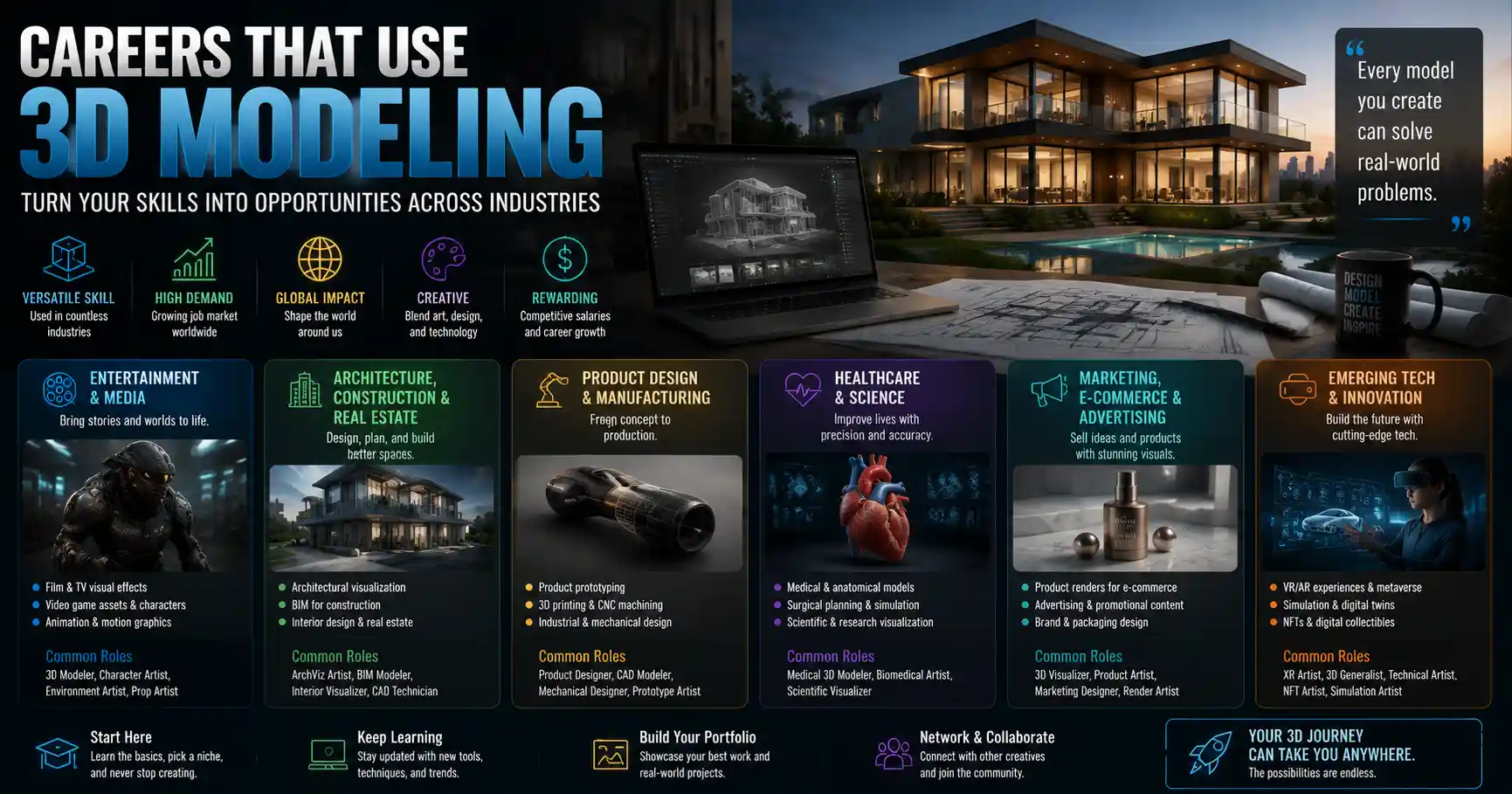
When 3D modeling first emerged in the 1960s, it was a niche tool limited to university research labs and large aerospace engineering teams. Today, it is a foundational skill that powers hundreds of careers across nearly every major industry, from entertainment to healthcare to construction. Whether you are scrolling through a social media feed, driving over a new bridge, or undergoing a medical procedure, 3D modeling is working behind the scenes to shape the world around you. If you have ever considered learning 3D modeling but wondered what types of jobs actually use the skill, this guide breaks down the most common and in-demand career paths available today.
Entertainment and Media: The Most Visible 3D Modeling Careers
For many people, 3D modeling is synonymous with movies and video games. This industry was one of the first to adopt 3D modeling at scale, and it remains the largest employer of 3D artists globally. The rise of streaming services, virtual reality, and social media content has only increased demand for skilled 3D modelers in this space.
Film and Television
Modern film and television rely on 3D modeling for everything from background props to entire digital characters. Blockbuster movies like Avatar and Dune use 3D models to create alien worlds, fantastical creatures, and seamless visual effects that blend with live-action footage. Even small-budget productions and TV shows use 3D modeling to build set designs, create prosthetic molds, and plan complex stunt sequences before filming begins. 3D modelers in this field often specialize in specific types of assets: some focus on hard-surface modeling for vehicles or buildings, while others create organic models of characters or plants. Entry-level roles typically start as 3D modeling interns or junior asset artists, with experienced senior modelers earning six-figure salaries at major studios.
Video Game Development
The $200 billion global video game industry is one of the fastest-growing employers of 3D modelers. Every modern video game, from mobile casual games to AAA console titles, is built almost entirely from 3D models. 3D modelers create everything from playable characters and weapons to open-world landscapes and interactive objects. Many modelers specialize in a specific area, such as character modeling, environment art, or prop design. With the rise of independent game development, many 3D modelers also work as freelance creators, building assets for indie studios or selling pre-made models on marketplaces like Sketchfab or the Unity Asset Store. According to the Entertainment Software Association, over 2,000 video game companies operate in the United States alone, creating thousands of new 3D modeling jobs every year.
Animation and Motion Graphics
Beyond film and games, 3D modeling is a core skill for animators and motion graphics designers working in advertising, social media, and corporate content. Brands use 3D animated commercials to showcase new products, and social media creators use 3D modeling to build engaging short-form content for platforms like TikTok and Instagram. Motion graphics designers working for news networks or tech companies also use 3D modeling to create dynamic data visualizations and branded intros. Unlike game or film modeling, 3D modelers in this space often prioritize speed and visual appeal over strict technical accuracy, making it a good fit for artists who enjoy creative, fast-paced projects.
Architecture, Construction, and Real Estate: 3D Modeling for the Built Environment
3D modeling has transformed how we design, build, and sell physical structures. What once relied on 2D blueprints and hand-drawn renderings now uses sophisticated 3D models that help architects, builders, and developers visualize projects before breaking ground. This shift has created thousands of new 3D modeling jobs across the architecture, engineering, and construction (AEC) industry.
Architectural Visualization
Architectural visualization (often shortened to ArchViz) is one of the most popular 3D modeling careers outside of entertainment. ArchViz artists create realistic 3D models of buildings, interiors, and landscapes to help architects and real estate developers showcase their designs to clients, investors, and the public. Before a new housing development or skyscraper is built, an ArchViz artist will create a detailed 3D model that can be used to generate photorealistic still images, animated walkthroughs, or even interactive virtual reality tours. Many ArchViz artists work as freelance specialists, contracting with multiple architecture firms or developers on a project-by-project basis. The demand for ArchViz has grown exponentially in recent years as pre-construction home sales have become the norm, requiring developers to market properties before they are built.
Building Information Modeling (BIM) for Construction
While ArchViz focuses on visual marketing, building information modeling (BIM) is a technical 3D modeling role that is critical to modern construction projects. BIM modelers create detailed 3D models that include not just the visual shape of a building, but also data about every component: material specifications, cost information, installation timelines, and maintenance schedules. These models are used by the entire construction team, from contractors to electricians to plumbers, to coordinate work, avoid conflicts, and reduce costly mistakes on the job site. Many countries, including the United Kingdom and United States, now require BIM for all publicly funded construction projects, creating consistent demand for skilled BIM specialists. According to the National BIM Institute, the global BIM market is expected to grow to $70 billion by 2027, with thousands of new job openings for trained modelers.
Interior Design and Real Estate
3D modeling has also become a standard tool for interior designers and real estate professionals. Interior designers use 3D modeling to show clients how a space will look after renovations, allowing them to experiment with different furniture layouts, paint colors, and material finishes before any work begins. Real estate agencies use 3D modeling to create virtual tours of properties, allowing buyers to explore homes remotely without visiting in person. Some 3D modelers even specialize in creating 3D models of furniture and home decor for online retailers, allowing customers to see how a new sofa or table will look in their home using augmented reality (AR) apps. As remote property viewing and AR home design become more popular, demand for 3D modelers in this space continues to rise.
Product Design, Manufacturing, and Industrial 3D Modeling
Every physical product you own, from your smartphone to your car to your coffee mug, was probably designed using 3D modeling. The rise of 3D printing and custom manufacturing has made 3D modeling an essential skill for product designers and manufacturers across nearly every sector.
Industrial Design and Product Development
Industrial designers use 3D modeling to create everything from small consumer goods to large industrial machinery. Unlike artistic 3D modeling for entertainment, industrial 3D modeling requires strict adherence to technical specifications: every dimension, angle, and material has to be accurate so the product can be manufactured correctly. 3D modeling allows designers to quickly iterate on multiple designs, test how different parts fit together, and identify potential flaws before moving to production. This reduces the cost of prototyping and speeds up the time it takes to bring a new product to market. 3D modelers in this field often work alongside engineers and product managers, and many have training in both design and engineering principles. Common products designed with 3D modeling include consumer electronics, furniture, home appliances, sporting goods, and medical devices.
3D Printing and Custom Manufacturing
The growth of 3D printing has created an entirely new category of 3D modeling jobs. 3D printers can only print objects from digital 3D models, so every custom part, prototype, or one-off product requires a skilled modeler to create the design. Some 3D modelers specialize in creating customized 3D printable products for consumers: everything from custom figurines to personalized jewelry to replacement parts for old household appliances. Others work in the medical field, creating 3D printed models of organs for surgical planning or custom prosthetics that are perfectly fitted to individual patients. The global market for 3D printing is expected to top $40 billion by 2026, and 3D modeling is the backbone of this industry. For many independent 3D printing entrepreneurs, 3D modeling is their most valuable skill, allowing them to offer custom products that cannot be found in traditional retail stores.
Automotive and Aerospace Design
The automotive and aerospace industries were some of the first adopters of 3D modeling, and they remain major employers of 3D modelers today. Every new car, airplane, and spacecraft is designed using 3D modeling, from the outer body shape to the smallest engine components. 3D modeling allows engineers to test how aerodynamic a vehicle is, how it will perform in crashes, and how different parts interact before building any physical prototypes. In the automotive industry, 3D modelers also create concept car models that are used to showcase new designs at auto shows and build buzz for upcoming models. With the rise of electric vehicles and private space travel, demand for skilled 3D modelers in these industries has never been higher. Most roles in automotive and aerospace 3D modeling require some knowledge of engineering, and many positions offer competitive salaries and benefits.
“3D modeling is no longer just a creative skill for artists—it’s a cross-disciplinary competency that bridges design, engineering, and technology. The next decade will see even more industries integrating 3D models into their core workflows, creating demand for skilled modelers that far outpaces current supply.”
Healthcare and Life Sciences: 3D Modeling for Medical Innovation
One of the most exciting new frontiers for 3D modeling is healthcare and life sciences. 3D modeling is revolutionizing how doctors plan surgeries, how researchers develop new drugs, and how medical device companies create custom treatments for patients. This growth has created a range of new specialized 3D modeling jobs that combine technical skill with medical knowledge.
Medical 3D Modeling for Surgical Planning
Surgeons now use 3D modeling to prepare for complex procedures by creating accurate models of a patient’s unique anatomy. By converting CT scan or MRI data into a 3D model, medical modelers can help surgeons visualize tumors, bone deformities, or heart defects before entering the operating room. This allows surgeons to practice the procedure in advance, reducing the risk of complications and cutting down on surgery time. For example, before separating conjoined twins, surgical teams often use 3D printed models based on 3D scans to plan the separation and reduce the risk of damage to critical organs. 3D modelers in this field often work in hospital imaging departments or for medical technology companies, and many have a background in radiology or biomedical engineering.
Prosthetics and Medical Device Design
3D modeling has transformed the prosthetics industry by making custom prosthetics affordable and accessible. Every patient has a unique body shape, so prosthetics need to be custom-fitted to each person. 3D modelers take scan data of a patient’s residual limb and create a 3D model of a custom prosthetic socket that can be 3D printed on-demand. This process is much faster and cheaper than traditional prosthetic manufacturing, making custom prosthetics accessible to more people around the world. 3D modeling is also used to design everything from pacemakers to artificial joints to dental implants. Medical device companies rely on skilled 3D modelers to create designs that are safe, functional, and perfectly fitted to the human body.
Scientific Research and Education
Life science researchers use 3D modeling to study complex biological structures that cannot be easily seen with the naked eye. For example, molecular biologists use 3D modeling to create models of proteins and viruses, helping them understand how diseases work and develop new treatments and vaccines. During the COVID-19 pandemic, 3D modeling was critical to helping scientists understand the structure of the SARS-CoV-2 virus and develop effective mRNA vaccines. 3D models are also used in medical and science education, allowing students to interact with 3D renderings of anatomy, molecular structures, and geological formations to improve learning outcomes. Many 3D modelers in this field work for universities, research institutions, or educational content companies, combining a passion for science with technical modeling skills.
Emerging and Niche 3D Modeling Careers
As 3D modeling software becomes more affordable and accessible, new 3D modeling careers are popping up in unexpected industries. Many of these niche roles offer unique opportunities for creative modelers who want to work outside of traditional fields. Below are some of the fastest-growing niche 3D modeling careers today:
- AR/VR and Metaverse Content Creation: Augmented reality (AR) and virtual reality (VR) apps require 3D models of everything from furniture to virtual clothing to interactive environments. 3D modelers create assets for VR games, AR shopping apps, virtual events, and digital experiences in the metaverse. Many digital artists also create 3D NFT art and sell custom 3D models to virtual world users.
- Fashion and Jewelry Design: Top fashion brands now use 3D modeling to design clothing, shoes, and accessories, reducing the need for physical sample production and speeding up the design process. 3D modelers create digital clothing for virtual influencers, digital fashion collections, and AR try-on apps. Jewelry designers also use 3D modeling to create custom designs that can be cast directly into metal.
- Forensic Animation and Reconstruction: Law enforcement and legal teams use 3D modeling to reconstruct crime scenes, traffic accidents, and natural disasters. 3D modelers work with forensic scientists to create accurate models that can be used as evidence in court, helping juries understand complex events.
- Archaeology and Cultural Heritage: Archaeologists use 3D modeling to create digital records of ancient artifacts, fossils, and archaeological sites. 3D modelers scan artifacts to create detailed digital models that can be studied by researchers around the world or used to create replicas for museums. This is especially important for preserving cultural heritage that is at risk of damage from climate change, conflict, or erosion.
- Landscape and Urban Planning: City planners and landscape architects use 3D modeling to design new parks, public spaces, and neighborhood developments. 3D models allow planners to show how new developments will impact traffic, sunlight, and the local environment, helping communities make informed decisions about urban growth.
Many of these niche careers are well-suited to freelance work, allowing 3D modelers to set their own schedules and work with a variety of clients. Platforms like Upwork, Fiverr, and Behance make it easy for freelance 3D modelers to market their skills and connect with clients around the world.
If you are interested in pursuing a 3D modeling career, there are a few key steps you can take to get started, regardless of which industry interests you:
- Choose a specialty that aligns with your interests: 3D modeling for games requires different skills than 3D modeling for BIM or medical applications, so picking a niche early will help you focus your training.
- Learn industry-standard software: Most industries use specific tools like Blender, Autodesk Maya, 3ds Max, SolidWorks, or Revit. Learning the software your target industry uses is critical for getting hired.
- Build a portfolio: Your portfolio is the most important part of getting a 3D modeling job. Employers want to see examples of your work, so focus on creating 5-10 high-quality projects that showcase your skills.
- Practice consistently: 3D modeling is a skill that improves with practice. Even 1-2 hours of practice a day will help you improve faster and build your portfolio more quickly.
- Network with other professionals: Join online communities, attend industry events, and connect with other 3D modelers to learn about job openings and get feedback on your work.
Conclusion
3D modeling is far more than a creative hobby or a niche technical skill. It is a versatile competency that powers thousands of different careers across nearly every major industry, from entertainment and architecture to healthcare and scientific research. As new technologies like 3D printing, AR/VR, and custom manufacturing continue to grow, demand for skilled 3D modelers will only increase. Whether you are an artist looking for a creative career, an engineer interested in product design, or someone looking to switch to a more in-demand field, there is likely a 3D modeling career that fits your skills and interests. With affordable training, accessible software, and a growing number of job openings, there has never been a better time to learn 3D modeling and explore the diverse career opportunities it offers.