
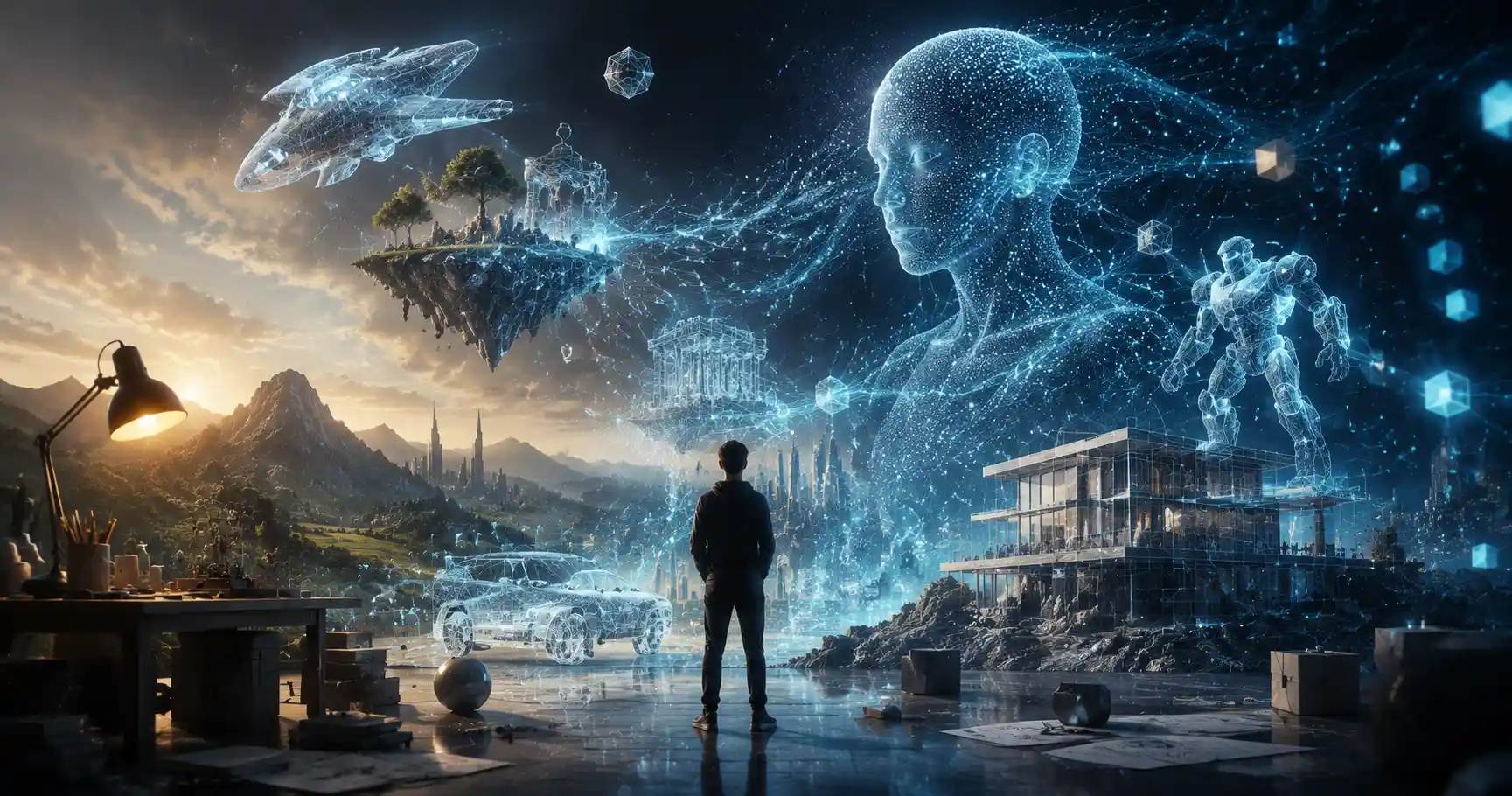
In 2023, a small indie game studio based in Melbourne, Australia, cut its 3D character modeling timeline from six weeks to three days using a new AI-powered generative tool. The team didn’t need a team of senior sculptors or expensive rendering farms; they typed a text description of a post-apocalyptic farmer, adjusted a few base textures, and exported a game-ready model ready for animation. Just five years ago, that workflow would have been unthinkable. Today, it’s a sign of how artificial intelligence is reshaping 3D modeling, turning a niche, time-intensive craft into an accessible tool for creators across industries. From architecture and game development to manufacturing and film, AI is not just automating old tasks—it’s reimagining what 3D modeling can do, and what it will become in the next decade.
The Current State of AI in 3D Modeling: Where We Stand Today
To understand where AI is taking 3D modeling, it’s important to ground ourselves in where we are right now. Just five years ago, AI could generate blurry, low-resolution 2D images, but 3D models—with their complex geometry, UV mapping, and topology requirements—were out of reach. Today, the landscape is very different. Generative AI tools for 3D modeling are already mainstream, with options ranging from consumer-facing tools like Luma AI and 3DFY.ai to professional plugins integrated into industry-standard software like Blender, Maya, and ZBrush.
The biggest breakthrough that made this possible was the shift from 2D diffusion models to 3D-aware generative models, which can learn the structure of three-dimensional objects from millions of existing 3D models and 2D image datasets. Unlike early 3D AI tools that only converted 2D images to rough 3D meshes, modern models can generate clean, editable topology from text prompts, sketch inputs, or even reference photos. For example, NVIDIA’s Instant NeRF technology turned 2D photos into detailed 3D scene reconstructions in minutes, a process that used to take hours of manual photogrammetry work.
Key AI Capabilities Already In Use Today
To see how far we’ve come, consider the common AI-powered 3D workflows already adopted by professionals:
- Generative base mesh creation: Creators can generate a fully formed 3D base model from a text prompt or 2D sketch, cutting out hours of manual polygon modeling. For example, an architect can generate 10 different massings for a residential building in minutes, compared to the days it would take to model each one by hand.
- Texturing and PBR mapping: AI tools can automatically generate high-resolution physically based rendering (PBR) textures, normal maps, and ambient occlusion maps from a single reference image or text prompt, eliminating the tedious manual work of unwrapping UVs and painting textures by hand.
- Photogrammetry cleanup: Photogrammetry, the process of creating 3D models from photos, produces messy, unoptimized meshes with thousands of unnecessary polygons. AI can automatically clean up these meshes, retopologize them to create clean geometry, and fill in missing data from occluded areas.
- Retopology and topology optimization: AI can automatically retopologize high-poly sculpts to create low-poly versions optimized for game engines or 3D printing, a task that used to take senior modelers days to complete manually.
Even with these capabilities, today’s AI 3D tools have clear limitations. Most consumer tools still struggle with complex organic shapes, topological accuracy for engineering applications, and maintaining consistent UV mapping across large scenes. Professional creators still need to refine AI outputs manually, and many companies worry about intellectual property issues with models trained on copyrighted 3D assets. But these limitations are shrinking by the quarter, as larger datasets and more powerful models enter the market.
Emerging Trends Shaping the Next Five Years of AI 3D Modeling
The next five years will bring far more transformative changes to AI-powered 3D modeling, as models become more powerful, integration with existing workflows deepens, and new use cases emerge. Three key trends stand out that will redefine how creators work with 3D.
1. Text-to-3D Moving From Proof of Concept to Production-Ready Workflows
Today’s text-to-3D tools are great for creating quick concept models, but they are rarely ready for production without significant manual editing. That will change rapidly by 2028, as models are trained on production-quality 3D datasets tagged for topology, polygon count, and use case. Companies like Adobe, which integrated basic text-to-3D into its Substance 3D suite in 2023, are already working on full production-ready text-to-3D pipelines that will output game-ready or 3D-printable models directly from a prompt.
This shift won’t just benefit professional studios. Small businesses, independent creators, and even hobbyists will be able to create custom 3D models for products, marketing, or personal projects without formal 3D modeling training. For example, a small jewelry designer based in Portland, Oregon, will be able to type “a rose-shaped gold ring with a small sapphire in the center, optimized for 3D printing” and get a production-ready model they can send directly to a printer, eliminating the cost of hiring a freelance 3D modeler.
2. AI-Powered Real-Time 3D Scene Generation for Immersive Media
As the metaverse, augmented reality (AR), and virtual reality (VR) continue to grow, demand for large, detailed 3D scenes is outpacing the ability of human modelers to create them. AI is stepping in to fill this gap, with tools that can generate entire 3D environments from text or sketch inputs in real time. For example, a VR game developer working on an open-world hiking game can generate an entire mountain range with unique trees, rocks, and terrain in hours, instead of spending months building assets by hand.
What makes this particularly powerful is that AI can generate procedural infinite worlds that follow consistent design rules, so users never see the same asset twice. Epic Games, the creator of Unreal Engine, has already invested heavily in AI-powered scene generation, with tools that can fill large open worlds with optimized, game-ready assets automatically.
3. Edge AI and On-Device 3D Generation
Most AI 3D generation today happens on cloud servers, because it requires massive computing power that most consumer devices can’t handle. That is changing, as smaller, more efficient AI models are optimized for running on consumer GPUs and even mobile devices. Within five years, creators will be able to generate complex 3D models directly on their laptops, tablets, or even phones, without waiting for cloud processing or paying monthly subscription fees for cloud compute time.
This shift will open up new use cases for mobile 3D creation, like AR creators who can generate custom 3D assets directly on their phone while on location, or product designers who can tweak 3D models while visiting a factory. It will also reduce costs for small creators, who no longer need to invest in expensive high-end GPUs to do complex 3D work.
"AI won't replace 3D modelers, but 3D modelers who use AI will replace those who don't. The next generation of 3D creation isn't about eliminating human input—it's about eliminating the tedious, repetitive work that keeps creators from focusing on design and storytelling."
This quote, from a 2024 panel of professional 3D artists at the Game Developers Conference, sums up the consensus among most working creators: AI is a tool, not a replacement, and the future of the industry depends on embracing that reality.
Industry-Specific Impacts: How AI Will Transform Key 3D Modeling Sectors
AI’s impact on 3D modeling won’t be uniform across industries. Different sectors have different requirements for 3D models—from the strict precision needed for industrial manufacturing to the creative flexibility needed for game development—and AI will reshape each one in unique ways.
Game Development and Entertainment
The game and film industries are already the biggest users of 3D modeling, and they stand to gain the most from AI. For game developers, AI cuts down the time and cost of building large libraries of 3D assets, enabling smaller teams to create large open-world games that would have only been possible for big AAA studios a decade ago. For example, the indie game Titan Slayer, released in 2024, used AI to generate over 90% of its 3D enemy and environment assets, allowing a team of five people to create a 30-hour open-world game with a budget of less than $500,000.
In film and VFX, AI is speeding up the process of creating 3D assets for visual effects and animation. Wētā FX, the VFX studio behind The Lord of the Rings and Avatar, already uses AI to automate the creation of background assets, clothing textures, and even secondary character models, cutting down the time it takes to finish a feature film by months. This doesn’t just reduce costs—it allows creators to iterate more, trying more creative ideas before settling on a final design.
Architecture, Engineering, and Construction (AEC)
In the AEC industry, 3D modeling is the foundation of modern building design, but creating detailed BIM (Building Information Modeling) models is still a time-intensive, manual process. AI is changing that by automating the creation of BIM models from 2D architectural drawings, generating multiple design iterations based on constraints like budget, site size, and building codes, and even optimizing models for energy efficiency before construction starts.
For example, architecture firm Perkins&Will recently used an AI 3D tool to generate 50 different design options for a new K-12 school, based on constraints like maximum building height, number of classrooms, and natural light requirements. The AI generated all 50 models in 48 hours, a process that would have taken a team of architects six weeks to complete. The firm was then able to pick the top three designs and refine them with human input, cutting the overall design timeline by a third.
Manufacturing and Product Design
For product designers and manufacturers, AI-powered 3D modeling is accelerating the product development cycle, from initial concept to final production. AI can generate 3D models of new products based on functional requirements, optimize them for 3D printing or injection molding, and even test for structural weakness automatically, before a physical prototype is ever created.
The medical device industry is already seeing major benefits from this. A 2023 study published in the Journal of Medical Devices found that AI-powered 3D modeling cut the time to design custom orthopedic implants from two weeks to 48 hours, while also reducing material waste by 20% by optimizing the implant’s internal structure. For patients needing custom implants, that means faster surgery times and better outcomes, while manufacturers see lower production costs.
eCommerce and Marketing
Brands and retailers are increasingly using 3D models and AR to let customers preview products online before they buy, but creating 3D models for hundreds or thousands of products is expensive. AI is solving this by automatically generating 3D models from existing 2D product photos, cutting the cost of 3D product modeling by up to 90% according to a 2024 report from Shopify. This makes it feasible for small and medium-sized retailers to offer 3D and AR previews for their entire product catalog, leading to higher conversion rates and lower return rates.
Key Challenges and Unresolved Questions for AI 3D Modeling
For all its promise, AI-powered 3D modeling still faces significant challenges that need to be resolved before it reaches its full potential. These issues aren’t just technical—they’re legal, ethical, and practical, and they will shape how the industry develops over the next decade.
Intellectual Property and Copyright Uncertainty
One of the biggest unresolved issues is who owns AI-generated 3D models, and whether it’s legal to train AI models on existing copyrighted 3D assets. Unlike 2D AI image generation, which has already seen high-profile copyright lawsuits, 3D AI is still in the early stages of legal battles. Many existing 3D AI models were trained on datasets scraped from 3D asset platforms like Sketchfab and TurboSquid, without permission from the original creators.
This uncertainty creates risk for companies that want to use AI-generated 3D models in commercial products. A game studio that uses an AI-generated 3D character model could find themselves sued by the original creator of a similar model that was used to train the AI. Some companies are already addressing this by training models on licensed datasets of original 3D assets, but that increases the cost of developing AI tools, and it doesn’t fully resolve the issue of how to protect creators’ rights.
Maintaining Precision for Professional Use Cases
For creative use cases like game development or concept art, small imperfections in AI-generated 3D models are easy to fix. But for industries like manufacturing, aerospace, and civil engineering, 3D models need to be dimensionally accurate down to the millimeter. A 1% error in a 3D model of a turbine blade can lead to catastrophic failure when the part is manufactured. Today’s AI 3D models still struggle to consistently produce dimensionally accurate, precision models for these use cases.
Part of the problem is that most training data for 3D AI is creative assets, not engineering-grade models with precise dimensional data. As more companies start training models on engineering datasets, this will improve, but it will take time to build high-quality, tagged datasets for precision applications. Companies also need to develop new quality control tools to verify that AI-generated 3D models meet required accuracy standards before they go into production.
Job Displacement and the Changing Role of 3D Modelers
It’s no secret that AI will change the job market for 3D modelers, just as it has for many other creative and technical roles. Entry-level 3D modeling jobs focused on repetitive tasks like retopology, UV unwrapping, and base mesh creation are already declining, as AI automates these tasks. But at the same time, demand for senior 3D artists and designers who can refine AI outputs and lead creative projects is growing rapidly.
A 2024 survey of 500 3D studios by the International Game Developers Association found that 68% of studios increased their headcount after adopting AI 3D tools, because they were able to take on more projects and expand into new areas. The roles changed, however: instead of spending 80% of their time on manual modeling work, modelers now spend 80% of their time on creative direction, refinement, and quality control. This shift requires new skills from 3D modelers, who now need to know how to work with AI tools instead of just working by hand.
Accessibility and the Skills Gap
AI has made 3D modeling more accessible to new creators, but there is still a significant skills gap for people who want to use AI 3D tools effectively. Generating a good 3D model with AI requires skill in prompt engineering, knowing how to adjust outputs, and understanding the basic principles of 3D design to fix errors. Many new creators who can use text-to-3D tools still struggle to get the results they want, because they don’t have a background in 3D modeling fundamentals.
This gap is gradually being addressed by better user interfaces and educational resources, but it will take time for new workflows to become intuitive for non-professionals. Over the next five years, we can expect AI 3D tools to become more user-friendly, with guided workflows that help non-experts get good results without needing years of training.
Practical Steps for Creators and Businesses to Prepare for the AI 3D Future
Whether you’re an independent 3D artist, a studio manager, or a business owner looking to adopt 3D modeling for the first time, there are practical steps you can take right now to prepare for the AI-powered future of 3D modeling.
- Start experimenting with AI plugins for your existing workflow: You don’t need to replace your current 3D software to start using AI. Most professional tools like Blender, Maya, ZBrush, and Substance 3D already have AI plugins for retopology, texturing, and base mesh generation. Start using these tools for repetitive tasks to save time, and get comfortable with how AI works before adopting more advanced tools.
- Upskill to focus on high-value creative work: If you’re a 3D modeler, shift your skill development away from repetitive manual tasks and toward creative direction, design thinking, and quality control. Learn how to prompt AI effectively, how to refine AI outputs, and how to solve creative problems that AI can’t handle. The most in-demand 3D professionals of the future will be people who can work with AI to bring creative visions to life, not people who still model every polygon by hand.
- Use licensed AI tools to reduce intellectual property risk: For commercial use, avoid open-source AI 3D tools trained on scraped datasets. Instead, use tools from reputable companies that train their models on licensed, royalty-free datasets, and that grant you full commercial rights to the models you generate. This reduces the risk of costly copyright lawsuits down the line.
- Start small with AI for new 3D projects: If you’re a business owner who hasn’t used 3D modeling before, start with a small project to test AI 3D tools, like creating 3D product models for your eCommerce site or generating concept models for a new product design. This lets you test the workflow and see the cost and time savings before rolling it out across your entire organization.
- Stay updated on new tools and regulatory changes: The AI 3D industry is evolving very quickly, with new tools, new regulations, and new legal precedents changing the landscape every quarter. Follow industry blogs, attend conferences like GDC or Autodesk University, and join professional communities to stay up to date on the latest changes.
One common mistake many creators and businesses make is waiting for AI to be “perfect” before adopting it. But the reality is that AI 3D tools are already good enough to deliver significant time and cost savings for most use cases, and they will only get better. By starting now, you can build the skills and workflows you need to stay competitive as the industry evolves.
Conclusion
The future of AI in 3D modeling is not about replacing human creators—it’s about removing the technical barriers that have kept 3D modeling inaccessible for decades, and giving creators more time to focus on what they do best: design, storytelling, and problem-solving. Over the next five years, we will see text-to-3D move from a novelty to a core part of professional workflows, AI will enable small teams to create projects that once required hundreds of artists, and 3D modeling will become a standard tool for everyone from small business owners to independent creators.
There are still challenges to overcome, from copyright uncertainty to precision issues for industrial use cases, but these are not insurmountable. As the industry matures, we will see clearer regulations, better training data, and more accurate models that address these concerns. For creators and businesses that are willing to adapt, AI 3D modeling opens up unprecedented opportunities to create more, iterate faster, and bring new ideas to life that would have never been possible before. The next era of 3D creation is here, and it’s powered by AI.