
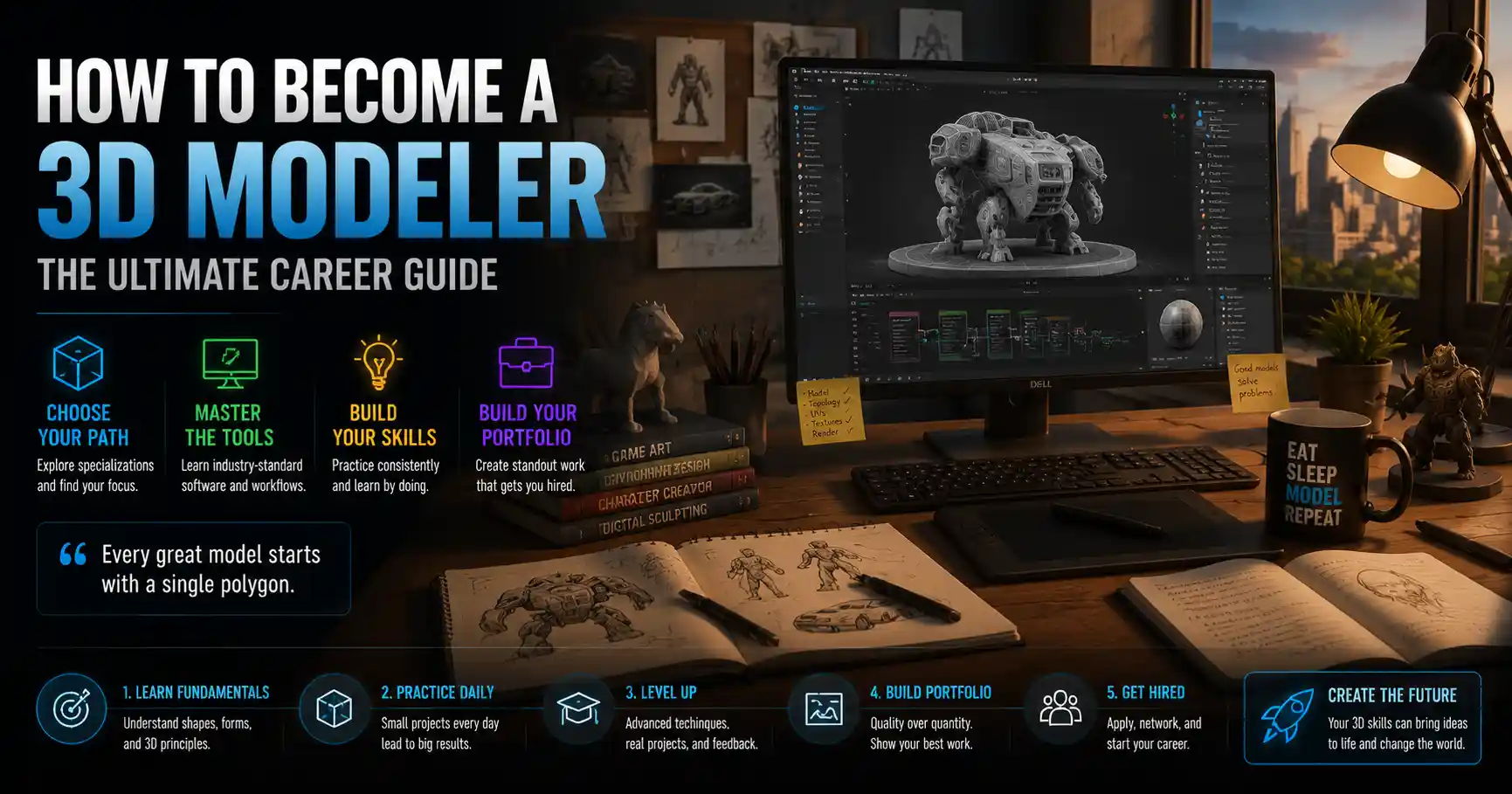
If you’ve ever paused to admire the lifelike characters in a hit video game, the smooth product animations on a brand website, or the detailed architectural renderings that help developers sell luxury homes, you’ve experienced the work of a skilled 3D modeler. 3D modeling is no longer a niche skill reserved for Hollywood special effects teams; today, it’s a high-demand career across industries from gaming and healthcare to manufacturing and marketing. The global 3D modeling market is projected to exceed $4 billion by 2028, driven by the rise of virtual reality, e-commerce product visualization, and 3D printing. Whether you’re a creative student exploring career options or a professional looking to pivot into a more dynamic field, becoming a 3D modeler is achievable with the right combination of education, practice, and strategy. This guide breaks down exactly what you need to know to build a successful career in 3D modeling.
Understand the Different Types of 3D Modeling and Specialize
Before you download your first 3D software or sign up for a course, it’s important to understand that 3D modeling is a broad field with dozens of specialized roles. Not all 3D modelers create the same work, and choosing a niche early can help you focus your learning and stand out to employers. Different specializations require different skills, tools, and work environments, so taking time to explore your options will save you months of unfocused practice.
Common 3D modeling specializations
- Game art 3D modeling: Creates characters, environments, weapons, and props for video games. This role requires optimizing models for real-time rendering, meaning models must have a low polygon count to run smoothly on consoles and mobile devices.
- Product visualization modeling: Builds 3D models of consumer products for marketing, e-commerce, and prototyping. Brands use these models for website animations, digital catalogs, and 3D print prototypes, so accuracy and attention to real-world materials are critical.
- Architectural visualization modeling: Creates detailed 3D models of buildings, interiors, and landscapes for real estate developers, architects, and construction firms. These models help clients visualize finished projects before ground is broken, requiring knowledge of building codes and scale.
- Film and VFX modeling: Builds high-poly models for animated films, television, and feature film special effects. Unlike game modeling, VFX models don’t need to be optimized for real-time performance, so artists can add incredible levels of detail for pre-rendered scenes.
- 3D printing and manufacturing modeling: Creates technically accurate models that can be printed or machined in the real world. This role requires a deep understanding of tolerances, material properties, and design for additive manufacturing.
- Medical and scientific modeling: Builds 3D models of organs, body parts, or scientific structures for research, education, or surgical planning. This niche often requires collaboration with medical professionals and a commitment to absolute accuracy.
While it’s tempting to try to learn every type of modeling, specializing early makes you more attractive to employers. For example, a game studio looking for a character modeler would rather hire someone with a portfolio full of well-crafted character models than a generalist who has one or two examples of each type of work. That said, it’s perfectly fine to experiment with different niches in your first year of learning to find what you enjoy most. Many 3D modelers even switch niches mid-career as they develop new interests.
Learn the Core Tools and Build Your Technical Foundation
Once you’ve chosen a general direction for your career, the next step is to master the core tools of 3D modeling. The software landscape can feel overwhelming for beginners, with dozens of options ranging from free open-source programs to thousands-of-dollars professional suites. The good news is that you don’t need to spend a fortune to get started, and most core 3D modeling skills transfer between programs regardless of price.
Choose the right software for your budget and niche
Your choice of software will depend largely on your niche and your budget. For beginners just starting out, there are excellent free options that can teach you everything you need to know:
- Blender: The most popular free open-source 3D software, Blender includes modeling, sculpting, rendering, animation, and even video editing all in one package. It’s widely used by independent game developers, hobbyists, and even some professional studios, and it has a massive global community that creates free tutorials and assets. Blender is a great starting point for any beginner, regardless of niche.
- SketchUp Free: A simplified 3D modeling tool that’s perfect for beginners interested in architectural modeling or product design. It’s intuitive to learn and great for creating quick, accurate models.
- Autodesk Fusion 360: Free for hobbyists and students, Fusion 360 is the industry standard for 3D printing and manufacturing modeling. It includes parametric modeling tools that make it easy to adjust designs, which is critical for engineering-focused work.
For those ready to invest in professional software, industry standards vary by niche: Autodesk Maya and 3ds Max are common in game and VFX studios, ZBrush is the go-to for high-poly sculpting of characters and detailed objects, and SolidWorks dominates the industrial manufacturing space. Many studios offer free software licenses to employees, so you don’t necessarily need to purchase a $1,500 license yourself to get a job. Learning core skills in Blender first will give you a solid foundation that makes learning professional software much easier later on.
Master core 3D modeling concepts
Beyond software, there are core technical concepts that every 3D modeler needs to understand, regardless of their niche:
- Polygon modeling: The foundation of most 3D work, polygon modeling involves building shapes from vertices, edges, and faces. Understanding how to create clean topology (the arrangement of polygons) is critical for models that deform correctly for animation or 3D printing.
- UV unwrapping: The process of unfolding a 3D model’s surface so you can apply 2D textures to it. A good UV unwrap avoids distortion and stretching, which makes the final model look realistic.
- Texturing and materials: Adding color, roughness, reflectivity, and other surface details to a model. Today, PBR (physically based rendering) workflows are the industry standard, as they create materials that react realistically to light in any environment.
- Rendering: The process of generating a final 2D image or animation from your 3D model. Learning how to light a scene and adjust render settings to get a high-quality result is a key skill for presenting your work.
Even if you specialize in a technical niche like 3D printing, understanding these core concepts will make you a more versatile and valuable modeler. Many entry-level roles require familiarity with all these processes, even if you end up specializing in just one part of the pipeline later in your career.
“The biggest mistake new 3D modelers make is jumping straight to advanced tools before mastering clean topology. A simple model with good topology will always look better than a complex model with messy, distorted geometry.”
— Ian McNaught, Lead 3D Character Artist at Blizzard Entertainment
Build a Targeted Portfolio That Wows Employers
In the world of 3D modeling, your portfolio is far more important than your degree or where you learned your skills. Employers don’t care if you got a certificate from a top art school or taught yourself via YouTube—they just want to see that you can create the kind of models they need. A great portfolio is targeted, focused on quality over quantity, and easy for potential employers to navigate.
Curate your portfolio for your target niche
The number one mistake new 3D modelers make is filling their portfolio with every project they’ve ever done, from random beginner exercises to personal art pieces that don’t align with their career goals. If you want to work as a product visualization modeler for an e-commerce brand, hiring managers don’t need to see your 10 different fan art character models. Instead, fill your portfolio with 5-10 high-quality projects that match the work you want to do. For example, if you want to do product visualization, include models of furniture, electronics, or sports equipment that show you can create clean, accurate models with realistic materials.
Aim for quality over quantity. It’s better to have 6 amazing, finished projects than 20 half-finished or beginner-level works. Most hiring managers spend less than two minutes scanning a portfolio on the first pass, so lead with your strongest work that’s most relevant to the role.
Include the right types of projects for entry-level roles
If you don’t have any professional client work yet, that’s completely fine. Most entry-level candidates build their portfolios with personal projects that demonstrate their skills. Good personal projects include:
- Fan art of popular game or movie characters (this is fine for portfolios, just avoid trying to sell it commercially)
- Recreations of real-world objects, like a vintage camera, a piece of furniture, or a car
- Concept models for original game characters or environments
- Arch-viz models of existing well-known buildings or original home designs
For every project in your portfolio, include wireframe previews of your model along with the final rendered images. This shows employers that you understand clean topology and technical best practices, not just how to make a pretty render. It’s also helpful to add a short description for each project explaining what your goal was, what tools you used, and any challenges you overcame. This gives employers context and shows you think strategically about your work.
Host your portfolio online
Today, hosting a professional 3D modeling portfolio is easy and affordable. Platforms like ArtStation, Behance, and Sketchfab are the industry standard for 3D modelers. ArtStation is particularly popular for game and VFX artists, while Behance is great for product and architectural visualization. Sketchfab allows you to embed interactive 3D models directly into your portfolio, so employers can rotate and inspect your work themselves—which is a huge advantage over just sharing static images. If you want extra control, you can build your own simple website with platforms like Squarespace or WordPress, but for most beginners, a well-curated ArtStation profile is more than enough to get noticed.
Gain Experience and Find Your First 3D Modeling Job
Once you’ve learned your skills and built a strong portfolio, the next step is to gain real-world experience and land your first job. Entry-level roles can be competitive, but there are proven strategies to stand out from the crowd and build the experience employers want.
Gain practical experience before applying for full-time roles
If you don’t have professional experience, there are many ways to get it while building your portfolio:
- Freelance on platforms like Upwork or Fiverr: Start with small, low-budget projects to build client feedback and real-world experience. Even small projects like modeling a product for a local business can teach you how to work with client feedback and meet deadlines.
- Contribute to open-source or indie game projects: Many independent game developers are looking for volunteer 3D modelers to help with their projects. This gives you professional credit and the chance to work on a released product that you can add to your portfolio.
- Participate in 3D modeling challenges: Platforms like ArtStation host weekly and monthly challenges where artists create models around a specific theme. It’s a great way to practice, get feedback from other artists, and get exposure to potential recruiters.
- Do pro bono work for nonprofits: Many museums, nonprofits, and educational organizations need 3D models for exhibits or educational content. Donating your skills gives you real project experience and helps a good cause at the same time.
Even a small amount of real-world experience makes you much more attractive to employers, because it proves you can work with clients, meet deadlines, and deliver finished work that meets requirements.
Apply for the right entry-level roles
When you’re ready to start applying for full-time work, focus on entry-level roles that match your skill level. Common entry-level titles for 3D modelers include Junior 3D Modeler, 3D Art Intern, Product Visualization Artist, and Junior Game Artist. Many large studios and design firms hire cohorts of interns every year, and many internships turn into full-time job offers. If you can’t find a full-time role right away, contract or freelance work can be a great way to get your foot in the door—many companies turn long-term contractors into full-time employees once they prove their skills.
Don’t limit yourself to just big game studios or VFX houses. 3D modelers are in demand across a huge range of industries: marketing agencies, architectural firms, manufacturing companies, medical device companies, and e-commerce brands all hire full-time 3D modelers. These roles are often less competitive than entertainment industry roles and can offer more stable work-life balance.
Network to find unadvertised opportunities
Many 3D modeling jobs are never advertised publicly—they’re filled through referrals and networking. Join online communities like the Blender Artists forum, Reddit’s r/3Dmodeling, or Discord servers for 3D artists in your niche. Attend industry events like GDC (Game Developers Conference) if you can, or local meetups for 3D artists and designers. Engage with other artists online by giving constructive feedback on their work, sharing your own process, and participating in discussions. Recruiters often scout for new talent on ArtStation and Twitter, so keeping your portfolio updated and sharing your work regularly can help you get noticed without even applying for jobs.
Continue Learning and Grow Your Career
Becoming a working 3D modeler isn’t the end of the journey—the 3D industry is constantly evolving, with new tools, techniques, and workflows emerging every year. The most successful 3D modelers are those who continue learning and adapting to new trends throughout their careers.
One of the biggest trends in 3D modeling right now is the rise of AI-powered tools that automate parts of the modeling process. Tools like Luma AI, Instant NeRF, and Blender’s built-in AI generation tools can help you create base models or texture objects much faster than manual work. Instead of fearing AI, successful modelers learn to use these tools to speed up their workflow, freeing up time to focus on the creative and detailed work that requires a human touch. For example, you can use AI to generate a base character model, then spend your time refining the topology, adding detailed sculpting, and adjusting textures to meet project requirements. Learning to integrate AI into your workflow will make you more productive and more valuable to employers in the coming years.
Beyond new tools, you can grow your career by expanding your skills into related areas. For example, if you’re a 3D modeler, learning basic animation or rigging can make you more versatile, as many small studios look for artists who can handle multiple parts of the 3D pipeline. If you work in product visualization, learning basic 3D animation for product reels can help you command higher rates. Many 3D modelers eventually move into specialized roles like lead artist, art director, or 3D design manager, while others prefer to stay hands-on and continue doing modeling work, increasing their rates as they gain experience.
If you prefer flexibility over a full-time job, many experienced 3D modelers build successful freelance businesses. Once you have a strong portfolio and a network of clients, you can work for multiple clients, set your own rates, and choose the projects you want to work on. Freelance 3D modelers can also sell pre-made models on marketplaces like TurboSquid or CGTrader, creating passive income that doesn’t require ongoing work.
Conclusion
Becoming a 3D modeler is a journey that requires consistent practice and patience, but it’s an incredibly rewarding career for people who love combining creativity with technical problem-solving. The path starts with exploring different niches to find what aligns with your interests, learning core skills on tools that fit your budget, and building a targeted portfolio that showcases your strengths to employers. From there, gaining practical experience through small projects and networking opens the door to your first job, and ongoing learning helps you grow and adapt as the industry evolves.
You don’t need an expensive art degree or a background in computer graphics to become a 3D modeler. Thousands of successful modelers today are self-taught, learning from free online resources and building their skills one project at a time. If you’re willing to put in the work to master the fundamentals and build a strong portfolio, you can land a fulfilling, well-paying job in this fast-growing creative field. Start small, practice consistently, and before you know it, you’ll be turning your passion for 3D art into a full-time career.